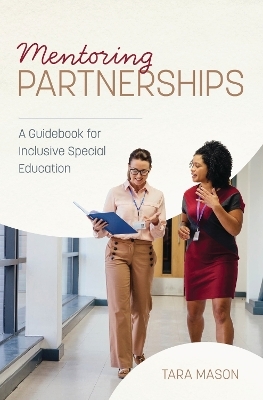
Mentoring Partnerships
Rowman & Littlefield (Verlag)
978-1-5381-7732-7 (ISBN)
Special education across education programs nationwide is an incredibly high-need teacher shortage area, and mentoring can make a profound difference in teacher retention and effectiveness. Within this handbook, mentoring partnerships will be guided through the first year of a new special education teacher from start to finish. A month-to-month resource for both mentors and mentees, this resource focuses on self-reflection cycles of growth and goal-setting, including self-care strategies. Additionally, the handbook focuses on evidence-based practices in special education tying resources to the High Leverage Teaching Practices (Council for Exceptional Children) providing templates to be adapted to local school districts for K-12 special education program use. The framework of this handbook is to provide evidence-based practices to promote inclusive special education programs where all K-12 students have equity, access, and achievement. New and experienced special education teachers will learn how to effectively promote and integrate inclusive special education programs, emphasizing that special education is not a “place” but instead a “service” comprised of intensive support, collaboration, and accessibility.
Dr. Tara Mason is a Universal Design for Learning (UDL) Consultant for the Center for Teaching and Learning at the University of California, Berkeley. She is passionate about working on teams focused on equitable and inclusive learning environments that uplift student voice, identity, and access to educational opportunities. She holds a Ph.D. in Special Education from Texas Tech University, specializing in assistive technology, serving students with multiple disabilities and visual impairments. Her Master of Education (M.Ed.) focused on Curriculum and Instruction from the University of Nebraska-Lincoln. Before joining UC Berkeley, she served as a faculty member directing a graduate and undergraduate special education teacher preparation program at a university in Colorado. While working in CO, Dr. Mason held leadership roles within the Teacher Education Division of the Council for Exceptional Children (CO-TED), and secured funding for teacher preparation grants to support paraprofessional and alternative special education teacher pipelines. Dr. Mason has an extensive background working within K-12 special education, spanning more than two decades. Her special education teaching background encompasses working in K-12 special education settings from elementary through teaching in 18+ transition programs. She has also led coaching teams to support new special education teachers at the school district level. In addition, Dr. Mason has taught as a self-contained special education teacher and worked as a teacher of students with visual impairments (TSVI) at the Texas School for the Blind and Visually Impaired. Dr. Mason’s research interests primarily relate to UDL, special education, promoting equity and inclusion, disrupting bias and disproportionality in special education, mentoring, and teacher preparation. She lives in California with her family.
Acknowledgments
Introduction
SECTION I: LAYING A FOUNDATION
August
Key Learning Goals
Part I: Getting Started in Your Mentoring Partnership?
Part II: The First-Year Special Education Teacher
Suggested Resources
September
Key Learning Goals
Part I: Evidence-Based Practices—Why Align with Evidence Based Instruction?
Part II: Evidence-Based Practices—How Can I Implement
Evidence-Based Practices in My Program?
Part III: Evidence-Based Practices–Part II
Suggested Resources
October
Key Learning Goals
Part I: A Brief History of Special Education
Part II: The Individualized Education Program (IEP)
Suggested Resources
SECTION II: GETTING INTO IT
November
Key Learning Goals
Part I: Universal Design for Learning (UDL)
Part II: Assistive Technology (AT) and Curriculum Planning
Suggested Resources
December
Key Learning Goals
Part I: Understanding Special Education Systems
Part II: Bias, Disproportionality, and Evaluation
Suggested Resources
January
Key Learning Goals
Part I: Working With Your Related Service Special Education
Teams
Part II: Working With Your General Education Teams and
Co-Teaching Configurations.
Suggested Resources
SECTION III: DIGGING OUT OF DISILLUSIONMENT
February
Key Learning Goals
Part I: Person-First Language and Disability Frameworks
Part II: What Are Disability Studies? (Medical, Social, and
Cultural Models)
Suggested Resources
March
Key Learning Goals
Part I: Understanding Least Restrictive Environment (LRE) and
Special Education Program Models
Part II: Creating a Strength-Based Special Education Program
Suggested Resources
April
Key Learning Goals
Part I: We Work as Collaborative Professionals
Part II: Build Up Your Team! How Can Special Education Teams
Amplify the Support Paraprofessionals Can Provide?
Suggested Resources
SECTION IV: REFLECTION, REVITALIZATION, REGROWTH
May
Key Learning Goals
Part I: Transition Planning
Part II: Transition Planning Systems versus Person Planning
Suggested Resources
June
Key Learning Goals
Part I: Early Intervention in Special Education
Part II: Map Out a Curriculum Goal for Next Year
Suggested Resources
July
Key Learning Goals
Part I: Making a Plan for Year Two, Leadership, and Professional
Organizations
Part II: Learning Leaders
Suggested Resources
SECTION V: RESOURCES
Resource 1: Who Is Who
Resource 2: Intensive Lesson Plan Template
Resource 3: Annual IEP Calendar
Resource 4: IEP Sections Template
Resource 5: Case Law Review Template
Resource 6: Student One-Pager Template
Resource 7: AT Evaluation and Template
Resource 8: Bias Self-Reflection Guide
Resource 9: Coming Down the Ladder
Resource 10: Co-Teaching Modalities and Guide
Resource 11: Evaluation Template
Resource 12: Intensify Intervention Taxonomy
Resource 13: Paraprofessional Schedule
Resource14: Transition Plan Template
Resource 15: Curriculum Planning Template
Index
About the Author
| Erscheinungsdatum | 04.07.2024 |
|---|---|
| Zusatzinfo | 50 BW Illustrations, 47 Tables |
| Sprache | englisch |
| Maße | 183 x 263 mm |
| Gewicht | 767 g |
| Themenwelt | Sozialwissenschaften ► Pädagogik ► Sonder-, Heil- und Förderpädagogik |
| ISBN-10 | 1-5381-7732-3 / 1538177323 |
| ISBN-13 | 978-1-5381-7732-7 / 9781538177327 |
| Zustand | Neuware |
| Informationen gemäß Produktsicherheitsverordnung (GPSR) | |
| Haben Sie eine Frage zum Produkt? |
aus dem Bereich