


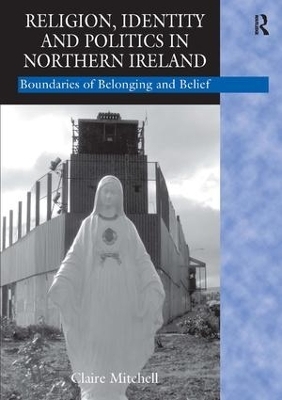
Religion, Identity and Politics in Northern Ireland
Boundaries of Belonging and Belief
Seiten
2005
Routledge (Verlag)
978-0-7546-4155-1 (ISBN)
Routledge (Verlag)
978-0-7546-4155-1 (ISBN)
Presents an analysis of religion in Northern Ireland. Drawing on interview material, this book traces how individuals and groups in Northern Ireland have absorbed religious types of cultural knowledge, belonging and morality, and how they reproduce these as they go about their daily lives.
Has conflict in Northern Ireland kept political dimensions of religion alive, and has religion played a role in fuelling conflict? Conflict in Northern Ireland is not and never will be a holy war. Yet religion is more socially and politically significant than many commentators presume. In fact, religion has remained a central feature of social identity and politics throughout conflict as well as recent change. There has been an acceleration of interest in the relationship between religion, identity and politics in modern societies. Building on this debate, Claire Mitchell presents a challenging analysis of religion in contemporary Northern Ireland, arguing that religion is not merely a marker of ethnicity and that it continues to provide many of the meanings of identity, community and politics. In light of the multifaceted nature of the conflict in Northern Ireland, Mitchell explains that, for Catholics, religion is primarily important in its social and institutional forms, whereas for many Protestants its theological and ideological dimensions are more pressing. Even those who no longer go to church tend to reproduce religious stereotypes of 'them and us'. Drawing on a range of unique interview material, this book traces how individuals and groups in Northern Ireland have absorbed religious types of cultural knowledge, belonging and morality, and how they reproduce these as they go about their daily lives. Despite recent religious and political changes, the author concludes that perceptions of religious difference help keep communities in Northern Ireland socially separate and often in conflict with one another.
Has conflict in Northern Ireland kept political dimensions of religion alive, and has religion played a role in fuelling conflict? Conflict in Northern Ireland is not and never will be a holy war. Yet religion is more socially and politically significant than many commentators presume. In fact, religion has remained a central feature of social identity and politics throughout conflict as well as recent change. There has been an acceleration of interest in the relationship between religion, identity and politics in modern societies. Building on this debate, Claire Mitchell presents a challenging analysis of religion in contemporary Northern Ireland, arguing that religion is not merely a marker of ethnicity and that it continues to provide many of the meanings of identity, community and politics. In light of the multifaceted nature of the conflict in Northern Ireland, Mitchell explains that, for Catholics, religion is primarily important in its social and institutional forms, whereas for many Protestants its theological and ideological dimensions are more pressing. Even those who no longer go to church tend to reproduce religious stereotypes of 'them and us'. Drawing on a range of unique interview material, this book traces how individuals and groups in Northern Ireland have absorbed religious types of cultural knowledge, belonging and morality, and how they reproduce these as they go about their daily lives. Despite recent religious and political changes, the author concludes that perceptions of religious difference help keep communities in Northern Ireland socially separate and often in conflict with one another.
Claire Mitchell lectures in the Department of Sociology and Social Policy in Queen's University Belfast. She is currently carrying out research on evangelicalism and politics and has published articles in Sociology, Ethnic and Racial Studies, and on religion and politics in Northern Ireland.
Contents: Introduction; The 'sectarian headcount'; The churches and politics; Religion as a boundary marker; Religious practice and community construction; Religious ideology and politics; Theology and politics; Conclusions; Glossary of terms; Appendix; Notes; Bibliography; Index.
| Erscheint lt. Verlag | 28.12.2005 |
|---|---|
| Verlagsort | London |
| Sprache | englisch |
| Maße | 174 x 246 mm |
| Gewicht | 360 g |
| Themenwelt | Geisteswissenschaften ► Religion / Theologie |
| Sozialwissenschaften ► Politik / Verwaltung | |
| ISBN-10 | 0-7546-4155-4 / 0754641554 |
| ISBN-13 | 978-0-7546-4155-1 / 9780754641551 |
| Zustand | Neuware |
| Informationen gemäß Produktsicherheitsverordnung (GPSR) | |
| Haben Sie eine Frage zum Produkt? |
Mehr entdecken
aus dem Bereich

aus dem Bereich
Antisemitismus in der Bibel
Buch | Hardcover (2025)
Verlag Herder
CHF 29,90


