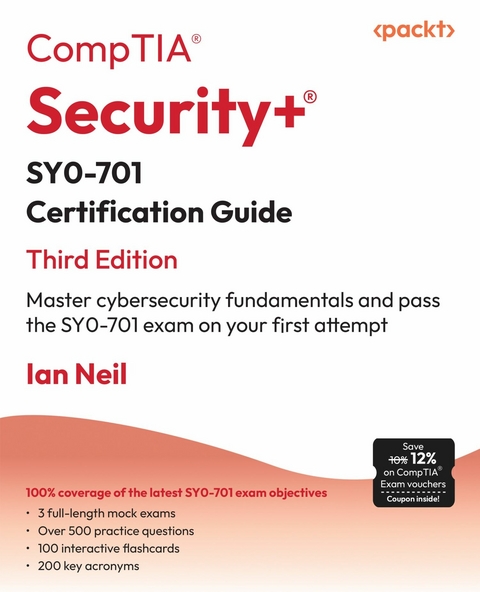
CompTIA(R) Security+(R) SY0-701 Certification Guide (eBook)
634 Seiten
Packt Publishing (Verlag)
978-1-83546-279-9 (ISBN)

Building on the success of its international bestselling predecessor, this third edition of the CompTIA Security+ SY0-701 Certification Guide serves as your one-stop resource for Security+ exam preparation. Written by cybersecurity expert Ian Neil, this comprehensive guide helps you unlock the intricacies of cybersecurity and understand the technology behind the CompTIA Security+ SY0-701 certification, ensuring you approach the exam with confidence and pass on your first attempt.
By exploring security in detail, this book introduces essential principles, controls, and best practices. The chapters are meticulously designed to provide 100% coverage of the CompTIA Security+ SY0-701 exam objectives, ensuring you have the most up-to-date and relevant study material. By mastering cybersecurity fundamentals, you'll acquire the knowledge and skills to identify and mitigate threats, manage vulnerabilities, and safeguard enterprise infrastructure. Additionally, the book grants lifetime access to web-based exam prep tools, including 3 full-length mock exams, flashcards, acronyms, along with a 12% Security+ exam discount voucher.
Whether you aim to excel the CompTIA Security+ SY0-701 exam, advance your career in cybersecurity, or enhance your existing knowledge, this book will transform you into a cybersecurity expert.
100% coverage of the latest CompTIA Security+ SY0-701 exam objectives ensures you study what you need to passUnlocks access to an interactive online platform featuring over 500 practice test questions, 100 flashcards, and 200 key acronyms to enhance your Security+ exam preparationKey FeaturesGain certified security knowledge from Ian Neil, a world-class CompTIA certification trainerBuild a strong foundation in cybersecurity and gain hands-on skills for a successful careerAssess your CompTIA Security+ exam readiness with 3 mock exams to pass confidently on your first tryBenefit from an exclusive 12% Security+ exam discount voucher included with this bookBook DescriptionBuilding on the success of its international bestselling predecessor, this third edition of the CompTIA Security+ SY0-701 Certification Guide serves as your one-stop resource for Security+ exam preparation. Written by cybersecurity expert Ian Neil, this comprehensive guide helps you unlock the intricacies of cybersecurity and understand the technology behind the CompTIA Security+ SY0-701 certification, ensuring you approach the exam with confidence and pass on your first attempt. By exploring security in detail, this book introduces essential principles, controls, and best practices. The chapters are meticulously designed to provide 100% coverage of the CompTIA Security+ SY0-701 exam objectives, ensuring you have the most up-to-date and relevant study material. By mastering cybersecurity fundamentals, you ll acquire the knowledge and skills to identify and mitigate threats, manage vulnerabilities, and safeguard enterprise infrastructure. Additionally, the book grants lifetime access to web-based exam prep tools, including 3 full-length mock exams, flashcards, acronyms, along with a 12% Security+ exam discount voucher. Whether you aim to excel the CompTIA Security+ SY0-701 exam, advance your career in cybersecurity, or enhance your existing knowledge, this book will transform you into a cybersecurity expert.What you will learnDifferentiate between various security control typesApply mitigation techniques for enterprise securityEvaluate security implications of architecture modelsProtect data by leveraging strategies and conceptsImplement resilience and recovery in securityAutomate and orchestrate for running secure operationsExecute processes for third-party risk assessment and managementConduct various audits and assessments with specific purposesWho this book is forWhether you have an IT background or not, if you aspire to pass the CompTIA Security+ SY0-701 exam or pursue a career in certified security, this book will help you achieve your goals. It is also a valuable companion for the US government and US Department of Defense personnel looking to achieve security certification. It serves as an excellent reference material for college students pursuing a degree in cybersecurity.]]>
Preface
In the ever-evolving world of information security, the CompTIA Security+ certification stands as a benchmark for cybersecurity proficiency that equips professionals with the necessary skills to secure a network and manage risk effectively. This guide, tailored for the latest CompTIA Security+ SY0-701 exam, is designed as a comprehensive resource to master the CompTIA Security+ exam.
This brand new exam guide from Ian Neil, one of the world’s top Security+ trainers, and Packt Publishing is specifically written for the 701 exam, and covers the five critical domains of the new exam:
Domain 1
General Security Concepts: This domain covers various types of security controls, including technical, managerial, operational, and physical aspects
Domain 2
Threats, Vulnerabilities, and Mitigations: This domain covers common threat actors, their motivations, and various threat vectors, along with understanding different types of vulnerabilities
Domain 3
Security Architecture: This domain covers the security implications of different architecture models, including cloud, serverless, microservices, and network infrastructure
Domain 4
Security Operations: This domain covers common security techniques for computing resources, understanding the security implications of hardware, software, and data asset management, and diving into the realms of vulnerability management and security alerting
Domain 5
Security Program Management and Oversight: This domain covers the various elements of effective security governance, risk management, third-party risk assessment, compliance, audits, and security awareness practices.
By the end of this guide, you will not only be well-prepared to ace the CompTIA Security+ SY0-701 exam but also possess the confidence to implement and oversee comprehensive security measures in any organization. This book is an essential tool for anyone aspiring to become a proficient cybersecurity professional in today’s ever-evolving digital landscape.
Who This Book Is For
This book helps you build a comprehensive foundation in cybersecurity, and prepares you to overcome the challenges of today’s digital world. Whether you’re pursuing a career in cybersecurity or looking to enhance your existing knowledge, this book is your ultimate guide to passing the SY0-701 exam.
What This Book Covers
To help you easily revise for the new CompTIA Security+ SY0-701 exam, this book has been organized to directly reflect the structure of the exam. The book is separated into 5 sections, reflecting the core domains. Each section includes one chapter per exam objective. Each chapter is organized by the core competencies as stated in CompTIA 701 exam outline.
Domain 1: General Security Concepts
Chapter 1, Compare and contrast various types of security controls, gives an overview of different categories (technical, managerial, operational, physical) and types (preventive, deterrent, detective, corrective, compensating, directive) of security controls.
Chapter 2, Summarize fundamental security concepts, introduces key security concepts like CIA, non-repudiation, AAA, gap analysis, zero trust, physical security, and deception and disruption technology.
Chapter 3, Explain the importance of change management processes and the impact to security, discusses the significance of change management in security, covering business processes, technical implications, documentation, and version control.
Chapter 4, Explain the importance of using appropriate cryptographic solutions, details the use of cryptographic solutions like PKI, encryption levels, tools, obfuscation, hashing, digital signatures, and certificates.
Domain 2: Threats, Vulnerabilities, and Mitigations
Chapter 5, Compare and contrast common threat actors and motivations, examines various threat actors (nation-state, unskilled attacker, hacktivist, etc.) and their motivations like data exfiltration, espionage, and service disruption.
Chapter 6, Explain common threat vectors and attack surfaces, explores different threat vectors and attack surfaces, including message-based, image-based, file-based threats, and human vectors.
Chapter 7, Explain various types of vulnerabilities, discusses a range of vulnerabilities in applications, operating systems, hardware, cloud, and more.
Chapter 8, Given a scenario, analyze indicators of malicious activity, outlines how to identify indicators of malicious activities like malware attacks, physical attacks, and network attacks.
Chapter 9, Explain the purpose of mitigation techniques used to secure the enterprise, details the various mitigation techniques like segmentation, encryption, monitoring, and hardening techniques.
Domain 3: Security Architecture
Chapter 10, Compare and contrast security implications of different architecture models, compares security implications in different architecture models like cloud, IaC, serverless, microservices, and network infrastructure.
Chapter 11, Given a scenario, apply security principles to secure enterprise infrastructure, focuses on applying security principles in different infrastructure scenarios including device placement, security zones, and network appliances.
Chapter 12, Compare and contrast concepts and strategies to protect data, discusses strategies and concepts for data protection including data types, classifications, and methods to secure data.
Chapter 13, Explain the importance of resilience and recovery in security architecture, highlights the importance of resilience and recovery, covering high availability, site considerations, testing, backups, and power management.
Domain 4: Security Operations
Chapter 14, Given a scenario, apply common security techniques to computing resources, covers securing computing resources through secure baselines, hardening targets, wireless security settings, and application security.
Chapter 15, Explain the security implications of proper hardware, software, and data asset management, discusses the implications of asset management in security, focusing on acquisition, monitoring, and disposal processes.
Chapter 16, Explain various activities associated with vulnerability management, details activities in vulnerability management including identification methods, analysis, response, and reporting.
Chapter 17, Explain security alerting and monitoring concepts and tools, explores concepts and tools for security alerting and monitoring like SCAP, SIEM, antivirus, and DLP.
Chapter 18, Given a scenario, modify enterprise capabilities to enhance security, focuses on modifying enterprise security capabilities using tools and strategies like firewalls, IDS/IPS, web filters, and secure protocols.
Chapter 19, Given a scenario, implement and maintain identity and access management, discusses implementation and maintenance of identity and access management, including multifactor authentication and password concepts.
Chapter 20, Explain the importance of automation and orchestration related to secure operations, highlights the role of automation and orchestration in security operations, discussing use cases, benefits, and other considerations.
Chapter 21, Explain appropriate incident response activities, details the processes and activities involved in incident response, including preparation, analysis, containment, and recovery.
Chapter 22, Given a scenario, use data sources to support an investigation, discusses using various data sources like log data and automated reports to support security investigations.
Domain 5: Security Program Management and Oversight
Chapter 23, Summarize elements of effective security governance, summarizes key elements of security governance including guidelines, policies, standards, and procedures.
Chapter 24, Explain elements of the risk management process, focuses on elements of security governance related to risk management, covering...
| Erscheint lt. Verlag | 19.1.2024 |
|---|---|
| Sprache | englisch |
| Themenwelt | Informatik ► Netzwerke ► Sicherheit / Firewall |
| Informatik ► Weitere Themen ► Zertifizierung | |
| Sozialwissenschaften ► Pädagogik | |
| ISBN-10 | 1-83546-279-0 / 1835462790 |
| ISBN-13 | 978-1-83546-279-9 / 9781835462799 |
| Informationen gemäß Produktsicherheitsverordnung (GPSR) | |
| Haben Sie eine Frage zum Produkt? |
 EPUB (Ohne DRM)
Digital Rights Management: ohne DRM
Dieses eBook enthält kein DRM oder Kopierschutz. Eine Weitergabe an Dritte ist jedoch rechtlich nicht zulässig, weil Sie beim Kauf nur die Rechte an der persönlichen Nutzung erwerben.
Dateiformat: EPUB (Electronic Publication)
EPUB ist ein offener Standard für eBooks und eignet sich besonders zur Darstellung von Belletristik und Sachbüchern. Der Fließtext wird dynamisch an die Display- und Schriftgröße angepasst. Auch für mobile Lesegeräte ist EPUB daher gut geeignet.
Systemvoraussetzungen:
PC/Mac: Mit einem PC oder Mac können Sie dieses eBook lesen. Sie benötigen dafür die kostenlose Software Adobe Digital Editions.
eReader: Dieses eBook kann mit (fast) allen eBook-Readern gelesen werden. Mit dem amazon-Kindle ist es aber nicht kompatibel.
Smartphone/Tablet: Egal ob Apple oder Android, dieses eBook können Sie lesen. Sie benötigen dafür eine kostenlose App.
Geräteliste und zusätzliche Hinweise
Buying eBooks from abroad
For tax law reasons we can sell eBooks just within Germany and Switzerland. Regrettably we cannot fulfill eBook-orders from other countries.
aus dem Bereich