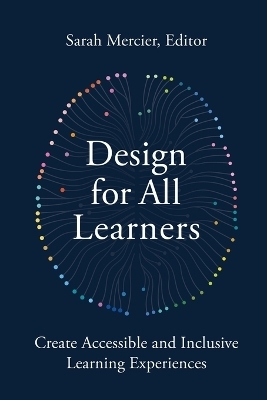
Design for All Learners
ATD Press (Verlag)
978-1-957157-89-4 (ISBN)
Design for All Learners empowers instructional designers, trainers, and other talent development professionals to create learning experiences that are accessible to and inclusive of all people. Learn from practitioners’ vulnerable lived experiences, moving stories, and practical advice. Written with accessibility, inclusion, and L&D experts and edited by Sarah Mercier, this book will help you ensure that individuals can fully participate in the talent development and training programs you offer.
Adopt a progress-over-perfection approach. Start with shifting your mindset to consider that all learners are people who have unique experiences, perspectives, backgrounds, and abilities—and that learning design should be built for people, not just to meet compliance standards. Find what you need to know about designing for the modality you’re using to reach learners—from e-learning and job aids to training in the physical and virtual classroom. Gain a clearer understanding of requirements and standards, and then explore strategies and tactics to foster an inclusive mindset throughout your organization.
Anyone involved with the practice of design in learning and development will benefit from the wide range of perspectives and techniques offered, whether you’re a team of one or work in an organization with a variety of resources. If your goal is to become a better designer, developer, teacher, and leader, this book presents a packed toolbox to do so. It will change everything you think you know. Use it as a guide in your journey to accessible, inclusive design for all.
Sarah Mercier, CEO and strategic consultant at Build Capable, specializes in instructional strategy and learning technology. Sarah is known for translating highly technical concepts and research to real-world practice. Her innovative learning solutions have been recognized by winning industry awards, such as Best of Show at FocusOn Learning DemoFest and Best Performance Support Solution at DevLearn DemoFest. Her work has been published in ATD’s 2020 Trends in Learning Technology, The Book of Road-Tested Activities, TD magazine, Learning Solutions magazine, CLO magazine, and many other training and workforce publications. She lives in Olympia, Washington.
Introduction: A Journey to Design for All
Part 1. Exploring an Inclusive Mindset
Chapter 1. Accessibility Benefits Everyone by Leah Holroyd
Chapter 2. Misconceptions and Myths: “No One Is ___ in My Organization” by Leah Holroyd
Chapter 3. Thinking Outside Your Ability by Brian Dusablon
Chapter 4. Lessons in Persona Design by Kristin Torrence
Chapter 5. Design and Develop With People in Mind by Yvonne Urra-Bazain
Chapter 6. Intersectional Inclusion: Understanding How Dimensions of Social Identity Play Into Accessibility to Help Everyone THRIVE by Jess Jackson
Chapter 7. Personal Discoveries: Accessible Does Not Always Mean Accessible for All by Jean Marrapodi
Chapter 8. Understanding Neurodivergent Learners by Judy Katz
Chapter 9. The Importance of Testing With Real Users by Diane Elkins
Chapter 10. Beyond Accessibility Checklists: Integrating an Inclusive Design Mindset by Leah Holroyd
Chapter 11. Jobs That Require a Certain Ability by Diane Elkins
Chapter 12. A Proactive Approach to Inclusion: Universal Design for Learning by Sarah Mercier
Part 2. Designing Inclusive Digital Content
Chapter 13. Perspectives: Thinking Through Lenses by Brian Dusablon
Chapter 14. Busting Myths About Accessible Digital Content by Diane Elkins
Chapter 15. Keyboard Navigation, Headings, and Focus Order by Michelle Jackson
Chapter 16. Designing Visual Hierarchy With Headings by Judy Katz
Chapter 17. What Frozen Shoulder Taught Me About Accessible Layout by Diane Elkins
Chapter 18. Screen Reader Overload: Considering Changes of Context When Demonstrating Assistive Technology by Yvonne Urra-Bazain
Chapter 19. My Personal Experience With Color Contrast by Leah Holroyd
Chapter 20. Navigating Color Blindness in Digital Content Creation by Michelle Jackson
Chapter 21. What Air Hockey Taught Me About Color Contrast and Alt Text by Diane Elkins
Chapter 22. Why Include Alt Text in Digital Learning? by Michelle Jackson
Chapter 23. Typeface, Text, and Captions: A Creative Journey in Making Digital Content Accessible by Alan Natachu
Chapter 24. Closed Captions: When Sound Matters by Sarah Mercier
Chapter 25. The Case for Transcription by Yvonne Urra-Bazain
Chapter 26. Audio Description Versions by Diane Elkins
Chapter 27. Embracing Simplicity: Making a Complex Table Accessible by Yvonne Urra-Bazain
Chapter 28. Accessible Documents—Why Bother? by Diane Elkins
Chapter 29. Complex Topic, Plain Language: Harnessing Plain Language Guidelines to Support Complex Learning by Yvonne Urra-Bazain
Chapter 30. Accessibility Lessons for Augmented Reality (AR) by Betty Dannewitz
Chapter 31. Virtual Reality: A Request for On-the-Knees Angled Training by Kristin Torrence
Part 3. Creating an Inclusive Physical Classroom
Chapter 32. New to Mastery: How Applying UDL Crafted the Path to CNC Machining Careers by Cara North
Chapter 33. Inclusive Design Considerations for Physical Learning Environments by Suzanne Ehrlich and Michelle Bartlett
Chapter 34. Unlocking Focus: The Vital Role of Fidget Toys in Enhancing Concentration for Neurodivergent Learners by Judy Katz
Chapter 35. Beyond the Rules: A Lesson in Accessibility and Empathy by Jean Marrapodi
Chapter 36. Tailoring Group Work for Neurodivergent Learners by Judy Katz
Chapter 37. Describe Your Visuals in Instructor-Led Programs by Diane Elkins
Chapter 38. Improving Accessibility With Presentation Captioning by JD Dillon
Chapter 39. Driving Dreams: Overcoming Dyslexia With Adaptive Learning and Technology by Jean Marrapodi
Chapter 40. Don’t Forget Interpreting Needs! by Mary Henry Lightfoot
Chapter 41. Working With Sign Language Interpreters by Diane Elkins
Chapter 42. Creating Sensory-Smart Spaces: Strategies for Crafting Neurodivergent-Friendly Training Environments by Judy Katz
Chapter 43. Addressing Speech Access Needs in the Physical Classroom by Susi Miller and Sarah Mercier
Chapter 44. Beyond Barriers: Creating Inclusive Learning Pathways for Nonliterate Liberian Elders in Providence by Jean Marrapodi
Chapter 45. Left in the Margins: Discover an Unexpected Accessibility Barrier by Sarah Mercier
Part 4. Creating an Inclusive Virtual Classroom
Chapter 46. Inclusive Design Considerations for a Welcoming Virtual Learning Space by Michelle Bartlett and Suzanne Ehrlich
Chapter 47. Revolutionizing Remote Learning: A Guide to Crafting Inclusive Virtual Classrooms by Karen Hyder
Chapter 48. Redefining Engagement: Designing Accessible and Inclusive Activities in Virtual Classrooms by Kassy LaBorie
Chapter 49. Strategies to Overcome Auditory Processing Challenges by Judy Katz
Chapter 50. Optimizing Virtual Training Accessibility: Addressing Speech Access Needs by Susi Miller
Part 5. A Primer on Accessibility Standards
Chapter 51. Interpreting Accessibility Standards by Haley Shust
Chapter 52. Practically Applying WCAG Standards to Learning Content by Susi Miller
Chapter 53. Testing WCAG Standards by Susi Miller
Part 6. Adopting an Inclusive Mindset in Your Organization
Chapter 54. The Invisible Why by Daron Moore
Chapter 55. Breaking the “Serving One” Mentality by Belo Miguel Cipriani
Chapter 56. Accessibility Advocacy in Corporate Environments by Haley Shust
Chapter 57. Hiring an Accessibility Consultant by Belo Miguel Cipriani
Chapter 58. Incorporating Accessibility in Development: Guidance for Quality Assurance by David Lindenberg
Chapter 59. Keeping Neurodivergent Learners in the Flow With Quality Content by Judy Katz
Chapter 60. Accessibility Is Better When You’re in It Together by Sarah Mercier
Part 7. Taking Action
Chapter 61. When Efforts to Be Inclusive Don’t Go as Planned by Todd Cummings
Chapter 62. Progress Over Perfection by Meryl K. Evans
Take Action Toolbox
| Erscheinungsdatum | 08.01.2025 |
|---|---|
| Zusatzinfo | Illustrations |
| Verlagsort | Alexandria |
| Sprache | englisch |
| Maße | 152 x 228 mm |
| Themenwelt | Sozialwissenschaften ► Soziologie ► Makrosoziologie |
| Wirtschaft ► Betriebswirtschaft / Management ► Personalwesen | |
| ISBN-10 | 1-957157-89-5 / 1957157895 |
| ISBN-13 | 978-1-957157-89-4 / 9781957157894 |
| Zustand | Neuware |
| Informationen gemäß Produktsicherheitsverordnung (GPSR) | |
| Haben Sie eine Frage zum Produkt? |
aus dem Bereich