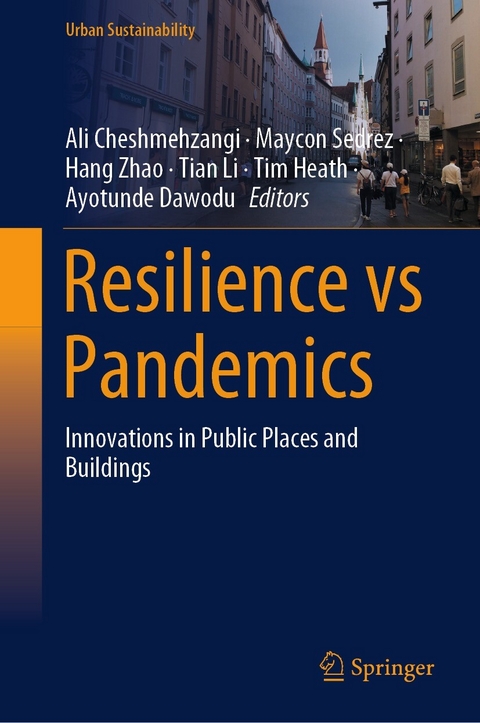
Resilience vs Pandemics (eBook)
161 Seiten
Springer Nature Singapore (Verlag)
978-981-99-8672-9 (ISBN)
“Resilience vs Pandemics: Innovations in Public Places and Buildings” explores innovative solutions for architecture and public places during and after the pandemic. Additionally, the authors contribute to the documentation of architectural and social transformations that have been prompted by previous transmissible diseases, as this knowledge can inform responses to future pandemics. In this volume, the chapters present critical, exploratory, multi- and interdisciplinary, and cutting-edge research approaches; with a particular focus on the effects of COVID-19 and other highly transmissible diseases on the design, use, performance, and perception of the built environment, particularly at the building scale. This volume aims to organize a collection of scientific studies, reviews, analysis, recommendations, and solutions in the fields of urban design, architecture, design, landscape design, etc.
The overarching goal is to document new approaches to createand enhance built environment resilience. Chapters shed light on novel methods, tools, processes, regulations, behaviours, and other relevant details contributing to a comprehensive understanding of this crucial issue. The two scales of the built environment under consideration are:
(1) Public Places, including research on transformations (death, emergencies, changes), requirements, adaptability, usability, virtual immersion, historical perspectives, interactivity, shifts in use and programs, etc.
(2) Buildings, including regulations, shifts in use and program, non-pharmaceutical interventions, human interactions, and human-machine interfaces.
The book covers a wide range of studies, including physical and non-physical studies, which may refer to the city infrastructure, green/blue spaces, housing, policy-making, health services, social and economic issues, etc. The findings and results of various global case study examples contribute to the decision-making of governments, organizations, and institutions, as well as inspire scholars and future research for developing resilience in the post-pandemic era.
"e;Resilience vs Pandemics: Innovations in Public Places and Buildings"e; explores innovative solutions for architecture and public places during and after the pandemic. Additionally, the authors contribute to the documentation of architectural and social transformations that have been prompted by previous transmissible diseases, as this knowledge can inform responses to future pandemics. In this volume, the chapters present critical, exploratory, multi- and interdisciplinary, and cutting-edge research approaches; with a particular focus on the effects of COVID-19 and other highly transmissible diseases on the design, use, performance, and perception of the built environment, particularly at the building scale. This volume aims to organize a collection of scientific studies, reviews, analysis, recommendations, and solutions in the fields of urban design, architecture, design, landscape design, etc. The overarching goal is to document new approaches to createand enhance built environment resilience. Chapters shed light on novel methods, tools, processes, regulations, behaviours, and other relevant details contributing to a comprehensive understanding of this crucial issue. The two scales of the built environment under consideration are: (1) Public Places, including research on transformations (death, emergencies, changes), requirements, adaptability, usability, virtual immersion, historical perspectives, interactivity, shifts in use and programs, etc.(2) Buildings, including regulations, shifts in use and program, non-pharmaceutical interventions, human interactions, and human-machine interfaces. The book covers a wide range of studies, including physical and non-physical studies, which may refer to the city infrastructure, green/blue spaces, housing, policy-making, health services, social and economic issues, etc. The findings and results of various global case study examples contribute to the decision-making of governments, organizations, and institutions, as well as inspire scholars and future research for developing resilience in the post-pandemic era.
| Erscheint lt. Verlag | 6.1.2024 |
|---|---|
| Reihe/Serie | Urban Sustainability | Urban Sustainability |
| Zusatzinfo | XVII, 161 p. 40 illus., 35 illus. in color. |
| Sprache | englisch |
| Themenwelt | Sozialwissenschaften ► Politik / Verwaltung ► Staat / Verwaltung |
| Technik ► Architektur | |
| Technik ► Bauwesen | |
| Technik ► Elektrotechnik / Energietechnik | |
| Schlagworte | buildings • Communities • Covid-19 • Disease Outbreaks • Innovation • Pandemics/Epidemics • Public places • Resilience • Resilient city • urban management |
| ISBN-10 | 981-99-8672-9 / 9819986729 |
| ISBN-13 | 978-981-99-8672-9 / 9789819986729 |
| Informationen gemäß Produktsicherheitsverordnung (GPSR) | |
| Haben Sie eine Frage zum Produkt? |
 PDF (Wasserzeichen)
DRM: Digitales Wasserzeichen
Dieses eBook enthält ein digitales Wasserzeichen und ist damit für Sie personalisiert. Bei einer missbräuchlichen Weitergabe des eBooks an Dritte ist eine Rückverfolgung an die Quelle möglich.
Dateiformat: PDF (Portable Document Format)
Mit einem festen Seitenlayout eignet sich die PDF besonders für Fachbücher mit Spalten, Tabellen und Abbildungen. Eine PDF kann auf fast allen Geräten angezeigt werden, ist aber für kleine Displays (Smartphone, eReader) nur eingeschränkt geeignet.
Systemvoraussetzungen:
PC/Mac: Mit einem PC oder Mac können Sie dieses eBook lesen. Sie benötigen dafür einen PDF-Viewer - z.B. den Adobe Reader oder Adobe Digital Editions.
eReader: Dieses eBook kann mit (fast) allen eBook-Readern gelesen werden. Mit dem amazon-Kindle ist es aber nicht kompatibel.
Smartphone/Tablet: Egal ob Apple oder Android, dieses eBook können Sie lesen. Sie benötigen dafür einen PDF-Viewer - z.B. die kostenlose Adobe Digital Editions-App.
Buying eBooks from abroad
For tax law reasons we can sell eBooks just within Germany and Switzerland. Regrettably we cannot fulfill eBook-orders from other countries.
aus dem Bereich