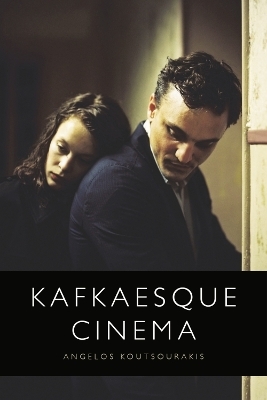
Kafkaesque Cinema
Edinburgh University Press (Verlag)
978-1-4744-9896-8 (ISBN)
For all its familiarity as a widely used term, "Kafkaesque cinema" remains an often-baffling concept that is poorly understood by film scholars. Taking a cue from Jorge Luis Borges’ point that Kafka has modified our conception of past and future artists, and André Bazin’s suggestion that literary concepts and styles can exceed authors and "novels from which they emanate", this monograph proposes a comprehensive examination of Kafkaesque Cinema in order to understand it as part of a transnational cinematic tradition rooted in Kafka’s critique of modernity, which, however, extends beyond the Bohemian author’s work and his historical experiences. Drawing on a range of disciplines in the Humanities including film, literary, and theatre studies, critical theory, and history, Kafkaesque Cinema will be the first full-length study of the subject and will be a useful resource for scholars and students interested in film theory, World Cinema, World Literature, and politics and representation.
Angelos Koutsourakis is Professor in Film and Cultural Studies at the Centre for World Cinemas and Digital Cultures, University of Leeds. He is the author of Rethinking Brechtian Film Theory and Cinema (2018), Politics as Form in Lars von Trier (2013) and the co-editor of Cinema of Crisis: Film and Contemporary Europe (2020), and The Cinema of Theo Angelopoulos (2015).
List of Figures
Acknowledgements
Notes on the Text
Introduction
The Kafkaesque Beyond Kafka
What we Know: Literature on Kafka and the Kafkaesque in Film Studies
Kafkaesque Cinema and the Crisis of Liberalism in its Longue Durée
Part I: ‘Modernity’s Objective Spirit’
Chapter 1: Anxious Humour and Alienating Labour
Prelude: The Chaplinesque and the Kafkaesque
Alienating Labour: Шинель (The Overcoat, 1926) and Modern Times (1936)
Bullshit Jobs: Il Posto (The Job, 1961)
Chapter 2: Bureaucracy
Prelude: Bureaucracy and Violence
Stalinist Depoliticisation: Postava k podpírání (Joseph Kilián, 1963)
Post-Revolutionary Contradictions: La muerte de un burócrata (Death of a Bureaucrat, 1966)
‘The New Class of Administrators’: Mandabi (The Money Order, 1968)
Chapter 3: Social Alienation
Prelude: Modernism’s Reaction to Liberal Individualism
Post-War Repression: Jonas (1957)
Memories from the Repressed Past
Kōbō Abe: Between literature and the Audiovisual Arts
他人の顔 (The Face of Another, 1966): Hiroshi Teshigahara’s Adaptation of Abe’s Homonymous Text
Chapter 4: The Work of Art as Alienating Labour: Barton Fink (1991) and the End of Jewish Modernity
Jewish Modernity: Some Introductory Remarks
Barton Fink (1991): Clifford Odets and the Estranged Artist
‘Assimilation’? Part II: Fascism and its Legacies
Chapter 5: Fernando Arrabal and the Persistence of the Spanish Civil War
Prelude: The Spanish Civil War and the Crisis of Anti-fascism
Baal Babylonia’s (Baal Babylon, 1959) Visual Dramaturgy and its Transposition to Film: Viva La Muerte (Long Live Death, 1971)
Cruelty as Protest: L’arbre de Guernica (The Tree of Guernica, 1975)
Chapter 6: Memories from the Holocaust in Central Europe
Prelude: Central/Eastern Europe and the Holocaust
Tragicomedy in Obchod na korze (The Shop on Main Street, 1965)
Some Notes on Bruno Schulz, the Polish Kafka
Theatre of Death: Sanatorium pod klepsydrą (The Hourglass Sanatorium, 1973)
Chapter 7: Parables of Underdevelopment
Prelude: Kafkaesque Cinema and Enforced Underdevelopment
A City under Siege: Invasión (1969)
Invasión’s Afterlives
Neocolonial Conditions of Existence: Raúl Ruiz’s La colonia penal (The Penal Colony, 1970)
Part III: Stalinist Terror
Chapter 8: Memories from the Rákosi Era
Prelude: The Minor and the Kafkaesque
Self-Renunciations: Hannibál tanár úr (Professor Hannibal, 1956)
Laughing at the Rákosi Era: A tanú (The Witness, 1969)
Chapter 9: Politicising the Absurd
Prelude: Beyond the Existentialist Understanding of the Absurd
Late Modernist Language Scepticism: O slavnosti a hostech (A Report on the Party and the Guests, 1966)
Surveillance Anxieties: Ucho (The Ear, 1970) Chapter 10: Jewish Purges
Prelude: Jewish Purges in the Soviet Bloc Kafkaesque Realism: Artur London’s Testimony
Suspended Time: L’aveu (The Confession, 1970)
The Doctor’s Plot: Хрусталёв, машину (Khrustalyov, My Car!, 1998)
Part IV: Late Capitalist Contradictions
Chapter 11: Behaviourist Surveillance
Introduction: Surveillance as a Feature of Modernity The Prison Industrial Complex: Ghosts … of the Civil Dead (1988)
Surveillance Capitalism: Some Key Definitions
Consumer Behaviourism: Paranoia 1.0 (2004)
Chapter 12: Post-Fascism
Prelude: Counter-Enlightenment in Contemporary Liberal Societies
The Curves of Time: La Jetée (1962)
Belated Style in Béla Tarr’s Werckmeister harmóniák (Werckmeister Harmonies, 2000)
Transit (2018): Anna Seghers’s Anti-Fascism Revisited
Chapter 13: The Anthropocene Crisis
On the Anthropocene
The Multiple Temporalities of Colonial Modernity: Die Parallelstraße (The Parallel Street, 1962)
‘What if Spring did not Come?’ La Cinquième Saison (The Fifth Season, 2012)
Epilogue
Bibliography
Index
| Erscheinungsdatum | 07.05.2024 |
|---|---|
| Zusatzinfo | 21 black and white illustrations |
| Verlagsort | Edinburgh |
| Sprache | englisch |
| Maße | 156 x 234 mm |
| Themenwelt | Kunst / Musik / Theater ► Film / TV |
| Schulbuch / Wörterbuch ► Lexikon / Chroniken | |
| Sozialwissenschaften ► Kommunikation / Medien ► Medienwissenschaft | |
| ISBN-10 | 1-4744-9896-5 / 1474498965 |
| ISBN-13 | 978-1-4744-9896-8 / 9781474498968 |
| Zustand | Neuware |
| Informationen gemäß Produktsicherheitsverordnung (GPSR) | |
| Haben Sie eine Frage zum Produkt? |
aus dem Bereich