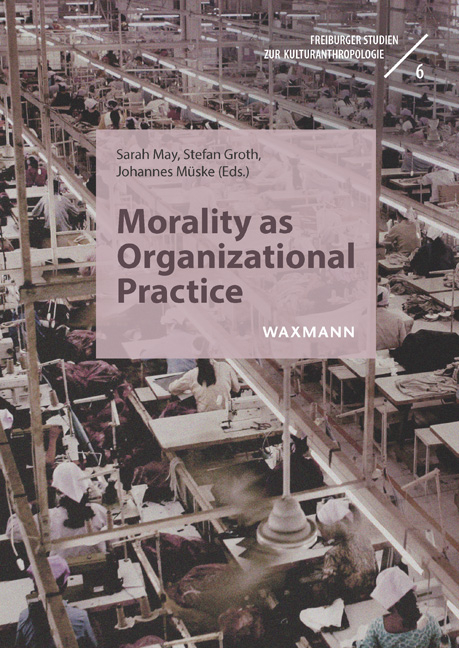
Morality as Organizational Practice
Organizations are increasingly the subject of moral debates. The positioning of enterprises of various sizes, non-governmental organizations, or public institutions is discussed and taken as a basis for consumer, client, and political decisions in a broad scope of topics. While the perspectives of customers, organizations, and further stakeholders on such developments have been highlighted under the label of "ethical consumption" or vis-à-vis the fragility of organizations, the impact and effects on actors working in or for such organizations or subcontractors have so far only been dealt with tangentially or left as a blank spot. This volume turns its attention to the actors and organizational practices in order to trace the effects of these discourses on everyday lives. Similarly, the ethnographic case studies collected in this volume explore the extent to which everyday work life itself shapes discourses on the negotiation of morality in the present.
PD Dr. Sarah May (geb. 1983 in Bad Friedrichshall) studierte Empirische Kulturwissenschaft, Rhetorik, Romanistik und Medienwissenschaft in Tübingen und wurde dort mit einer Arbeit zur Konstituierung von Cultural Property promoviert. Seit Oktober 2016 ist sie wissenschaftliche Mitarbeiterin (Post-Doc) am Freiburger Institut.
Johannes Müske, Dr. phil., Kulturwissenschaftler, ist derzeit Scholar in Residence am Deutschen Museum, München und Lehrbeauftragter an der Universität Liechtenstein. Studium der Kulturanthropologie (Volkskunde), BWL, Jura und Museumsmanagement an den Universitäten Hamburg und Sevilla; Promotion an der Universität Zürich (2012), dort Postdoc und wiss. Koordinator des Projekts Broadcasting Swissness. Forschungs- und Lehrstationen u. a. an den Universitäten Basel, Bloomington, LMU München, Zürich. Forschungsinteressen: Arbeitskulturenforschung, kulturwissenschaftliche Technikforschung, Archive und Kulturerbe, Sinne und Medienethnografie.
Lea Breitsprecher MA arbeitet als wissenschaftliche Mitarbeiterin im Projekt „Biookonomie als kulturelle Transformation“ und promoviert am Institut fur Empirische Kulturwissenschaft der Universitat Freiburg. Ihre Forschungsschwerpunkte sind: Materielle Kultur, Okologische Transformation / Biookonomie und Okonomische Anthropologie.
Lehrstuhl für Europäische Ethnologie/Volkskunde, Julius-Maximilians-Universität Würzburg
| Erscheinungsdatum | 12.12.2023 |
|---|---|
| Reihe/Serie | Freiburger Studien zur Kulturanthropologie ; 6 |
| Co-Autor | Anke Bahl, Lea Breitsprecher, Stefan Groth, Christine Hämmerling, Mohammad Tareq Hasan, Isabella Kölz, Ruzana Liburkina, Michael Maile, Sarah May, Theresa Mentrup, Johannes Müske, Janine Schemmer, Lisa Szepan, Barbara Wittmann |
| Sprache | englisch |
| Maße | 170 x 240 mm |
| Gewicht | 410 g |
| Themenwelt | Sozialwissenschaften ► Ethnologie ► Volkskunde |
| Sozialwissenschaften ► Soziologie ► Mikrosoziologie | |
| Schlagworte | Amnesty International • Arbeitskulturen • Auditing • Bangladeshi Garment Factory • Bioeconomic Practice • Brumadinho Dam Collapse • CSR • Design • Ecology • economy • ethics • Europäisierung / Globalisierung: Ethnografien des Politischen • Europäisierung/ Globalisierung: Ethnografien des Politischen • factory farming • moral turn • Organizational Consulting • precarious employment • Quality management • Responsibility • Social Business |
| ISBN-13 | 9783830947875 / 9783830947875 |
| Zustand | Neuware |
| Informationen gemäß Produktsicherheitsverordnung (GPSR) | |
| Haben Sie eine Frage zum Produkt? |
aus dem Bereich