


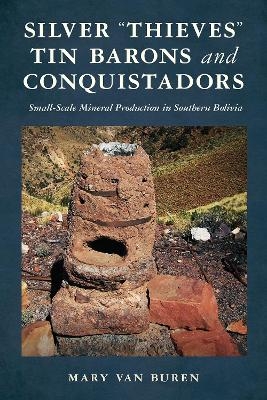
Silver "Thieves," Tin Barons, and Conquistadors
Small-Scale Mineral Production in Southern Bolivia
Seiten
2024
University of Arizona Press (Verlag)
978-0-8165-5333-4 (ISBN)
University of Arizona Press (Verlag)
978-0-8165-5333-4 (ISBN)
The Spanish conquest of Peru was motivated by the quest for precious metals, this histpry of which omits the role played by thousands of independent miners, often working illegally. In this work, Mary Van Buren examines the long-term history of these workers, the technology they used, and their relationship to successive large-scale mining.
The Spanish conquest of Peru was motivated by the quest for precious metals, a search that resulted in the discovery of massive silver deposits in what is now southern Bolivia. The enormous flow of specie into the world economy is usually attributed to the Spanish imposition of a forced labor system on the Indigenous population as well as the introduction of European technology. This narrative omits the role played by thousands of independent miners, often working illegally, who at different points in history generated up to 30 percent of the silver produced in the region. In this work, Mary Van Buren examines the long-term history of these workers, the technology they used, and their relationship to successive large-scale mining.
The methods of historian Bertell Ollman, particularly a dialectical approach and “doing history backwards,” are used to examine small-scale mineral production in Porco, Bolivia. The research is based on nine seasons of archaeological fieldwork and historical research, with a particular focus on labor and technology. Van Buren argues that artisanal mineral production must be understood in relation to large-scale mining rather than as a traditional practice and that the Bolivian case is a culturally specific instantiation of a broader economic phenomenon that began under colonial regimes.
The Spanish conquest of Peru was motivated by the quest for precious metals, a search that resulted in the discovery of massive silver deposits in what is now southern Bolivia. The enormous flow of specie into the world economy is usually attributed to the Spanish imposition of a forced labor system on the Indigenous population as well as the introduction of European technology. This narrative omits the role played by thousands of independent miners, often working illegally, who at different points in history generated up to 30 percent of the silver produced in the region. In this work, Mary Van Buren examines the long-term history of these workers, the technology they used, and their relationship to successive large-scale mining.
The methods of historian Bertell Ollman, particularly a dialectical approach and “doing history backwards,” are used to examine small-scale mineral production in Porco, Bolivia. The research is based on nine seasons of archaeological fieldwork and historical research, with a particular focus on labor and technology. Van Buren argues that artisanal mineral production must be understood in relation to large-scale mining rather than as a traditional practice and that the Bolivian case is a culturally specific instantiation of a broader economic phenomenon that began under colonial regimes.
Mary Van Buren is a professor in the Department of Anthropology and Geography at Colorado State University. Her research focuses on the historical archaeology of the southern Andes.
Introduction: Small-scale Metal Production and Long-term History in Porco, Bolivia
Chapter 1: Small-Scale Metal Production at the Turn of the 21st Century
Chapter 2: Small-scale Metal Production in the Age of Industrialization (1825-1964)
Chapter 3: Silver Extraction under Colonial Rule (1573-1825)
Chapter 4. Spanish Conquistadors and Indigenous Control of Mineral Production, 1538-1572
Chapter 5. Inka Silver Mining and its Antecedents in the Southern Andes
Chapter 6. A Return to the Present: Kajcheo in Global Perspective Conclusion References Cited
| Erscheinungsdatum | 09.04.2025 |
|---|---|
| Reihe/Serie | Archaeology of Indigenous-Colonial Interactions in the Americas |
| Zusatzinfo | 28 b&w illustrations, 9 maps |
| Verlagsort | Tucson |
| Sprache | englisch |
| Maße | 152 x 229 mm |
| Gewicht | 454 g |
| Themenwelt | Geisteswissenschaften ► Archäologie |
| Geisteswissenschaften ► Geschichte ► Regional- / Ländergeschichte | |
| Sozialwissenschaften ► Ethnologie | |
| Sozialwissenschaften ► Soziologie | |
| ISBN-10 | 0-8165-5333-5 / 0816553335 |
| ISBN-13 | 978-0-8165-5333-4 / 9780816553334 |
| Zustand | Neuware |
| Informationen gemäß Produktsicherheitsverordnung (GPSR) | |
| Haben Sie eine Frage zum Produkt? |
Mehr entdecken
aus dem Bereich



aus dem Bereich
die Geschichte meiner Urgroßmutter
Buch | Hardcover (2025)
C.H.Beck (Verlag)
CHF 32,15


