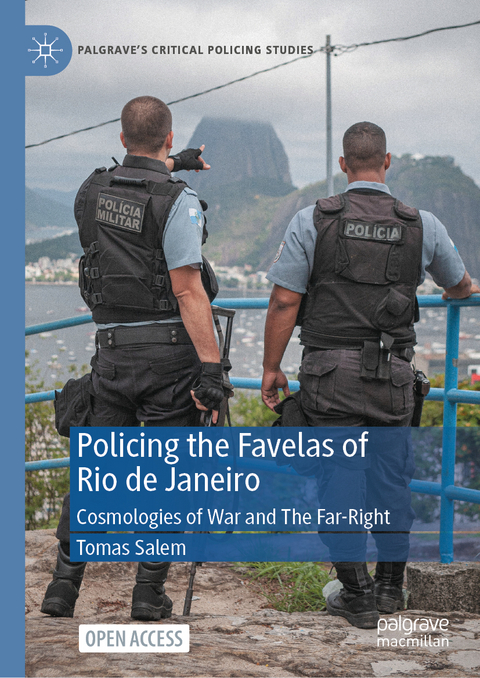
Policing the Favelas of Rio de Janeiro
Springer International Publishing (Verlag)
978-3-031-49026-2 (ISBN)
This book offers a unique look into the world of policing and the frontline of Brazil's war on drugs. It analyzes the tensions produced by attempts to modernize Rio de Janeiro's public security policies. Since the return of democracy in 1985, Rio's police forces have waged war against armed drug gangs based in the city's favelas, casting the people who live in these communities as internal enemies. In preparation for the Olympics in 2016, the police sought to 'pacify' the favelas and their populations through the establishment of Pacifying Police Units (UPPs) in many of the city's favela communities. Drawing on eight months of ethnographic fieldwork with the police, this book follows officers across the institutional hierarchy in their daily activities, on patrol, and during training. Tracing the genealogies of contemporary forms of policing-as-warfare through the notion of 'colonial war' and 'cultural war', it highlights the material and ideational dimensions of war as a cosmological force that shapes Brazilian social relations, subjectivities, landscapes, economies, and politics. It draws on the Deleuzian notion of 'war machine and state dynamics' to show how practices of elimination co-exist with attempts to transform favela territories and their people and analyzes the link between the moral universe of policing and right-wing populism in Brazil. Through rich and nuanced ethnography, it offers a critical perspective on militarized policing and 21st century forms of authoritarianism.
lt;p>Tomas Salem is a PhD-fellow at the University of Bergen, Norway, and has an interdisciplinary background, holding a MA in Social Anthropology from the University of Bergen and an MA in Societal Safety from the University of Tromsø. His thesis Taming the War Machine: Police, Pacification, and Power in Rio de Janeiro won the Norwegian Association for Development Research's Master Thesis Award in 2016. Tomas has almost ten years of engagement with Rio de Janeiro's Military Police.
Introduction Chapter 1: Favela/Asphalt.- Chapter 2: Policing in Rio de Janeiro.- Chapter 3: Pacification and Militarization.- Chapter 4: War Zones.- Chapter 5: Violent Masculinities.- Chapter 6: Training Warriors.- Chapter 7: The World of Warfare.- Chapter 8: Fascism in Brazil.
| Erscheinungsdatum | 21.07.2024 |
|---|---|
| Reihe/Serie | Palgrave's Critical Policing Studies |
| Zusatzinfo | XXI, 330 p. 38 illus., 37 illus. in color. |
| Verlagsort | Cham |
| Sprache | englisch |
| Maße | 148 x 210 mm |
| Themenwelt | Recht / Steuern ► Strafrecht ► Kriminologie |
| Sozialwissenschaften ► Ethnologie | |
| Sozialwissenschaften ► Politik / Verwaltung | |
| Schlagworte | authoritarianism • Fascism • Favela • Masculinity • militarization • Military Police • Necropolitics • open access • police ethnography • policing in the global south • post-colonial studies • predatory accumulation • Race • war • warzone |
| ISBN-10 | 3-031-49026-6 / 3031490266 |
| ISBN-13 | 978-3-031-49026-2 / 9783031490262 |
| Zustand | Neuware |
| Informationen gemäß Produktsicherheitsverordnung (GPSR) | |
| Haben Sie eine Frage zum Produkt? |
aus dem Bereich