


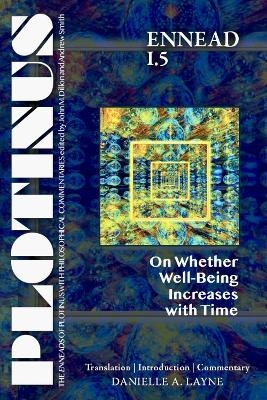
PLOTINUS Ennead I.5: on Whether Well-Being Increases with Time
Translation, with an Introduction, and Commentary
Seiten
2024
Parmenides Publishing (Verlag)
978-1-7335357-4-8 (ISBN)
Parmenides Publishing (Verlag)
978-1-7335357-4-8 (ISBN)
In Ennead I.5, Plotinus responds to popular theories on human flourishing, and insists emphatically that well-being belongs to the present moment. Layne analyzes Plotinus' unique conception of the present moment by highlighting his dialogue with Aristotle and Hellenistic conceptions of the soul, pleasure and pain, time and eternity, etc.
In Ennead I.5 Plotinus attempts to navigate a well-trodden path of inquiry by directly responding to a wide spectrum of popular theories on human flourishing, and insisting emphatically that well-being belongs to the present moment. Indeed, Aristotle—with his insistence that well-being be measured by "a complete life" (Nicomachean Ethics 1098a16–20) or a life measured by virtue, a modus vivendi sustained via the development of appropriate habits (hexis) and the avoidance of misfortunes—is one of Plotinus' central targets. Nevertheless, it is also obvious that the Hellenistic schools, with their almost evangelical insistence that happiness is available to practitioners in the immediacy of the "now," take pride of place in Plotinus' short treatise on the subject. Layne analyzes in depth Plotinus' unique conception of the value of the present moment by highlighting his dialogue with Aristotle and Hellenistic conceptions of the soul, pleasure and pain, time and eternity, and so forth.
In Ennead I.5 Plotinus attempts to navigate a well-trodden path of inquiry by directly responding to a wide spectrum of popular theories on human flourishing, and insisting emphatically that well-being belongs to the present moment. Indeed, Aristotle—with his insistence that well-being be measured by "a complete life" (Nicomachean Ethics 1098a16–20) or a life measured by virtue, a modus vivendi sustained via the development of appropriate habits (hexis) and the avoidance of misfortunes—is one of Plotinus' central targets. Nevertheless, it is also obvious that the Hellenistic schools, with their almost evangelical insistence that happiness is available to practitioners in the immediacy of the "now," take pride of place in Plotinus' short treatise on the subject. Layne analyzes in depth Plotinus' unique conception of the value of the present moment by highlighting his dialogue with Aristotle and Hellenistic conceptions of the soul, pleasure and pain, time and eternity, and so forth.
Danielle A. Layne is Professor of Philosophy at Gonzaga University. She has published widely on Plato and the Platonic tradition, most notably the edited volume, with Harold Tarrant, The Neoplatonic Socrates (Penn State 2014) and the essay relevant for this book, "The Present Moment in Neoplatonic Philosophy" (Epoché: A Journal for the History of Philosophy 23, no. 2 [Spring 2019]: 445–460).
| Erscheinungsdatum | 07.10.2023 |
|---|---|
| Reihe/Serie | The Enneads of Plotinus |
| Verlagsort | Las Vegas |
| Sprache | englisch |
| Maße | 127 x 191 mm |
| Gewicht | 136 g |
| Themenwelt | Geisteswissenschaften ► Philosophie ► Philosophie Altertum / Antike |
| Sozialwissenschaften | |
| ISBN-10 | 1-7335357-4-8 / 1733535748 |
| ISBN-13 | 978-1-7335357-4-8 / 9781733535748 |
| Zustand | Neuware |
| Informationen gemäß Produktsicherheitsverordnung (GPSR) | |
| Haben Sie eine Frage zum Produkt? |
Mehr entdecken
aus dem Bereich


aus dem Bereich
Anleitung zu einer Lektüre Mark Aurels
Buch | Hardcover (2025)
FinanzBuch Verlag
CHF 27,95


