



Political Process and the Development of Black Insurgency, 1930-70
Seiten
1985
|
New edition
University of Chicago Press (Verlag)
978-0-226-55552-2 (ISBN)
University of Chicago Press (Verlag)
978-0-226-55552-2 (ISBN)
- Titel erscheint in neuer Auflage
- Artikel merken
Zu diesem Artikel existiert eine Nachauflage
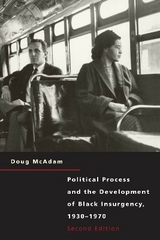
In this work of sociology, Doug McAdam presents a political-process model that explains the rise and decline of the black protest movement in the United States.
In this classic work of sociology, Doug McAdam presents a political-process model that explains the rise and decline of the black protest movement in the United States. Moving from theoretical concerns to empirical analysis, he focuses on the crucial role of three institutions that foster protest: black churches, black colleges, and Southern chapters of the NAACP. He concludes that political opportunities, a heightened sense of political efficacy, and the development of these three institutions played a central role in shaping the civil rights movement. In his new introduction, McAdam revisits the civil rights struggle in light of recent scholarship on social movement origins and collective action. "[A] first-rate analytical demonstration that the civil rights movement was the culmination of a long process of building institutions in the black community."--Raymond Wolters, Journal of American History "A fresh, rich, and dynamic model to explain the rise and decline of the black insurgency movement in the United States."--James W. Lamare, Annals of the American Academy of Political and Social Science
In this classic work of sociology, Doug McAdam presents a political-process model that explains the rise and decline of the black protest movement in the United States. Moving from theoretical concerns to empirical analysis, he focuses on the crucial role of three institutions that foster protest: black churches, black colleges, and Southern chapters of the NAACP. He concludes that political opportunities, a heightened sense of political efficacy, and the development of these three institutions played a central role in shaping the civil rights movement. In his new introduction, McAdam revisits the civil rights struggle in light of recent scholarship on social movement origins and collective action. "[A] first-rate analytical demonstration that the civil rights movement was the culmination of a long process of building institutions in the black community."--Raymond Wolters, Journal of American History "A fresh, rich, and dynamic model to explain the rise and decline of the black insurgency movement in the United States."--James W. Lamare, Annals of the American Academy of Political and Social Science
| Erscheint lt. Verlag | 15.11.1985 |
|---|---|
| Sprache | englisch |
| Maße | 150 x 230 mm |
| Gewicht | 424 g |
| Themenwelt | Sozialwissenschaften ► Ethnologie |
| Sozialwissenschaften ► Politik / Verwaltung ► Politische Systeme | |
| Sozialwissenschaften ► Politik / Verwaltung ► Staat / Verwaltung | |
| Sozialwissenschaften ► Soziologie | |
| ISBN-10 | 0-226-55552-6 / 0226555526 |
| ISBN-13 | 978-0-226-55552-2 / 9780226555522 |
| Zustand | Neuware |
| Informationen gemäß Produktsicherheitsverordnung (GPSR) | |
| Haben Sie eine Frage zum Produkt? |
Mehr entdecken
aus dem Bereich


aus dem Bereich
Das politische System der USA und die Zukunft der Demokratie
Buch | Hardcover (2025)
C.H.Beck (Verlag)
CHF 39,20
Russland, Europa, Amerika
Buch | Softcover (2025)
C.H.Beck (Verlag)
CHF 25,20


