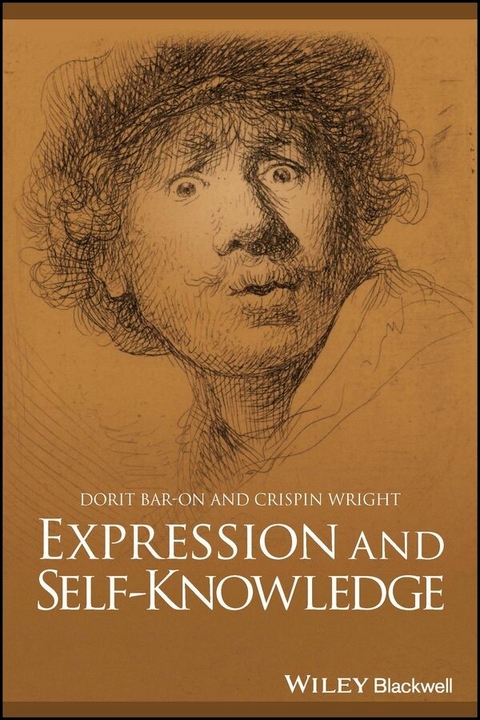
Expression and Self-Knowledge (eBook)
John Wiley & Sons (Verlag)
978-1-118-90854-9 (ISBN)
Provides a timely and original contribution to the debate surrounding privileged self-knowledge
Contemporary epistemologists and philosophers of mind continue to find puzzling the nature and source of privileged self-knowledge: the ordinary and effortless 'first-person' knowledge we have of our own sensations, moods, emotions, beliefs, desires, and hopes.
In Expression and Self-Knowledge, Dorit Bar-On and Crispin Wright articulate their joint dissatisfaction with extant accounts of self-knowledge and engage in a sustained and substantial critical debate over the merits of an expressivist approach to the topic. The authors incorporate cutting-edge research while defending their own alternatives to existing approaches to so-called 'first-person privilege'.
Bar-On defends her neo-expressivist account, addressing the objection that neo-expressivism fails to provide an adequate epistemology of ordinary self-knowledge, and addresses new objections levelled by Wright. Wright then presents an alternative pluralist approach, and Bar-On argues in response that pluralism faces difficulties neo-expressivism avoids. Providing invaluable insights on a hotly debated topic in epistemology and philosophy of mind, Expression and Self-Knowledge:
- Presents an in-depth debate between two leading philosophers over the expressivist approach
- Offers novel developments and penetrating criticisms of the authors' respective views
- Features two different perspectives on the influential remarks on expression and self-knowledge found in Wittgenstein's later writings
- Includes four jointly written chapters that offer a critical overview of prominent existing accounts, which provide a useful advanced introduction to the subject.
Expression and Self-Knowledge is essential reading for epistemologists, philosophers of mind and language, psychologists with an interest in self-knowledge, and researchers and graduate students working in expression, expressivism, and self-knowledge.
DORIT BAR-ON is Professor of Philosophy at the University of Connecticut and Director of the Expression, Communication, and the Origins of Meaning Research Group which she established in 2010, while at the University of North Carolina, Chapel Hill. She specializes in philosophy of language and mind, epistemology, and metaethics, and has published on topics such as translation, conceptual relativism, expression and expressivism, and origins of meaning.
CRISPIN WRIGHT is Professor of Philosophical Research at the University of Stirling. Specializing in epistemology, the philosophies of language and mathematics and the later Wittgenstein's philosophy, he has taught at leading universities including Oxford, Columbia, Princeton, and St. Andrews, where he founded the philosophical research center, Arché.
DORIT BAR-ON is Professor of Philosophy at the University of Connecticut and Director of the Expression, Communication, and the Origins of Meaning Research Group which she established in 2010, while at the University of North Carolina, Chapel Hill. She specializes in philosophy of language and mind, epistemology, and metaethics, and has published on topics such as translation, conceptual relativism, expression and expressivism, and origins of meaning. CRISPIN WRIGHT is Professor of Philosophical Research at the University of Stirling. Specializing in epistemology, the philosophies of language and mathematics and the later Wittgenstein's philosophy, he has taught at leading universities including Oxford, Columbia, Princeton, and St. Andrews, where he founded the philosophical research center, Arché.
1
Privileged Access
Dorit Bar-On and Crispin Wright
Contents
§1.1 Privileged Access: What Is the Problem?
§1.3 Language First or Thought First?
***
§1.1 Privileged Access: What Is the Problem?
Although some philosophers have preferred to think otherwise, it is not philosophical theory but a part of the ordinary folk notion of the mental, enshrined in literature and drama, that each of us stands in a special relationship, denied to others, to our own mental lives—that (many of) our mental states and attributes are (normally) directly available to us and only indirectly available to others, that “You cannot really know what another is thinking,” for example, whereas of one’s own (occurrent) thoughts one cannot but be aware. This special relationship—often referred to by the term privileged access—seems to embrace (some instances of) each of sensation, mood, emotion, belief, desire, fear, intention, action (what I am currently doing), memory (what I am currently remembering), perception (what I am seeing), thought (what I am thinking), imagination, (idiolectic) meaning … the list goes on.
The putative special relationship is frequently gestured at by the phrase “first-person authority.” But the term, “authority,” oversimplifies the respects in which, according to the folk notion, self-knowledge is special. As an initial approximation, there are three distinct features to reckon with.
First (Immediacy), in a wide class of cases, your knowledge of your own psychological attributes need not rely on the kind of evidence—what you say, how you act, how you look—on which others have to rely in coming to justified views about your psychological attributes, and may often seem to rely on no kind of evidence at all.
Second (Authority), your knowledge of a wide class of your own mental attributes does not only originate differently from the ways others can know of them—it is generally superior, and to be deferred to.
And third (Salience), we tend, in the round, to know what there is to know: our own mental attributes of the kinds listed do not, in general, elude our awareness, although those of others may often do so.1, 2
We shall refer to these three features collectively as the Trifecta and, sometimes, will use “Privileged Access” and “First-Person Privilege” as catch-all terms for the three.3
So, the problem—as it initially impresses—is to provide a philosophical account of these asymmetries. Knowledge generally is democratic in the sense that ways to achieve knowledge about various subject matters, while they may in practice be exclusive to those with special gifts of intellect, opportunity or training, are in principle open to anyone. Self-knowledge, by contrast, of perfectly everyday kinds, is routinely achieved by the self concerned in ways that are denied to others, even in principle. What explains this?
§1.2 The Cartesian “Solution”
There is a venerable response to this question, which springs to mind so naturally that it can seem constitutive of the very subject matter, an aspect of the “data.” This is the idea, associated (perhaps erroneously) by many modern thinkers with Descartes,4 that each one’s mental life constitutes a totally transparent inner theater, with an audience, necessarily, of one. Others will need indirect evidence to suppose that something is happening on your inner stage, but you can just observe it. So of course you know best. And since there is total transparency, you will be able to observe what is there to be observed.
Familiarly, however, when pressed, the venerable response transpires to be deeply problematic on several counts. To begin with, the appeal to a kind of interior observation involves distortion of the phenomenology of many—too many—of the attributes that intuitively fall within the province of privileged access. For example, when you acknowledge that you believe something, or have a certain intention, there is normally no distinctive, individuative state of consciousness involved, as there is with, say, a toothache or an itch—nothing in particular that “it is like” to have that particular belief or intention. But more theoretically, the inner theater model plays a villain’s part in generating the sceptikal problem of other minds. And its very coherence is put in serious question by the misgivings about “private language”—really, they concern the possibility of private conceptualization—original to Wittgenstein in the Philosophical Investigations.
Since constraints are thereby imposed on any more satisfactory account, it is worthwhile reviewing these points in some detail. For Cartesianism, our access to our mental states is afforded by a superior kind of inner perception, a faculty that brings us to awareness of the character of states, events, and processes within our inner mental lives broadly as our ordinary perceptual faculties bring us to awareness of states, events, and processes taking place in the perceptible material world around us. But there are crucial differences. While a perceptually normal subject paying close attention to the objects around them will normally be accorded a certain authority for what is there and how matters stand with it, and will normally be expected to notice these things, the Cartesian view, as traditionally understood, embraces far stronger—maximally strong—versions of Authority and Salience:
- Absolute First-Person Authority: If a (sincere, competent) subject spontaneously avows being in mental state M, then their avowal is absolutely indubitable, infallible, and incorrigible.
- Guaranteed Salience: If a subject S is in mental state M, then they are guaranteed to know that they are in M.
Moreover, the access given by the inner gaze is comprehensive yet local:
- All-Encompassing Yet Restricted Epistemic Access: A subject’s inner gaze encompasses all their occurrent mental attributes but exclusively concerns their own mental attributes. It does not take in their physical states, or the mental states of others.
And finally:
- Necessarily Privileged Self-Knowledge: The matters which a subject’s avowals concern are things which the subject necessarily knows.
According to the above theses, sincere avowals would constitute self-attributions that are guaranteed to be true, could never rationally be doubted, and could never reasonably be corrected by others. As such, they would present a radically unusual subclass of things we know and would contrast sharply not only with mental attributions to others but also with all bodily self-attributions. Self-attributions of bodily features and conditions such as height and weight, disease, heart rate, digestive processes, etc. are often made on the same kinds of bases as similar attributions to others. And (as we shall later see) even self-attributions of limb position and bodily orientation, as well as self-attributions of what we see, hear, or touch, or of what we are doing at a given moment—all of which do exhibit certain notable first-person/third-person contrasts—seem open to straightforward rejection and correction by others and are even open to doubt by oneself. Though one does not normally tell what the position of one’s legs, or whether one is sitting down, or whether one sees something, or is doing something, in the same way in which others determine these facts about oneself, others can nevertheless be in a position straightforwardly to deny and correct a self-attribution such as “My legs are crossed” or “I am sitting down”; similarly, e.g., “I (am) hear(ing) a loud siren,” or “I’m drawing a horse.” By contrast, on the Cartesian conception, the corresponding avowals (“It feels to me as though my legs are crossed,” or “I feel as though I am standing”; “I seem to be hearing a loud siren”) are absolutely indubitable, infallible, and incorrigible: with respect to such self-attributions, one enjoys absolute authority. (We will return to contrasts between first-person bodily and mental self-attributions later on.)
On the Cartesian conception, this absolute authority is due to the fact that we each have our own personal, absolutely secure form of access to our own present states of mind. The results delivered by this form of access are guaranteed to be true. There is a striking corollary of this. Since it seems impossible that we could have such secure access to any of our bodily states, the privileged epistemic access we each have to our mental states requires those states to have a peculiar non-bodily nature. Hence, as noted, the pressure to adopt the following, metaphysical thesis—one that the historical Descartes undoubtedly did hold—regarding the relation between mind and body:
- Substance Dualism: The states known via the “inner gaze” are states of an immaterial substance that is (only contingently) associated with our material body.
Given this thesis, it transpires that avowals and nonmental bodily self-attributions differ in the metaphysical...
| Erscheint lt. Verlag | 1.9.2023 |
|---|---|
| Reihe/Serie | Great Debates in Philosophy | Great Debates in Philosophy |
| Sprache | englisch |
| Themenwelt | Geisteswissenschaften ► Philosophie ► Ethik |
| Sozialwissenschaften | |
| Schlagworte | ethics • Ethik • expressivism debate • expressivism self-knowledge • Geistesphilosophie • neo-expressivism debate • Philosophie • Philosophy • Philosophy of Language • Philosophy of mind • philosophy of mind expressivist debate • privileged self-knowledge • privileged self-knowledge debate • privileged self-knowledge research • self-knowledge epistemology debate • Sprachphilosophie |
| ISBN-10 | 1-118-90854-6 / 1118908546 |
| ISBN-13 | 978-1-118-90854-9 / 9781118908549 |
| Informationen gemäß Produktsicherheitsverordnung (GPSR) | |
| Haben Sie eine Frage zum Produkt? |
 EPUB (Adobe DRM)
Kopierschutz: Adobe-DRM
Adobe-DRM ist ein Kopierschutz, der das eBook vor Mißbrauch schützen soll. Dabei wird das eBook bereits beim Download auf Ihre persönliche Adobe-ID autorisiert. Lesen können Sie das eBook dann nur auf den Geräten, welche ebenfalls auf Ihre Adobe-ID registriert sind.
Details zum Adobe-DRM
Dateiformat: EPUB (Electronic Publication)
EPUB ist ein offener Standard für eBooks und eignet sich besonders zur Darstellung von Belletristik und Sachbüchern. Der Fließtext wird dynamisch an die Display- und Schriftgröße angepasst. Auch für mobile Lesegeräte ist EPUB daher gut geeignet.
Systemvoraussetzungen:
PC/Mac: Mit einem PC oder Mac können Sie dieses eBook lesen. Sie benötigen eine
eReader: Dieses eBook kann mit (fast) allen eBook-Readern gelesen werden. Mit dem amazon-Kindle ist es aber nicht kompatibel.
Smartphone/Tablet: Egal ob Apple oder Android, dieses eBook können Sie lesen. Sie benötigen eine
Geräteliste und zusätzliche Hinweise
Buying eBooks from abroad
For tax law reasons we can sell eBooks just within Germany and Switzerland. Regrettably we cannot fulfill eBook-orders from other countries.
aus dem Bereich