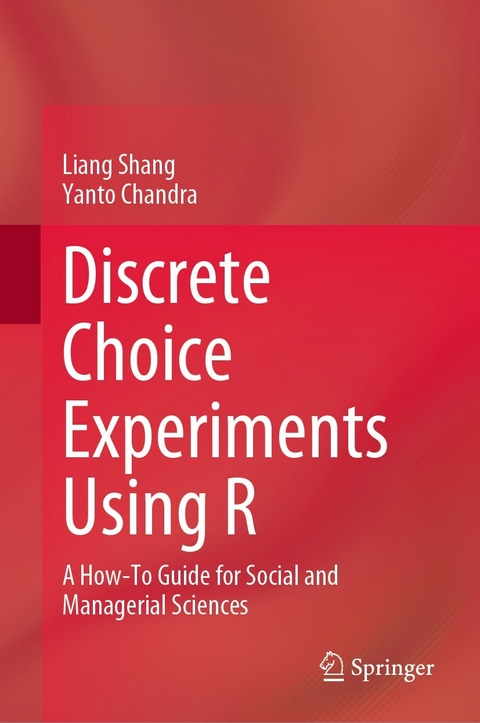
Discrete Choice Experiments Using R (eBook)
203 Seiten
Springer Nature Singapore (Verlag)
978-981-99-4562-7 (ISBN)
This book delivers a user guide reference for researchers seeking to build their capabilities in conducting discrete choice experiment (DCE). The book is born out of the observation of the growing popularity – but lack of understanding – of the techniques to investigate preferences. It acknowledges that these broader decision-making processes are often difficult, or sometimes, impossible to study using conventional methods. While DCE is more mature in certain fields, it is relatively new in disciplines within social and managerial sciences. This text addresses these gaps as the first ‘how-to’ handbook that discusses the design and application of DCE methodology using R for social and managerial science research. Whereas existing books on DCE are either research monographs or largely focused on technical aspects, this book offers a step-by-step application of DCE in R, underpinned by a theoretical discussion on the strengths and weaknesses of the DCE approach, with supporting examples of best practices. Relevant to a broad spectrum of emerging and established researchers who are interested in experimental research techniques, particularly those that pertain to the measurements of preferences and decision-making, it is also useful to policymakers, government officials, and NGOs working in social scientific spaces.
This book delivers a user guide reference for researchers seeking to build their capabilities in conducting discrete choice experiment (DCE). The book is born out of the observation of the growing popularity - but lack of understanding - of the techniques to investigate preferences. It acknowledges that these broader decision-making processes are often difficult, or sometimes, impossible to study using conventional methods. While DCE is more mature in certain fields, it is relatively new in disciplines within social and managerial sciences. This text addresses these gaps as the first 'how-to' handbook that discusses the design and application of DCE methodology using R for social and managerial science research. Whereas existing books on DCE are either research monographs or largely focused on technical aspects, this book offers a step-by-step application of DCE in R, underpinned by a theoretical discussion on the strengths and weaknesses of the DCE approach, with supporting examples of best practices. Relevant to a broad spectrum of emerging and established researchers who are interested in experimental research techniques, particularly those that pertain to the measurements of preferences and decision-making, it is also useful to policymakers, government officials, and NGOs working in social scientific spaces.
| Erscheint lt. Verlag | 25.8.2023 |
|---|---|
| Zusatzinfo | XVI, 203 p. 141 illus., 60 illus. in color. |
| Sprache | englisch |
| Themenwelt | Geisteswissenschaften ► Psychologie ► Allgemeine Psychologie |
| Mathematik / Informatik ► Mathematik ► Statistik | |
| Sozialwissenschaften ► Soziologie ► Empirische Sozialforschung | |
| Wirtschaft | |
| Schlagworte | Data visualization using R • discrete choice experiment • Experimental Design • factorial design • maximum likelihood estimation • Preference methods • Random utility theory • R Programming • Social science research • stated preference |
| ISBN-10 | 981-99-4562-3 / 9819945623 |
| ISBN-13 | 978-981-99-4562-7 / 9789819945627 |
| Informationen gemäß Produktsicherheitsverordnung (GPSR) | |
| Haben Sie eine Frage zum Produkt? |
 PDF (Wasserzeichen)
DRM: Digitales Wasserzeichen
Dieses eBook enthält ein digitales Wasserzeichen und ist damit für Sie personalisiert. Bei einer missbräuchlichen Weitergabe des eBooks an Dritte ist eine Rückverfolgung an die Quelle möglich.
Dateiformat: PDF (Portable Document Format)
Mit einem festen Seitenlayout eignet sich die PDF besonders für Fachbücher mit Spalten, Tabellen und Abbildungen. Eine PDF kann auf fast allen Geräten angezeigt werden, ist aber für kleine Displays (Smartphone, eReader) nur eingeschränkt geeignet.
Systemvoraussetzungen:
PC/Mac: Mit einem PC oder Mac können Sie dieses eBook lesen. Sie benötigen dafür einen PDF-Viewer - z.B. den Adobe Reader oder Adobe Digital Editions.
eReader: Dieses eBook kann mit (fast) allen eBook-Readern gelesen werden. Mit dem amazon-Kindle ist es aber nicht kompatibel.
Smartphone/Tablet: Egal ob Apple oder Android, dieses eBook können Sie lesen. Sie benötigen dafür einen PDF-Viewer - z.B. die kostenlose Adobe Digital Editions-App.
Buying eBooks from abroad
For tax law reasons we can sell eBooks just within Germany and Switzerland. Regrettably we cannot fulfill eBook-orders from other countries.
aus dem Bereich