


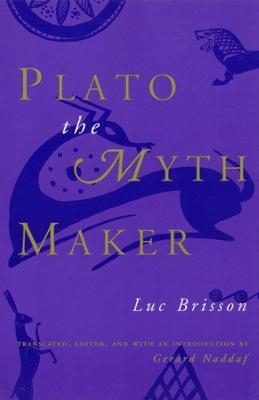
Plato the Myth Maker
Seiten
1999
University of Chicago Press (Verlag)
978-0-226-07518-1 (ISBN)
University of Chicago Press (Verlag)
978-0-226-07518-1 (ISBN)
- Titel z.Zt. nicht lieferbar
- Versandkostenfrei
- Auch auf Rechnung
- Artikel merken
Reconstructing Plato's multifaceted and not uncritical description of "muthos" in light of the "Atlantis" story, Luc Brisson also contrasts this sense of myth, as Plato does, with another form of speech which he believed was far superior: the "logos" of philosophy.
One thinks of a myth as a fictional story, and Plato was the first to use the term "muthos" in that sense. But Plato also used "muthos" to describe the practice of making and telling myths, the oral transmission of all that a community keeps in its collective memory. In the first part of this text, Luc Brisson reconstructs Plato's multifaceted and not uncritical description of "muthos" in light of the latter's famous Atlantis story. The second part of the book contrasts this sense of myth, as Plato does, with another form of speech which he believed was far superior: the "logos" of philosophy. Brisson's work is part lexical, part philosophical, and part ethnological, and Gerard Naddaf's introduction shows the originality and importance both of Brisson's method and of Plato's analysis in the context of contemporary debates over the origin and evolution of the oral tradition.
One thinks of a myth as a fictional story, and Plato was the first to use the term "muthos" in that sense. But Plato also used "muthos" to describe the practice of making and telling myths, the oral transmission of all that a community keeps in its collective memory. In the first part of this text, Luc Brisson reconstructs Plato's multifaceted and not uncritical description of "muthos" in light of the latter's famous Atlantis story. The second part of the book contrasts this sense of myth, as Plato does, with another form of speech which he believed was far superior: the "logos" of philosophy. Brisson's work is part lexical, part philosophical, and part ethnological, and Gerard Naddaf's introduction shows the originality and importance both of Brisson's method and of Plato's analysis in the context of contemporary debates over the origin and evolution of the oral tradition.
Luc Brisson is director of research at the Centre National de la Recherche Scientifique in France. He is the author of several books including Plato the Mythmaker, published in English by the University of Chicago Press. Catherine Tihanyi, a research associate at Western Washington University, has translated a number of books for the University of Chicago Press, including Adam Biro's Two Jews on a Train.
| Erscheint lt. Verlag | 10.5.1999 |
|---|---|
| Übersetzer | Gerard Naddaf |
| Sprache | englisch |
| Maße | 16 x 24 mm |
| Gewicht | 454 g |
| Themenwelt | Geisteswissenschaften ► Philosophie ► Philosophie Altertum / Antike |
| Sozialwissenschaften ► Soziologie | |
| ISBN-10 | 0-226-07518-4 / 0226075184 |
| ISBN-13 | 978-0-226-07518-1 / 9780226075181 |
| Zustand | Neuware |
| Informationen gemäß Produktsicherheitsverordnung (GPSR) | |
| Haben Sie eine Frage zum Produkt? |
Mehr entdecken
aus dem Bereich

aus dem Bereich
Anleitung zu einer Lektüre Mark Aurels
Buch | Hardcover (2025)
FinanzBuch Verlag
CHF 27,95
Die Philosophie der Antike als Lebensweise in der modernen Welt
Buch | Hardcover (2025)
FinanzBuch Verlag
CHF 25,20


