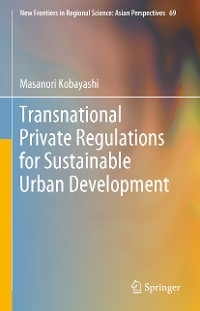
Transnational Private Regulations for Sustainable Urban Development (eBook)
XXIII, 218 Seiten
Springer Nature Singapore (Verlag)
978-981-99-1451-7 (ISBN)
This book analyzes the mechanism of transnational private regulations (TPRs) in the global property investment market and the conditions of their effectiveness for sustainable urban development.
In the present economy, with control over national legislation alone, state policymakers have been challenged to regulate transnational investors, markets, and issues such as global warming, financial crises, food safety risks, deforestation, and cross-border business transactions. Transgovernmental networks of regulators have assembled representatives and technical experts from national regulatory agencies, nongovernmental organizations, private firms, and business organizations. As private corporations become increasingly globalized, many forms of TPRs have emerged since the 1990s for legislation, standard-setting, monitoring of compliance, and implementation of transnational rules, to respond to challenges posed by the transformation of domestic and international regulatory environments. TPRs are self-regulated, non-state, market-driven regulations. Since the emergence of TPRs, the global rule-making landscape has become dynamic.
Urban development and property investment have been viewed historically as local phenomena: The regulations and standards in this field have been established and enforced by governments, local associations, and national professional bodies. However, as urban development and property investment increasingly have been globalized, the services, transactions, and investments by private firms have transcended national boundaries. For this reason, it has become difficult for states to regulate global activities through existing national legislation or international regulatory systems. As the management of new transnational issues through collaborations between various actors is unpredictable, it is necessary to examine the mechanism of TPRs in global property investment and their effectiveness for sustainable urban development.
Masanori KOBAYASHI; Joined in Ministry of Land, Infrastructure, Transport and Tourism after graduation of Keio University (L.L.B.). After mainly specializing in real estate and urban policies, studied at United States (Master in Urban Planning, Harvard University). Being back to Japan, posted as Director of Policy Coordination at Chiba Prefectural Government, promoted several urban development projects, continuing international urban development studies with the US and international associations. Received Encouragement Award of 2022, Public Policy Studies Association JAPAN for 'A study on transnational private regulations for sustainable urban development' and Outstanding Paper Award of 2020, Association of Urban Housing Sciences, for 'Relationship between Building Price Appraisal and Transaction Price in Existing Housing Transactions'. Ph.D., the University of Tokyo, Graduate School of Public Policy.
This book analyzes the mechanism of transnational private regulations (TPRs) in the global property investment market and the conditions of their effectiveness for sustainable urban development. In the present economy, with control over national legislation alone, state policymakers have been challenged to regulate transnational investors, markets, and issues such as global warming, financial crises, food safety risks, deforestation, and cross-border business transactions. Transgovernmental networks of regulators have assembled representatives and technical experts from national regulatory agencies, nongovernmental organizations, private firms, and business organizations. As private corporations become increasingly globalized, many forms of TPRs have emerged since the 1990s for legislation, standard-setting, monitoring of compliance, and implementation of transnational rules, to respond to challenges posed by the transformation of domestic and international regulatory environments. TPRs are self-regulated, non-state, market-driven regulations. Since the emergence of TPRs, the global rule-making landscape has become dynamic. Urban development and property investment have been viewed historically as local phenomena: The regulations and standards in this field have been established and enforced by governments, local associations, and national professional bodies. However, as urban development and property investment increasingly have been globalized, the services, transactions, and investments by private firms have transcended national boundaries. For this reason, it has become difficult for states to regulate global activities through existing national legislation or international regulatory systems. As the management of new transnational issues through collaborations between various actors is unpredictable, it is necessary to examine the mechanism of TPRs in global property investment and their effectiveness for sustainable urban development.
| Erscheint lt. Verlag | 17.7.2023 |
|---|---|
| Reihe/Serie | New Frontiers in Regional Science: Asian Perspectives | New Frontiers in Regional Science: Asian Perspectives |
| Zusatzinfo | XXIII, 218 p. 1 illus. |
| Sprache | englisch |
| Themenwelt | Sozialwissenschaften ► Politik / Verwaltung ► Staat / Verwaltung |
| Sozialwissenschaften ► Soziologie | |
| Wirtschaft ► Betriebswirtschaft / Management ► Finanzierung | |
| Wirtschaft ► Betriebswirtschaft / Management ► Rechnungswesen / Bilanzen | |
| Betriebswirtschaft / Management ► Spezielle Betriebswirtschaftslehre ► Immobilienwirtschaft | |
| Wirtschaft ► Volkswirtschaftslehre ► Wirtschaftspolitik | |
| Schlagworte | Global Property Investment • Global Rule Making • International Public Policy • Sustainable Urban Development • Transnational private regulation |
| ISBN-10 | 981-99-1451-5 / 9819914515 |
| ISBN-13 | 978-981-99-1451-7 / 9789819914517 |
| Informationen gemäß Produktsicherheitsverordnung (GPSR) | |
| Haben Sie eine Frage zum Produkt? |
 PDF (Wasserzeichen)
DRM: Digitales Wasserzeichen
Dieses eBook enthält ein digitales Wasserzeichen und ist damit für Sie personalisiert. Bei einer missbräuchlichen Weitergabe des eBooks an Dritte ist eine Rückverfolgung an die Quelle möglich.
Dateiformat: PDF (Portable Document Format)
Mit einem festen Seitenlayout eignet sich die PDF besonders für Fachbücher mit Spalten, Tabellen und Abbildungen. Eine PDF kann auf fast allen Geräten angezeigt werden, ist aber für kleine Displays (Smartphone, eReader) nur eingeschränkt geeignet.
Systemvoraussetzungen:
PC/Mac: Mit einem PC oder Mac können Sie dieses eBook lesen. Sie benötigen dafür einen PDF-Viewer - z.B. den Adobe Reader oder Adobe Digital Editions.
eReader: Dieses eBook kann mit (fast) allen eBook-Readern gelesen werden. Mit dem amazon-Kindle ist es aber nicht kompatibel.
Smartphone/Tablet: Egal ob Apple oder Android, dieses eBook können Sie lesen. Sie benötigen dafür einen PDF-Viewer - z.B. die kostenlose Adobe Digital Editions-App.
Buying eBooks from abroad
For tax law reasons we can sell eBooks just within Germany and Switzerland. Regrettably we cannot fulfill eBook-orders from other countries.
aus dem Bereich