


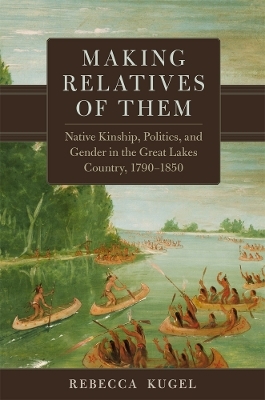
Making Relatives of Them Volume 21
Native Kinship, Politics, and Gender in the Great Lakes Country, 1790-1850
Seiten
2023
University of Oklahoma Press (Verlag)
978-0-8061-9282-6 (ISBN)
University of Oklahoma Press (Verlag)
978-0-8061-9282-6 (ISBN)
Examines kinship among the Great Lakes Native nations in the eventful years of the late eighteenth and early nineteenth century, revealing how these Indigenous peoples’ understanding of kinship, in complex relationship with concepts of gender, defined their social, political, and diplomatic interactions.
Kinship, as an organizing principle, gives structure to communities and cultures—and it can vary as widely as the social relationships organized in its name. Making Relatives of Them examines kinship among the Great Lakes Native nations in the eventful years of the late eighteenth and early nineteenth century, revealing how these Indigenous peoples’ understanding of kinship, in complex relationship with concepts of gender, defined their social, political, and diplomatic interactions with one another and with Europeans and their descendants.
For these Native nations—Wyandot, Shawnee, Delaware, Miami, Ojibwe, Odawa, Potawatomi, Dakota, Menomini, and Ho-chunk—the constructs and practices of kinship, gender, and social belonging represented a daily lived reality. They also formed the metaphoric foundation for a regionally shared Native political discourse. In at least one English translation, Rebecca Kugel notes, Indigenous peoples referred to the kin-based language of politics as “the Custom of All the Nations.” Clearly defined yet endlessly elastic, the Custom of All the Nations generated a shared vocabulary of kinship that facilitated encounters among the many Indigenous political entities of the Great Lakes country, and framed their interactions with the French, the British, and later, the Americans. Both the European colonizers and Americans recognized the power-encoding symbolism of Native kinship discourse, Kugel tells us, but they completely misunderstood the significance that Native peoples accorded to gender—a misunderstanding that undermined their attempts to co-opt the Indigenous discourse of kinship and bend it to their own political objectives.
A deeply researched, finely observed work by a respected historian, Making Relatives of Them offers a nuanced perspective on the social and political worlds of the Great Lakes Native peoples, and a new understanding of those worlds in relation to those of the European colonizers and their descendants.
Kinship, as an organizing principle, gives structure to communities and cultures—and it can vary as widely as the social relationships organized in its name. Making Relatives of Them examines kinship among the Great Lakes Native nations in the eventful years of the late eighteenth and early nineteenth century, revealing how these Indigenous peoples’ understanding of kinship, in complex relationship with concepts of gender, defined their social, political, and diplomatic interactions with one another and with Europeans and their descendants.
For these Native nations—Wyandot, Shawnee, Delaware, Miami, Ojibwe, Odawa, Potawatomi, Dakota, Menomini, and Ho-chunk—the constructs and practices of kinship, gender, and social belonging represented a daily lived reality. They also formed the metaphoric foundation for a regionally shared Native political discourse. In at least one English translation, Rebecca Kugel notes, Indigenous peoples referred to the kin-based language of politics as “the Custom of All the Nations.” Clearly defined yet endlessly elastic, the Custom of All the Nations generated a shared vocabulary of kinship that facilitated encounters among the many Indigenous political entities of the Great Lakes country, and framed their interactions with the French, the British, and later, the Americans. Both the European colonizers and Americans recognized the power-encoding symbolism of Native kinship discourse, Kugel tells us, but they completely misunderstood the significance that Native peoples accorded to gender—a misunderstanding that undermined their attempts to co-opt the Indigenous discourse of kinship and bend it to their own political objectives.
A deeply researched, finely observed work by a respected historian, Making Relatives of Them offers a nuanced perspective on the social and political worlds of the Great Lakes Native peoples, and a new understanding of those worlds in relation to those of the European colonizers and their descendants.
Rebecca Kugel is Associate Professor of History at the University of California, Riverside. She is the author of To Be the Main Leaders of Our People: A History of Minnesota Ojibwe Politics, 1825–1898 and coeditor of Native Women’s History in Eastern North America before 1900: A Guide to Research and Writing.
| Erscheinungsdatum | 18.10.2023 |
|---|---|
| Reihe/Serie | New Directions in Native American Studies Series |
| Zusatzinfo | 10 b&w illus., 1 map |
| Verlagsort | Oklahoma |
| Sprache | englisch |
| Maße | 152 x 229 mm |
| Gewicht | 272 g |
| Themenwelt | Geschichte ► Allgemeine Geschichte ► Neuzeit (bis 1918) |
| Geisteswissenschaften ► Geschichte ► Regional- / Ländergeschichte | |
| Sozialwissenschaften ► Ethnologie | |
| Sozialwissenschaften ► Soziologie | |
| ISBN-10 | 0-8061-9282-8 / 0806192828 |
| ISBN-13 | 978-0-8061-9282-6 / 9780806192826 |
| Zustand | Neuware |
| Informationen gemäß Produktsicherheitsverordnung (GPSR) | |
| Haben Sie eine Frage zum Produkt? |
Mehr entdecken
aus dem Bereich


aus dem Bereich
Geschichte einer wilden Handlung
Buch | Hardcover (2024)
C.H.Beck (Verlag)
CHF 47,60


