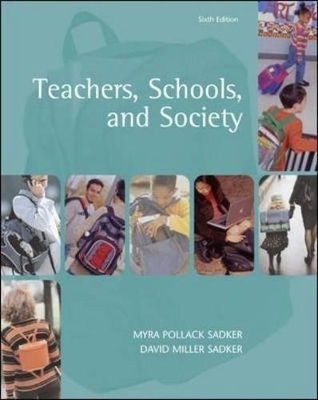
Teachers, Schools, and Society
McGraw Hill Higher Education
978-0-07-255842-5 (ISBN)
- Titel ist leider vergriffen;
keine Neuauflage - Artikel merken
Ever since its first edition, education professors have relied on the Sadkers for their comprehensive coverage of all aspects of American education. "Teachers, Schools, and Society" provides in-depth coverage of the foundations of education (history, philosophy, governance, and law), while also presenting a clear overview of what it means to be a teacher today, and including commentary on current critical topics. Most importantly, a multicultural/diversity-oriented approach is taken in every chapter to provide the most integrated and thorough coverage of diversity in any introduction to education textbook. Written in an informal and highly engaging style that appeals to students, "Teachers, Schools, and Society" is punctuated throughout with interesting features. The pedagogical system is expanded and refined in the sixth edition to provide extensive student support. New to the text is an interactive element that integrates reflection into all features and that links students to the Online Learning Center to perform interactive activities and to find additional resources.
Combine comprehensive coverage; an engaging, interactive pedagogical system; and unsurpassable integrated coverage of diversity with an excellent author team, detailed appendices, and a complete supplements package, and you have an extraordinary resource for introductory coverage of American education.
Myra Pollack Sadker (1943-1995) pioneered much of the research documenting gender bias in America's schools. She was Professor of Education and Dean of the School of Education at American University. She died while undergoing treatment for breast cancer in 1995. Through her writings and lectures, Myra Sadker alerted Americans to the academic, physical, psychological and career costs of sexism. She wrote the first book for teachers on the issue of sexism in 1973. Over twenty years later, in 1994, she coauthored the first popular book on this topic: Failing at Fairness: How America's Schools Cheat Girls. Between these two publications, Myra Sadker brought her cause for educational equity to a national audience. Along with her husband David, Myra Sadker spoke in more than forty states and overseas, giving hundreds of presentations and workshops for teachers and parents concerned with the negative impact of sexist behaviors. She wrote scores of articles on how to raise and teach children free from the debilitating impact of sexism. In her name, Myra Sadker Advocates was established to continue her efforts and create more equitable and effective schools. You are invited to learn more about Myra's contributions and the work of Myra Sadker Advocates, including Myra Sadker Day - March 5th, by visiting the website established in her name: www.sadker.org. David Miller Sadker is currently Professor of Education and Director of the Master of Arts in Teaching Program at American University. With his wife, Myra, who passed away in 1995, he coauthored five books, including Teachers, Schools, and Society (McGraw-Hill) and Failing at Fairness: How Our Schools Cheat Girls (Touchstone Press, 1995). More than fifty of their articles have appeared in Phi Delta Kappan, Harvard Educational Review, Educational Leadership, and other professional journals. Their research and writing efforts received distinguished achievement awards from the American Educational Research Association, The American Association of University Women, the Educational Press Association, the American University, Harvard University, and the University of Massachusetts. Dr. Sadker's research interests have focused on foundations of education, educational equity, teacher preparation, and curriculum. He has codirected numerous grants funded by the U.S. Department of Education. He has conducted teaching and equity workshops for principals, teachers, and professors in over forty states and overseas.
PART I: Teachers and Students Chapter 1: Becoming a Teacher What Are You Doing for the Rest of Your Life? Do Teachers Like Teaching? Professionalism at the Crossroads From Normal Schools to Board-Certified Teachers Teacher Education Today On Discipline On Competition On Honesty and Dependability On Urban Legends about Teaching Southwest Airlines and Teaching We Like Questions Summary Key Terms and People Discussion Questions and Activities Reel to Real Teaching For Further Reading Chapter 2: Student Diversity Different Ways of Learning Multiple Intelligences and Emotional Intelligence Cultural Diversity Teaching Them All Culture and Education Multicultural Education Bilingual Education Exceptional Learners Exceptional Learners: An Exceptional Struggle for Educational Rights The Gifted and Talented Summary Key Terms and People Discussion Questions and Activities Reel to Real Teaching For Further Reading Chapter 3: Teacher Effectiveness Are Teachers Born, or Made? The Mysterious Case of Teacher Effectiveness Academic Learning Time Classroom Management The Pedagogical Cycle Clarity and Academic Structure Questioning Student Response Reaction or Productive Feedback Variety in Process and Content Models for Effective Instruction Direct Teaching Cooperative Learning Mastery Learning Problem-Based Learning Effective and Reflective Teaching Summary Key Terms and People Discussion Questions and Activities Reel to Real Teaching For Further Reading Inter-mission Introduction Inter-mission Part 1 Teachers and Students PART II: Schools and Curriculum Chapter 4: Schools: Choices and Challenges A Meeting Here Tonight The Purposes of School Purpose 1: To Transmit Society's Knowledge and Values (Passing the Cultural Baton) Purpose 2: Reconstructing Society (Schools as Tools for Change) Public Demands for Schools Where Do You Stand? Education Reform Beyond the Neighborhood Public School The Choice Concept Magnet Schools Open Enrollment Vouchers Charter Schools EMOs (Educational Maintenance Organizations): Schools for Profit Is Choice a Good Idea? Home Schools, Home Teachers Summary Key Terms and People Discussion Questions and Activities Reel to Real Teaching For Further Reading Chapter 5: Life in Schools Rules, Rituals, and Routines "Come Right Up and Get Your New Books": A Teacher's Perspective "Come Right Up and Get Your New Books": A Student's Perspective Delay and Social Distraction Watching the Clock The Teacher as Gatekeeper The Other Side of the Tracks The Power of Elementary Peer Groups GUEST COLUMN: Haunted by Racist Attitudes High School's Adolescent Society The Affective Side of School Reform What Makes a School Effective? Factor 1: Strong Leadership Factor 2: A Clear School Mission Factor 3: A Safe and Orderly Climate Factor 4: Monitoring Student Progress Factor 5: High Expectations A Note of Caution on Effective Schools Research Beyond Five Factors Summary Key Terms and People Discussion Questions and Activities Reel to Real Teaching For Further Reading Chapter 6: What Students are Taught in Schools What Is a Curriculum? The Extracurriculum The Hidden or Implicit Curriculum The Formal or Explicit Curriculum The Curriculum Time Machine: A Historical Perspective Time Capsule 1: The Two Rs in the Seventeenth Century Time Capsule 2: Curricula in the Eighteenth Century Time Capsule 3: A Secularized Curriculum for Students in the Nineteenth Century Time Capsule 4: Progressive Education in the First Half of the Twentieth Century Time Capsule 5: Sputnik in Space and Structure in Knowledge, 1940s-1960s Time Capsule 6: Social Concern and Relevance, 1960s-1970s Time Capsule 7: Back to Basics and a Core Curriculum, 1980s-2002 The Subjects of the Formal Curriculum Language Arts and English Social Studies Mathematics Science Foreign Languages Technology The Arts Physical Education Health Vocational and Career Education New Directions for the Curriculum Summary Key Terms and People Discussion Questions and Activities Reel to Real Teaching For Further Reading Chapter 7: Controversy Over Who Controls the Curriculum The Faculty Room Who and What Shape the Curriculum? Teachers Parental and Community Groups Students Administrators The Federal Government The State Government Local Government Colleges and Universities Standardized Tests Education Commissions and Committees Professional Organizations Special Interest Groups Publishers The Standards Movement Tests and Protests Alternatives to High-Stakes Testing The Textbook Shapes the Curriculum Seven Forms of Bias Invisibility Stereotyping Imbalance and Selectivity Unreality Fragmentation and Isolation Linguistic Bias Cosmetic Bias Religious Fundamentalism Censorship and the Curriculum Cultural Literacy or Cultural Imperialism The Saber-Tooth Curriculum Summary Key Terms and People Discussion Questions and Activities Reel to Real Teaching For Further Reading Inter-mission Part 2 Schools and Curriculum PART III: Foundations Chapter 8: The History of American Education Christopher Lamb's Colonial Classroom Colonial New England Education: God's Classrooms A New Nation Shapes Education The Common School Movement Spinsters, Bachelors, and Gender Barriers in Teaching The Secondary School Movement School Reform Efforts John Dewey and Progressive Education The Federal Government The World We Created at Hamilton High: A Schoolography A Super School (If You're on the Right Side of the Tracks), 1953-1965 Social Unrest Comes to School, 1966-1971 The Students' Turn, 1972-1979 New Students, Old School, 1980-1985 Hall of Fame: Profiles in Education Summary Key Terms and People Discussion Questions and Activities Reel to Real Teaching For Further Reading Chapter 9: Philosophy of Education Finding Your Philosophy of Education Inventory of Philosophies of Education Interpreting Your Responses Five Philosophies of Education Teacher-Centered Philosophies Essentialism Perenialism Student-Centered Philosophies Progressivism Social Reconstructionism Existentialism Psychological Influences on Education Constructivism Behaviorism Cultural Influences on Education The Three Legendary Figures of Classical Western Philosophy Basic Philosophical Issues and Concepts Metaphysics and Epistemology Ethics, Political Philosophy, and Aesthetics Logic Your Turn Summary Key Terms and People Discussion Questions and Activities Reel to Real Teaching For Further Reading Chapter 10: Financing and Governing America's Schools Follow the Money: Financing America's Schools Why Should Teachers Care Where the Money Comes from? The Property Tax: The Road to Unequal Schools Reforming Education Finance The Move Toward Adequacy States Finding the Money The Federal Government's Role in Financing Education What the Future May Hold for School Finance Accountability Choice Programs Local Fundraising Decaying Infrastructure Governing America's Schools School Governance Quiz The Legal Control of Schools From an Idea to a Reality State Influence Grows as School Boards Come under Fire The School Superintendent and Principal Covert Power in Schools Business and Family Making Schools More Responsive Summary Key Terms and People Discussion Questions and Activities Reel to Real Teaching For Further Reading Chapter 11: School Law and Ethics Classroom Law What Is Your Rights Quotient? I: Teachers' Rights and Responsibilities II: Students' Rights and Responsibilities Teaching and Ethics Moral Education: Programs that Teach Right from Wrong Classrooms that Explore Ethical Issues Summary Key Terms and People Discussion Questions and Activities Reel to Real Teaching For Further Reading Inter-mission Part 3 Foundations PART IV: Tomorrow Chapter 12: The Struggle for Educational Opportunity Educational Opportunity for All Native Americans: The History of Miseducation Black Americans: The Struggle for a Chance to Learn Hispanics: Growing School Impact Mexican Americans Puerto Ricans Cuban Americans New Immigrants from Latin America Asian Americans and Pacific Islanders: The Magnitude of Diversity Chinese Americans Filipino Americans Asian Indian Americans Japanese Americans Southest Asian Americans Arab Americans: Moving Beyond the Stereotype Women and Education: A History of Sexism The Impact of Title IX Our Children, Your Students Family Patterns Wage Earners and Parenting Divorce Stepfamilies, Interracial Marriages, and Alternative Families Latchkey Kids Hidden America: Homeless Families Children: At Promise or At Risk? Dropping Out Sexuality and Teen Pregnancy AIDS: HIV comes to School Substance Abuse: Drinking, Drugs, and Smoking Youth Suicide Gays, Lesbians, and Bisexuals: Our Invisible Students Tension Point: Are Equity and Excellence Compatible? Summary Key Terms and People Discussion Questions and Activities Reel to Real Teaching For Further Reading Chapter 13: Technology in Education The Technology Revolution School.com It's the Teaching, Not the Technology The Global Curriculum The Virtual Teacher Technology and Equity The Digital Divide Is Computer Technology Worth the Effort? Summary Key Terms and People Discussion Questions and Activities Reel to Real Teaching For Further Reading Chapter 14: Your First Classroom Stages of Teacher Development Your First Year: Induction into the Profession Mentors Observation Professional Development Programs Personalizing Schools Finding that First Teachi ng Position Resumes, Portfolios, and Interviews Interviewing Teacher Recognition The National Board for Professional Teaching Standards Merit Pay Career Ladder Programs Educational Associations Which Teacher's Organization Speaks for You? Professional Associations and Resources American Schools: Better Than We Think? Summary Key Terms and People Discussion Questions and Activities Reel to Real Teaching: It's Your Turn For Further Reading Chapter 15: Q and A Guide to Entering the Teaching Profession What Are My Chances of Finding a Teaching Position? Who Are My Teaching Colleagues? What Are the Demographics of Today's Teachers? What Are My Chances for Earning a Decent Salary? Do Private Schools Pay Less Than Public Schools? How Do I Apply for a Teaching Job? Do I Need a Resume or a Portfolio? What Do I Need In Order to Teach -- a License or Certification? By the Way, What's the Difference? Who Awards Licenses, and How Do I Get One? What Type of License Do I Need? (You Mean, There's More Than One?) What Is an Endorsement? What Is Program Accreditation, and What Does It Mean In Terms of Getting a Teacher's License? What Are "Alternative Routes" to Getting a Teacher's License? What Are Teacher Competency Tests? How Do Teaching Contracts Work? What Are Some Advantages of Tenure? What Are Some Disadvantages of Tenure? Are Untenured Teachers Protected? Can Principals Be Tenured? What Kinds of Educational Careers Are Available Beyond Classroom Teaching? Summary Key Terms and People Inter-mission Part 4 Tomorrow Appendixes 1: State Offices for Teacher Certification and Licensure 2: Information about the Teacher Competency Exams (Praxis Series) 3: A Summary of Selected Reports on Education Reform 4: Observation Manual
| Erscheint lt. Verlag | 1.4.2002 |
|---|---|
| Verlagsort | London |
| Sprache | englisch |
| Maße | 208 x 261 mm |
| Gewicht | 1496 g |
| Themenwelt | Sozialwissenschaften ► Pädagogik ► Allgemeines / Lexika |
| Sozialwissenschaften ► Pädagogik ► Bildungstheorie | |
| ISBN-10 | 0-07-255842-3 / 0072558423 |
| ISBN-13 | 978-0-07-255842-5 / 9780072558425 |
| Zustand | Neuware |
| Informationen gemäß Produktsicherheitsverordnung (GPSR) | |
| Haben Sie eine Frage zum Produkt? |
aus dem Bereich