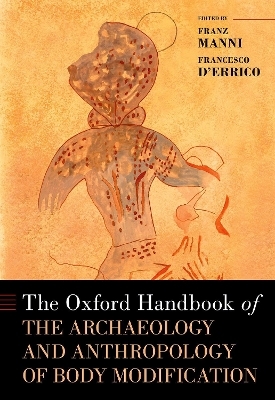
The Oxford Handbook of the Archaeology and Anthropology of Body Modification
Oxford University Press Inc (Verlag)
978-0-19-757252-8 (ISBN)
- Noch nicht erschienen (ca. Februar 2026)
- Versandkostenfrei
- Auch auf Rechnung
- Artikel merken
The Handbook's opening chapters synthesize the origins of body modification, examining the chronological emergence of clothing, body painting, and adornments across continents to introduce the deep connections between body modifications and social identity, focusing on rituals, gender, and symbolism in historical and archaeological contexts. Later chapters delve into cranial and dental modifications, tattooing, and body piercing, examining the cultural significance of these practices and the methods used to perform them. The final sections of the Handbook address other body alterations, including genital modifications and finger amputation. Museum collections are also examined, presenting a wide array of artifacts and visual media, including human remains, showing how they can be studied to understand past cultural contexts in a novel way.
Throughout the Handbook, Indigenous perspectives and methodologies are highlighted, offering insight into the amuletic function of tattoos and the relational practice of body modifications. It is important to note that colonization has stopped the cultural transmission of many of these practices, the value and dignity of which the Handbook attempts to restore. Taken together, the chapters in The Oxford Handbook of the Archaeology and Anthropology of Body Modification represent a unique and groundbreaking synthesis of scholarship on this widespread yet often misunderstood aspect of human culture.
Franz Manni is an Anthropologist at the National Museum of Natural History (Paris, France). He conducts multidisciplinary studies in the realms of human population genetics, biodemography, computational linguistics, archaeology, and geography. His primary research interest is in the dynamics and determinants of past and present human migrations. He has been scientific commissioner and curator of several exhibitions at the Musée de l'Homme, (Paris), including the first exhibition of body piercing adornments from prehistory to the present (Piercing, 2019). Francesco d'Errico is a CNRS Director of Research at the University of Bordeaux and Professor at the University of Bergen. His research explores the evolution of human cognition and symbolic cultural practices in Africa and Eurasia. The author of hundreds of papers in leading scientific journals, he is known for challenging the model of a symbolic revolution by showing that symbolic artifacts existed in Africa at least 80,000 years ago. He has co-led major ERC-funded projects on cultural modernity and human numerical cognition, as well as a University of Bordeaux project devoted to identifying tipping points in biological and cultural evolution.
1. The Archaeology and Anthropology of Body Modification: Introduction
Francesco d'Errico, Franz Manni
2. An Integrated Evolutionary Scenario for the Culturalization of the Human Body
Francesco d'Errico
3. Body Modification: Rituals, Gender, and Symbolism
Rosemary A. Joyce
4. An Introduction to Artificial Cranial Vault Modifications
Vera Tiesler
5. Identifying and Characterizing Artificial Cranial Modifications in Western Mesoamerican Populations: Inputs from 3D Imaging and Shape Quantification Techniques
Sélim Natahi
6. The Rise and Fall of Cranial Deformation in Southwestern France: Modern and Ancient Examples
Eric Crubézy, Patrice Gérard, Didier Paya, Guillaume Fleury, Sélim Djouad, Sylvie Duchesne
7. Intentional Dental Modification: Identification, Distribution, and Significance
Scott E. Burnett, Vera Tiesler, Kenneth Tremblay, John C. Willman
8. One Mark at A Time: Ethnographic Notes on Tattooing
Lars Krutak
9. Global Diversity and Distributions of Traditional Tattooing Tools: An Ethnographic, Ethnohistorical, and Anthropological Perspective
Benoît Robitaille, Aaron Deter-Wolf, Maya Sialuk Jacobsen
10. Archaeological Science and the Identification of Tattooing Tools
Aaron Deter-Wolf, Andrew Gillreath-Brown
11. The Medical Anthropology of Tattooing, Past and Present
Michael Smetana, Christopher D. Lynn, Marco Samadelli
12. Burning, Cutting, Piercing, and Tattooing the Skin for Healing Purposes
Luc Renaut
13. Amuletic Tattooing among Central and Eastern Inuit Tribes from an Inuit Perspective
Maya Sialuk Jacobsen
14. Nlaka'pamux Skin Marking (British Columbia, Canada): Past Significance and Current Efforts to Document, Preserve, and Update Its Ancestral Meaning
Dion Kaszas
15. Techniques and Ornaments for Enlarging Body Piercing Perforations
Franz Manni, Paul King
16. Cultural Transmission in the West: The Case of the Resurrection of Body Piercing in the 20th Century
Paul King, Franz Manni
17. Piercing the Body in Mesoamerica: Material, Social, and Ritual Significance from Historical and Archaeological Sources
Juliette Testard, Guilhem Olivier, Grégory Pereira, Eliseo F. Padilla Gutiérrez
18. The Typology of Archaeological Labrets from Kamchatka
Andrei V. Ptashinsky
19. To Wear, or Not to Wear: Symbolism and Technology of Labrets in Mun (Ethiopia) and Mebêngôkre (Brazil)
Shauna LaTosky, Pascale de Robert
20. The Penis Piercing Tradition in Borneo and the Philippines
Antonio Guerreiro
21. Male and Female Genital Modifications in Anthropological Perspective
Ellen Gruenbaum, Thomas R. Blanton IV, Cathie Spieser
22. Ancient Arts: Body Marking in Indigenous Australia
Michelle C. Langley
23. Body Modifications among San Hunter-Gatherers: A Relational Practice
Vibeke M. Viestad
24. Body Modifications in North-Eastern Africa
Andrea Manzo, Luisa Sernicola
25. Finger Amputation in the Ethnographic and Archaeological Records
Brea McCauley, Mark Collard
26. Ancient Andean Tattooing: New Perspectives from North American Museum Collections
Aaron Deter-Wolf, Madison Auten, Benoît Robitaille, Daniel Riday
27. The Collection of Tattoos of the Museum of Criminal Anthropology "Cesare Lombroso" and of the Museum of Human Anatomy, University of Turin (Italy)
Cristina Cilli, Giacomo Giacobini, Pierpaolo Leschiutta, Franz Manni, Silvano Montaldo
28. Body Modification at the Musée de l'Homme (National Museum of Natural History, Paris, France): An Overview of the Collections, and Research Examples.
Aline Averbouh, Martin Friess, François Gendron, Robin Gerst, Laurence Glemarec, Liliana Huet, Franz Manni
| Erscheinungsdatum | 16.05.2023 |
|---|---|
| Reihe/Serie | Oxford Handbooks |
| Verlagsort | New York |
| Sprache | englisch |
| Maße | 171 x 248 mm |
| Gewicht | 3 g |
| Themenwelt | Geisteswissenschaften ► Archäologie |
| Geschichte ► Allgemeine Geschichte ► Vor- und Frühgeschichte | |
| Sozialwissenschaften ► Ethnologie | |
| Sozialwissenschaften ► Soziologie | |
| ISBN-10 | 0-19-757252-9 / 0197572529 |
| ISBN-13 | 978-0-19-757252-8 / 9780197572528 |
| Zustand | Neuware |
| Informationen gemäß Produktsicherheitsverordnung (GPSR) | |
| Haben Sie eine Frage zum Produkt? |
aus dem Bereich