


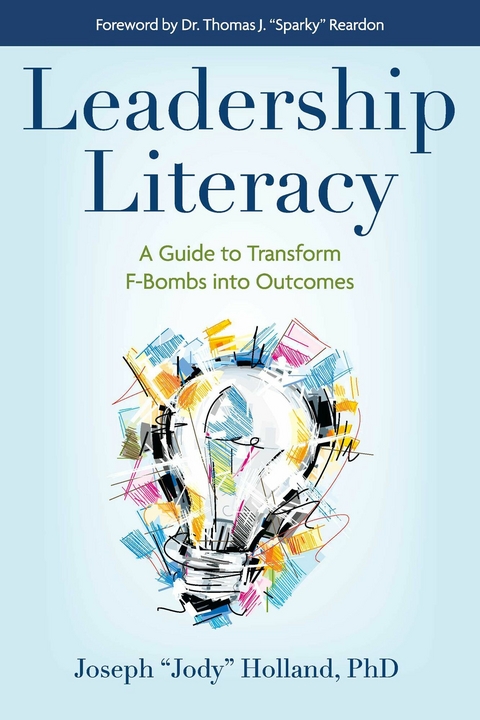
Leadership Literacy (eBook)
196 Seiten
Bookbaby (Verlag)
978-1-6678-8752-4 (ISBN)
Leadership is hard, and students are not taught tools regarding how to be a good leader. Too many times student leaders are propelled into leadership positions without proper training or knowledge, which creates Imposter Syndrome and fills them with self-doubt. Leadership Literacy introduces students to the INSPIRED Leadership Framework, which is a tool to enhance leadership knowledge, to improve leadership skills, and to develop stronger leadership habits so they can create positive outcomes. The framework highlights that student leaders should be Introspective, Nimble, Service-Oriented, Purposeful, Influential, Relational, Emotionally intelligent, and Determined. This book provides the foundation for improving a student's leadership journey and is an essential guide to transform F-bombs into outcomes.
Prologue
There I was, lying on the cold tile floor of the kitchen, hungover, hurting from drinking Jack Daniel’s and ripping cigs the night before. As I opened my eyes, I could see the dust, dirt, and a decaying cockroach under the dishwashing machine. I passed out there. What happened? How did I get here? What was going on in my life? I was 32 years old lying on the kitchen floor and trying to figure out what happened? At that moment, fog-headed and bruised on the inside and out, I realized the journey to this demise started in the eighth grade.
When I was four, my family moved to a rural farm, in Holcomb, Mississippi, where my father managed a 700-head cattle ranch on 2,500 acres of the most beautiful landscape you could imagine, which was owned by a German company. It was my beautiful hell—rolling hills and pristine views—but lots of work and tons of isolation. I attended the local academy 20 miles away from the farm. Every morning, my dad would take me to the local Baptist church and drop off my brother and me to catch the Road Runner school bus. It was a bright red school bus with the Road Runner cartoon character’s image on the side of it. It looked like we were on the way to Woodstock or Coachella, not school. The bus picked up the twenty or so farm kids at the local church at 7:15 a.m. and dropped us off at school at 7:50 a.m. The parents in the small, rural town who sent us to the academy collectively purchased the bus to haul all the students back and forth from school. Getting off that hippy-style bus every morning at school was a shot of insecurity. We were called Holcomb hooligans and most of us looked like little rednecks stepping out of a deer stand. Some kids on that bus were hailed by the nicknames of Bucket, Stick, and Boll Weevil (pronounced Bo Weevil). We were the country kids going to school with the sons and daughters of doctors, bankers, lawyers, and other wealthy folks. It was an all-White school, but it was segregated by socioeconomics, as well as urban and rural addresses. There were other rural kids there too, from other surrounding small communities. But the country club kids let us know our place in the pecking order within the walls of our educational sanctuary. Throughout elementary school, I was one of the smallest kids and was made fun of because of my crooked teeth. I was not popular, but in a class size of fifty students, everyone knew everyone. At that time in my life, I was not interested in learning. Honestly, reflecting on that time, I could barely read in the sixth grade. During the latter years of elementary school, I was energetic, extroverted, and developing a charismatic personality. Unknowingly, this persona was being created to compensate for the underlying insecurities that were growing inside me. These insecurities crystalized deeper in my soul as I entered junior high.
After going out for spring football in seventh grade, I began to belong to a team. Notably, everyone made the team. There were not enough players going out for football to cut anyone from the team. The next fall, in my eighth-grade year, I was sitting in the field house talking to my friend Bill. We were talking about the upcoming elections for eighth-grade class officers, and he said I should run for president. I laughed and thought he was nuts, but he insisted on it. For a few days, we discussed the topic over a Snickers bar and a Coke at the morning break area, and before I knew it, my name was on the ballot. Then before I knew what hit me, I was president of my class. No training, no skills, no knowledge of leadership, just bam, now I am a leader. At least, that is what everyone called me. They looked toward me to represent the class and get things done, but at best I couldn’t lead myself out of a wet paper sack. I couldn’t even use the correct words when I stood in front of the class to encourage them to “precipitate” (participate) in stuffing the homecoming float.
And then, the next year, the class voted for me to be the class president again. Why? I didn’t know what I was doing, but they didn’t care. My high school class voted me class president each year until graduation. I gave the commencement speech at our graduation. The speech wasn’t terrible, but it could have been so much better.
After high school, I attended a small regional university in the Mississippi Delta. Delta State University (DSU) is known for its mascot—a fighting okra, which was featured on a national late-night talk show. Not many people from my rural community of Holcomb, Mississippi, had a chance to go to college, but I did, and I had a grand plan. I told myself that I would go to college for three semesters. I would drink beer, have fun, and then come back and find a job somewhere around the town. No one in my family had attended a university, and my insecurities let me know it from the eighth grade. Being told I was “first-generation” college just enhanced it. But at DSU, most students were first generation—we just never talked about it. Being a first-generation college student was a collective insecurity. So, what did I do with these insecurities? Unknowingly, I suppressed them and started to overcompensate. I got involved in campus organizations because I was told I was a leader.
In college, I served in top leadership roles in the student government. I served in leadership roles in the student alumni association. I rose quickly in the ranks of the fraternity. I looked up, and I was a university orientation leader. My grades were adequate, but I filled all the hours with “leadership” activities and going out drinking beer. Remember, my college clock was only 18 months long. But after those 18 months, I realized I wanted to stay. My grades suffered badly in the fall semester of my sophomore year, and when I came home for Christmas, my parents told me to fix it or drop out. College was a privilege and not a cheap one. Right there and then, December of 1996, I had to “get my act together.” So, I did. I focused on my grades and pulled them up to a 4.0. I excelled at more leadership roles, still not knowing how to lead but getting things done. I was elected president of my fraternity, Pi Kappa Alpha, and I was hired as a paid intern for Wells Fargo, where I had to wear a suit to work every day. I was a leader! I would wake up at 8:00 a.m., put on a suit in my dorm room, go to business classes on campus, and drive an hour to my internship in Greenville, Mississippi, which paid $12 an hour in 1998. After work, I would drive back to the fraternity house and hang out and study. It was an enjoyable time in my life.
And with the work came the rewards. I received leadership awards. My fraternity recognized me as the top leader in the entire Delta Region, which consisted of thirteen universities, including top SEC schools. Awards are part of good leadership, and I liked getting awards. I liked winning. Today, my mom has all the awards on a wall in our cabin. Every time I see them, I am reminded of how ignorant a leader I was.
This act of getting it together didn’t stop after college graduation. With a degree in hand, I received an offer from Wells Fargo for a full-time job, and within 18 months they promoted me to branch manager and vice president because, as the regional director advised me during the promotion interview, I was a “natural-born leader.” I led that operation by the seat of my pants for six years, not knowing a real thing about leadership, but I learned a lot about finance. I even got a master’s degree at night studying management, and, by the way, management is not leadership.
I got married. I was making good money, but those eighth-grade insecurities didn’t stop yelling in my head. In fact, they were yelling louder. They had become a problem, and I did not have the tools to fix them. So, all I wanted to do was to shut them up. I was drinking too much to numb them. I was running too much to suppress them. I was traveling too much to avoid them. I even jumped out of a plane, skydiving, hoping to kill them, but as we learn in life, there is no shortcut for doing inner work. I was about to start the arduous work of introspection and didn’t even know it—a journey that was hard, but ultimately rewarding and, I believe, lifesaving.
After my feet hit the ground from a skydiving jump, I knew I was pushing my limit too much. I was not happy in life and wasn’t happy in my career, and I thought I was stuck. So, after much contemplation, I decided that I was going to quit my job and go be a professor. I didn’t have a clue how to be a professor, or what a professor’s real job even was like. During my undergraduate experience, I didn’t know what a PhD was until the spring of my freshman year. In my graduate program, I was able to learn more about academia from an institutional perspective, but all I knew was professors made good money and the job was easy, and it was high status. Boy, was I wrong about all of that!
So, I quit my job and started a PhD program, not having a clue about the transformation that was coming. I studied hard because it was important to me, and as with my master’s degree, I was paying for it. I had a full-time job working as a benefits coordinator in a mental health agency. That whole experience working at the mental health agency was loony, but I worked hard. I slept five hours a night and focused my efforts on reading books—lots of books—writing papers, developing my research skills, and working at the mental health agency to pay for my academic pursuit. I would wake up at 7:00 a.m., go to work from 8:00 a.m. to 5:00 p.m., go home and eat and rest until 7:00 p.m. Then, I would study from 7:00 p.m. to...
| Erscheint lt. Verlag | 25.3.2023 |
|---|---|
| Vorwort | Dr. Thomas J. & quote; Sparky& quote; Reardon |
| Sprache | englisch |
| Themenwelt | Sozialwissenschaften ► Pädagogik |
| ISBN-10 | 1-6678-8752-1 / 1667887521 |
| ISBN-13 | 978-1-6678-8752-4 / 9781667887524 |
| Informationen gemäß Produktsicherheitsverordnung (GPSR) | |
| Haben Sie eine Frage zum Produkt? |
 EPUB (Ohne DRM)
Größe: 3,3 MB
Digital Rights Management: ohne DRM
Dieses eBook enthält kein DRM oder Kopierschutz. Eine Weitergabe an Dritte ist jedoch rechtlich nicht zulässig, weil Sie beim Kauf nur die Rechte an der persönlichen Nutzung erwerben.
Dateiformat: EPUB (Electronic Publication)
EPUB ist ein offener Standard für eBooks und eignet sich besonders zur Darstellung von Belletristik und Sachbüchern. Der Fließtext wird dynamisch an die Display- und Schriftgröße angepasst. Auch für mobile Lesegeräte ist EPUB daher gut geeignet.
Systemvoraussetzungen:
PC/Mac: Mit einem PC oder Mac können Sie dieses eBook lesen. Sie benötigen dafür die kostenlose Software Adobe Digital Editions.
eReader: Dieses eBook kann mit (fast) allen eBook-Readern gelesen werden. Mit dem amazon-Kindle ist es aber nicht kompatibel.
Smartphone/Tablet: Egal ob Apple oder Android, dieses eBook können Sie lesen. Sie benötigen dafür eine kostenlose App.
Geräteliste und zusätzliche Hinweise
Buying eBooks from abroad
For tax law reasons we can sell eBooks just within Germany and Switzerland. Regrettably we cannot fulfill eBook-orders from other countries.
aus dem Bereich


