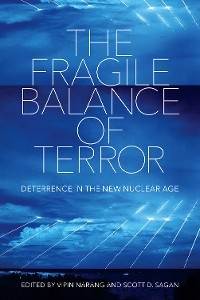
The Fragile Balance of Terror (eBook)
270 Seiten
Cornell University Press (Verlag)
978-1-5017-6702-9 (ISBN)
In The Fragile Balance of Terror, the foremost experts on nuclear policy and strategy offer insight into an era rife with more nuclear powers. Some of these new powers suffer domestic instability, others are led by pathological personalist dictators, and many are situated in highly unstable regions of the world—a volatile mix of variables.
The increasing fragility of deterrence in the twenty-first century is created by a confluence of forces: military technologies that create vulnerable arsenals, a novel information ecosystem that rapidly transmits both information and misinformation, nuclear rivalries that include three or more nuclear powers, and dictatorial decision making that encourages rash choices. The nuclear threats posed by India, Pakistan, Iran, and North Korea are thus fraught with danger.
The Fragile Balance of Terror, edited by Vipin Narang and Scott D. Sagan, brings together a diverse collection of rigorous and creative scholars who analyze how the nuclear landscape is changing for the worse. Scholars, pundits, and policymakers who think that the spread of nuclear weapons can create stable forms of nuclear deterrence in the future will be forced to think again.
Contributors: Giles David Arceneaux, Mark S. Bell, Christopher Clary, Peter D. Feaver, Jeffrey Lewis, Rose McDermott, Nicholas L. Miller, Vipin Narang, Ankit Panda, Scott D. Sagan, Caitlin Talmadge, Heather Williams, Amy Zegart
Vipin Narang is the Frank Stanton Professor of Nuclear Security and Political Science at the Massachusetts Institute of Technology. He is the author of Nuclear Strategy in the Modern Era and Seeking the Bomb. Follow him on X @narangvipin.
Scott D. Sagan is the Caroline S. G. Munro Professor of Political Science, the Mimi and Peter Haas University Fellow in Undergraduate Education, and Senior Fellow and Codirector at the Center for International Security and Cooperation (CISAC) at Stanford University. He is the author of The Limits of Safety and coauthor of The Spread of Nuclear Weapons.
| Erscheint lt. Verlag | 15.1.2023 |
|---|---|
| Reihe/Serie | Cornell Studies in Security Affairs | Cornell Studies in Security Affairs |
| Zusatzinfo | 1 chart |
| Verlagsort | Ithaca |
| Sprache | englisch |
| Maße | 150 x 150 mm |
| Themenwelt | Sozialwissenschaften ► Politik / Verwaltung |
| Schlagworte | emerging nuclear powers, nuclear escalation, multipolar nuclear interactions, future nuclear and missile tests by north korea, south korea or saudi arabia nuclear weaponsprograms |
| ISBN-10 | 1-5017-6702-X / 150176702X |
| ISBN-13 | 978-1-5017-6702-9 / 9781501767029 |
| Informationen gemäß Produktsicherheitsverordnung (GPSR) | |
| Haben Sie eine Frage zum Produkt? |
 EPUB (Adobe DRM)
Kopierschutz: Adobe-DRM
Adobe-DRM ist ein Kopierschutz, der das eBook vor Mißbrauch schützen soll. Dabei wird das eBook bereits beim Download auf Ihre persönliche Adobe-ID autorisiert. Lesen können Sie das eBook dann nur auf den Geräten, welche ebenfalls auf Ihre Adobe-ID registriert sind.
Details zum Adobe-DRM
Dateiformat: EPUB (Electronic Publication)
EPUB ist ein offener Standard für eBooks und eignet sich besonders zur Darstellung von Belletristik und Sachbüchern. Der Fließtext wird dynamisch an die Display- und Schriftgröße angepasst. Auch für mobile Lesegeräte ist EPUB daher gut geeignet.
Systemvoraussetzungen:
PC/Mac: Mit einem PC oder Mac können Sie dieses eBook lesen. Sie benötigen eine
eReader: Dieses eBook kann mit (fast) allen eBook-Readern gelesen werden. Mit dem amazon-Kindle ist es aber nicht kompatibel.
Smartphone/Tablet: Egal ob Apple oder Android, dieses eBook können Sie lesen. Sie benötigen eine
Geräteliste und zusätzliche Hinweise
Buying eBooks from abroad
For tax law reasons we can sell eBooks just within Germany and Switzerland. Regrettably we cannot fulfill eBook-orders from other countries.
aus dem Bereich