Critical Thinking in Biology and Environmental Education
Springer International Publishing (Verlag)
978-3-030-92008-1 (ISBN)
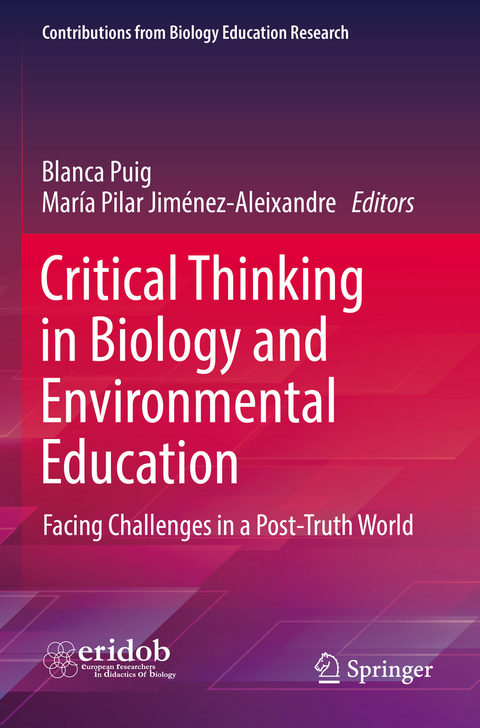
This volume seeks to broaden current ideas about the role of critical thinking (CT) in biology and environmental education considering educational challenges in the post-truth era. The chapters are distributed into three sections, perspectives of a theoretical character (part I), empirical research about CT in the context of biology and health education (part II), and empirical research on CT in the context of environmental and sustainability education (part III). The volume includes studies reporting students' engagement in the practice of critical thinking, and displays how CT can be integrated in biology and environmental education and why biology and environmental issues are privileged contexts for the development of CT. The chapters examine a range of dimensions of CT, such as skills, dispositions, emotions, agency, open-mindedness, or personal epistemologies. In addition, they explore topics such as climate change, sustainable diets, genetically modified food, vaccination, acceptance of evolution, homeopathy, and gene cloning.
Concluding remarks regarding the connections between the chapters and future directions for the integration of critical thinking in biology and environmental education are presented in a final chapter.
lt;p>Blanca Puig is assistant professor in science education at the Faculty of Education, Universidade de Santiago de Compostela (USC), Spain. Her research interest focusses on the analysis of argumentation and the practice of critical thinking in the context of socio-scientific instruction. She is the main investigator of RODA (Reasoning, Argumentation and Discourse) research group and the leader of a National project on critical thinking and epistemic practices in contexts related with the post-truth era . She serves on the ERIDOB academic committee and as associate editor in the Journal of Research in Science Teaching board.
Maria Pilar Jiménez-Aleixandre is Ad Honorem Professor of science education in the Universidade de Santiago de Compostela, Spain. Her research program explores the development of argumentation and critical thinking in the science classroom. Author of highly cited publications, her h Index is 40. She has received awards in the field, the last one NARST Distinguished Contribution to Science Education through Research award, in 2019. She serves on the board of Science Education and other WoS journals.
Under the pen name of Marilar Aleixandre, she has also published fiction and poetry; some books and a sample of her work in short stories and poems is collected in anthologies in English.
Part I. Perspectives on Critical Thinking.- 1. Educating critical citizens to face post-truth: the time is now.- 2. Critical thinking in the flesh: movement and metaphors in a world in flux.- 3. Emotional sense-making and critical thinking in the era of post-truth: The case of climate change.- 4. Culturally relevant science education and critical thinking in Indigenous groups: bridging the gap between community and school science.- Part II. Research about Critical Thinking in Biology and Health Education.- 5. The role of evidence evaluation in critical thinking.- 6. Supporting critical thinking through engagement in dialogic argumentation: The case of discussing genetically modified food.- 7. Critical thinking to decide what to believe and what to do regarding vaccination in schools. A case study with primary pre-service teachers.- 8. Students' thinking strategies and the role of arguments as a shared thinking tool.- 9. Fostering critical thinking about health issues. Facts of success and failure in the case of homeopathy.- Part III. Research about Critical Thinking in Environmental and Sustainability Education.- 10. Teaching science in environmentally degraded areas: An analysis from critical and ecofeminist perspective.- 11. Spatial and temporal dynamics in climate change education discourse: An ecolinguistic perspective.- 12. Social responsibility and critical disposition for considering and acting upon conflicting evidence in argumentation about sustainable diets.- 13. Epistemic beliefs as a means of understanding critical thinking in a socioscientific environmental debate.- 14. Primary school teachers' understanding of critical thinking in the context of education for sustainable development.- Part IV. Concluding Remarks.- 15. The integration of critical thinking in biology and environmental education. Contributions and further directions.
| Erscheinungsdatum | 03.03.2023 |
|---|---|
| Reihe/Serie | Contributions from Biology Education Research |
| Zusatzinfo | XII, 276 p. 1 illus. |
| Verlagsort | Cham |
| Sprache | englisch |
| Maße | 155 x 235 mm |
| Gewicht | 444 g |
| Themenwelt | Sozialwissenschaften ► Pädagogik ► Erwachsenenbildung |
| Schlagworte | biology education • Climate change education • community science • Critical Thinking in Biology Education • Critical Thinking in Indigenous Groups • education for sustainable development • Environmental education • Evidence Evaluation in Critical Thinking • indigenous science education • Vaccination in Schools |
| ISBN-10 | 3-030-92008-9 / 3030920089 |
| ISBN-13 | 978-3-030-92008-1 / 9783030920081 |
| Zustand | Neuware |
| Informationen gemäß Produktsicherheitsverordnung (GPSR) | |
| Haben Sie eine Frage zum Produkt? |
aus dem Bereich