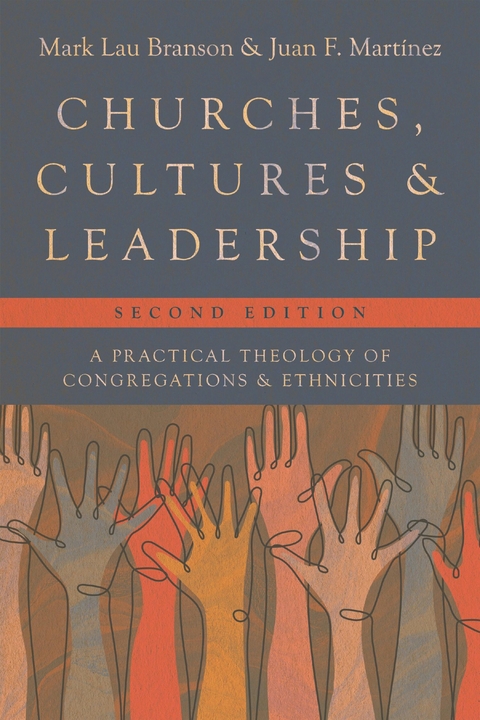
Churches, Cultures, and Leadership (eBook)
296 Seiten
IVP Academic (Verlag)
978-1-5140-0288-9 (ISBN)
Mark Lau Branson (EdD, University of San Francisco) is the Homer L. Goddard Senior Professor of the Ministry of the Laity at Fuller Theological Seminary. His most recent book is Leadership, God's Agency, and Disruptions: Confronting Modernity's Wager (with Alan Roxburgh).
Mark Lau Branson (EdD, University of San Francisco) is the Homer L. Goddard Senior Professor of the Ministry of the Laity at Fuller Theological Seminary. His most recent book is Leadership, God's Agency, and Disruptions: Confronting Modernity's Wager (with Alan Roxburgh). Juan Francisco Martínez (PhD, Fuller Theological Seminary) has served as vice president for diversity and international ministries, director of the Center for the Study of Hispanic Church and Community, and professor of Hispanic studies and pastoral leadership at Fuller Theological Seminary. His recent books include The Story of Latino Protestants in the United States.
Introduction
Who, What, Why?
MARK LAU BRANSON AND JUAN FRANCISCO MARTÍNEZ
Oakland—About sixteen seniors waited to welcome the new pastor. Half of them were in the kitchen, the others in the sanctuary. Six months earlier they had voted to close their sixty-year-old church, but the bishop wanted one more attempt. In the 1930s the members had decided, for a second time, to relocate, following the pattern of congregations moving when ethnic demographics affected their neighborhoods. Changes had also occurred in this new neighborhood, so most members had moved to the suburbs and commuted back to the city for Sundays. They obviously had relational connections with each other, but they seldom saw each other between Sunday gatherings. The neighborhood, with its people and networks, knew little about the church other than it was the site for a couple of twelve-step recovery groups hosted in the church basement. Over the next ten years the church became culturally diverse and deeply committed to its urban environment.1
Houston—After several decades of growth as a suburban, Caucasian, Baptist church near Houston, a congregation experienced a significant decline in the mid-1980s. Later, when the economy recovered and the community regained residents, those residents were ethnically diverse (80 percent non-White by 1990). The pastor shaped activities that he hoped would add members. Since he believed in the homogeneous unit principle, which taught that growth was most likely when churches remained racially specific, he asked members to knock on doors in the next suburb. Then, consistent with his vision, he proposed that the church move to a location that matched his ethnic strategy. Some of the church’s leaders were troubled by this strategy. They eventually decided they would stay in the diverse community and reach out to new neighbors; and they called a pastor who would work with them in this challenge.2
INTRODUCING OUR THEME
Moses left Egypt with a “mixed crowd,” and the earliest followers of Jesus learned that the Holy Spirit was leading them to cross cultural borders. The scriptural narratives are loaded with references to the strangeness of strangers and the discomforts of participating in God’s love for the world. This book is about that strangeness, those discomforts. It is about God’s call on the church to love our neighbors, and we acknowledge that such love is a matter of grace and of work.
Our focus is on churches in the United States and how we can be faithful to God’s call on our churches in this context. We live in a culturally diverse nation—and many of our cities and neighborhoods exhibit that cultural pluralism. Ethnic diversity is (unevenly) evident in the media, at shopping malls, and in many schools. Such diversity is less evident in our churches, but it is growing. We wish to promote more attentiveness, wisdom, and faithfulness concerning intercultural life in and among churches, and between churches and their neighbors.
We have all been shaped in a historical context of prejudice and racism. We carry the influences of our environment in our minds and hearts; too often our actions, choices, and words perpetuate ethnic biases. Many prejudices, rooted in racism, are built into our institutions. We believe that God’s love for the world is definitive in Jesus’ inauguration of God’s reign, and therefore we believe that the church’s identity and agency should be characterized by what Paul calls “all things coming together in Christ” (see Eph 1:10, CEB). Such reconciliation, if it is defined and empowered by the gospel, must be personal, interpersonal, cultural, and structural. When persons of different cultures share life, once we get beyond music and food, the complexities increase.
A core theological assumption of ours is that God is continually initiating in the world—in neighborhoods, among churches, and in our own lives. We are focused on how God initiates in concrete ways to counter racial injustice, break down social barriers, and foster life-altering love. We believe that the Spirit works in individuals, in social systems, and in organizational structures. If followers of Christ are to participate with God, then paying attention is key, and it is difficult work. Just as a competent painter, carpenter, or teacher learns, over many years, how to attend—how to train their senses and responses to their environment and their work—church leaders need to pay attention to cultural characteristics, to God’s initiatives, and to the participatory work of shaping intercultural life.
That is the purpose of our writing: to help men and women in our churches to see differently and to gain the skills and competencies needed for discerning God’s initiatives and embodying the gospel in multicultural contexts. We want to encourage church leaders to create environments that make God’s reconciling initiatives apparent in church life and in our missional engagement with neighborhoods and cities.
HISTORY MATTERS
History reminds us that many of the colonists who crossed the Atlantic and eventually formed the first states of the new United States were people seeking religious options that they were denied in Europe. These colonies were established by people who wanted the space to develop their own specific vision of church and society, without the interference of a European government committed to its own state religion. The degree of establishment (the official connections between governing structures and churches) varied throughout the colonies, and some who fled persecution in Europe initiated their own oppressive practices in the New World. Those with primarily religious reasons for migrating were mixed with others who sought economic opportunities or political freedom, and these motivations were often overlapping because religion, politics, and economics were overlapping factors in Europe.
These various European colonial communities wanted to develop their distinct visions free from the interference or persecution they had experienced in Europe. They brought their theologies and practices from Europe and adapted them to life in the New World. Their experiences included opportunities and threats, and their new churches offered familiar experiences, dialects, and practices. These immigrants valued their own familiar and distinctive theologies, social relationships, and worship practices. So churches and ethnicities were linked from colonial days, be they English Puritans in New England, Dutch Reformed in New York, English Anglicans in the mid-Atlantic, or Swiss-German Mennonites in Pennsylvania. Most colonists arrived in the New World with church life thoroughly embedded in ethnic culture.
Also, from the earliest years of European occupation in North America, some men and women were bought and traded,3 and, as was a pattern throughout colonized nations, indigenous persons were also oppressed, enslaved, and killed. Colonizers who worked to secure their own freedoms and opportunities did so by taking freedoms, agency, and lives. Racism, mainly present in the construct of White and Black, had other variations, but the overarching environment was a structure of power and economics fashioned from the European history of colonization and domination. One consequence was that involuntary immigrants did not have the freedom to practice their religions. Over those decades, some came to embrace Christian faith and even understood and practiced it with more awareness of God’s character and care than did White participants.
Most nineteenth-century European immigrants to the United States continued with some version of this pattern. When they migrated to the New World, they tended to bring their ethnic-specific religious expressions with them. Once in the United States they usually formed ethnic enclaves, and the churches were typically one of the central underpinnings of these new communities. Even when neighbors shared a Christian background, one could clearly identify the differences between Irish, Ukrainian, and Italian Catholics, or between German, Swedish, and English Baptists. Some of these ethno-religious communities formed their own denominations, while others created joint structures, even as they maintained their clearly defined ethnic-specific churches.
As the White population grew, the succeeding waves of immigrants in the new cities and towns put neighborhoods through ethnic transitions. It became increasingly common for a church facility to be turned over to a more recently arrived national or ethnic group as a previous tenant moved to a newer neighborhood. There were occasions, in the interim, in which some new arrivals investigated an unfamiliar church, especially in Puritan, Methodist, and Baptist congregations, but this overlap was usually temporary and did not tend to change the culture of the church unless there was a complete handoff of the organization.
Thus, ethnic homogeneity in US churches has been the norm from colonial days. Throughout the nineteenth century and into the twentieth, these ethno-religious churches adapted in numerous ways of life, responding to factors like language shifts, new immigration patterns, and continuing connections with homelands. The churches also dealt with realities that were unfamiliar: the frontier, close contact with those...
| Erscheint lt. Verlag | 28.2.2023 |
|---|---|
| Verlagsort | Lisle |
| Sprache | englisch |
| Themenwelt | Religion / Theologie ► Christentum ► Kirchengeschichte |
| Religion / Theologie ► Christentum ► Moraltheologie / Sozialethik | |
| Religion / Theologie ► Christentum ► Pastoraltheologie | |
| Sozialwissenschaften ► Soziologie ► Spezielle Soziologien | |
| Schlagworte | Biblical • Christian • Christian leadership • Communication • Competency • congregation • Cultural Anthropology • cultural competency • culturally competent missions • Diversity • Ethnicity • Intercultural • Intercultural communication • Justice • ministry • missions • multiethnic • multiethnic church • multiethnic ministry • Pastoral Resources • Practical Theology • Race • racial • Racial Justice • racial reconciliation • Racism • Reconciliation • response • Sociology |
| ISBN-10 | 1-5140-0288-4 / 1514002884 |
| ISBN-13 | 978-1-5140-0288-9 / 9781514002889 |
| Informationen gemäß Produktsicherheitsverordnung (GPSR) | |
| Haben Sie eine Frage zum Produkt? |
 EPUB (Wasserzeichen)
DRM: Digitales Wasserzeichen
Dieses eBook enthält ein digitales Wasserzeichen und ist damit für Sie personalisiert. Bei einer missbräuchlichen Weitergabe des eBooks an Dritte ist eine Rückverfolgung an die Quelle möglich.
Dateiformat: EPUB (Electronic Publication)
EPUB ist ein offener Standard für eBooks und eignet sich besonders zur Darstellung von Belletristik und Sachbüchern. Der Fließtext wird dynamisch an die Display- und Schriftgröße angepasst. Auch für mobile Lesegeräte ist EPUB daher gut geeignet.
Systemvoraussetzungen:
PC/Mac: Mit einem PC oder Mac können Sie dieses eBook lesen. Sie benötigen dafür die kostenlose Software Adobe Digital Editions.
eReader: Dieses eBook kann mit (fast) allen eBook-Readern gelesen werden. Mit dem amazon-Kindle ist es aber nicht kompatibel.
Smartphone/Tablet: Egal ob Apple oder Android, dieses eBook können Sie lesen. Sie benötigen dafür eine kostenlose App.
Geräteliste und zusätzliche Hinweise
Buying eBooks from abroad
For tax law reasons we can sell eBooks just within Germany and Switzerland. Regrettably we cannot fulfill eBook-orders from other countries.
aus dem Bereich