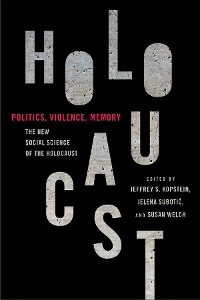
Politics, Violence, Memory (eBook)
348 Seiten
Cornell University Press (Verlag)
978-1-5017-6677-0 (ISBN)
Politics, Violence, Memory highlights important new social scientific research on the Holocaust and initiates the integration of the Holocaust into mainstream social scientific research in a way that will be useful both for social scientists and historians. Until recently social scientists largely ignored the Holocaust despite the centrality of these tragic events to many of their own concepts and theories.
In Politics, Violence, Memory the editors bring together contributions to understanding the Holocaust from a variety of disciplines, including political science, sociology, demography, and public health. The chapters examine the sources and measurement of antisemitism; explanations for collaboration, rescue, and survival; competing accounts of neighbor-on-neighbor violence; and the legacies of the Holocaust in contemporary Europe. Politics, Violence, Memory brings new data to bear on these important concerns and shows how older data can be deployed in new ways to understand the "index case" of violence in the modern world.
Jeffrey S. Kopstein is Professor of Political Science at the University of California, Irvine. He is the author of The Politics of Economic Decline in East Germany 1945–1989, coeditor of Growing Apart?, and coauthor of Intimate Violence. Follow him on X @JeffreyKopstein.
Jelena Subotić is Professor of Political Science at Georgia State University. She is the author of Hijacked Justice and Yellow Star, Red Star. Follow her on X @suboticjelena.
Susan Welch was Professor of Political Science at The Pennsylvania State University. She was the coauthor of numerous books and author of several articles on Holocaust transports.
Introduction: A Response Delayed
1. Can – Or Should – There Be a Political Science of the Holocaust?
2. Histories in Motion: The Holocaust, Social Science Research, and the Historian
Part I: Sites of Violence
3. Pogrom Violence and Visibility during the Kristallnacht Pogrom
4. Historical Legacies and Jewish Survival Strategies during the Holocaust
5. A Common History of Violence? The Pogroms of Summer 1941 in Comparative Perspective
6. Mass Violence without Mass Politics: Political Culture and the Holocaust in Lithuania
Part II: New Uses for Old Data on Antisemitism and the Holocaust
7. Territorial Loss and Xenophobia in the Weimar Republic: Evidence from Jewish Bogeymen in Children's Stories
8. Defeating Typhus in the Warsaw Ghetto: A Scientific Look at Historical Sources
9. Holocaust Survival among Immigrant Jews in the Netherlands: A Life Course Approach
10. Normalizing Violence: How Catholic Bishops Facilitated Vichy's Violence against Jews
11. Using the Yad Vashem Transport Database to Examine Gender and Selection during the Holocaust
12. Addressing the Missing Voices in Holocaust Testimony
Part III: Legacies of the Holocaust
13. Remembering Past Atrocities: Good or Bad for Attitudes toward Minorities?
14. Legitimating Myths and the Holocaust in Postsocialist States
15. The International Relations of Holocaust Memory
Conclusion: From the Micro to the Macro
| Erscheint lt. Verlag | 15.1.2023 |
|---|---|
| Zusatzinfo | 4 maps, 8 charts |
| Verlagsort | Ithaca |
| Sprache | englisch |
| Maße | 150 x 150 mm |
| Themenwelt | Geschichte ► Allgemeine Geschichte ► 1918 bis 1945 |
| Sozialwissenschaften ► Politik / Verwaltung | |
| Sozialwissenschaften ► Soziologie ► Empirische Sozialforschung | |
| Schlagworte | why have social scientists failed to study the holocaust, holocaust quantitative research, holocaust political science, political violence and the holocaust, new approaches to studying the holocaust, |
| ISBN-10 | 1-5017-6677-5 / 1501766775 |
| ISBN-13 | 978-1-5017-6677-0 / 9781501766770 |
| Informationen gemäß Produktsicherheitsverordnung (GPSR) | |
| Haben Sie eine Frage zum Produkt? |
 EPUB (Adobe DRM)
Kopierschutz: Adobe-DRM
Adobe-DRM ist ein Kopierschutz, der das eBook vor Mißbrauch schützen soll. Dabei wird das eBook bereits beim Download auf Ihre persönliche Adobe-ID autorisiert. Lesen können Sie das eBook dann nur auf den Geräten, welche ebenfalls auf Ihre Adobe-ID registriert sind.
Details zum Adobe-DRM
Dateiformat: EPUB (Electronic Publication)
EPUB ist ein offener Standard für eBooks und eignet sich besonders zur Darstellung von Belletristik und Sachbüchern. Der Fließtext wird dynamisch an die Display- und Schriftgröße angepasst. Auch für mobile Lesegeräte ist EPUB daher gut geeignet.
Systemvoraussetzungen:
PC/Mac: Mit einem PC oder Mac können Sie dieses eBook lesen. Sie benötigen eine
eReader: Dieses eBook kann mit (fast) allen eBook-Readern gelesen werden. Mit dem amazon-Kindle ist es aber nicht kompatibel.
Smartphone/Tablet: Egal ob Apple oder Android, dieses eBook können Sie lesen. Sie benötigen eine
Geräteliste und zusätzliche Hinweise
Buying eBooks from abroad
For tax law reasons we can sell eBooks just within Germany and Switzerland. Regrettably we cannot fulfill eBook-orders from other countries.
aus dem Bereich