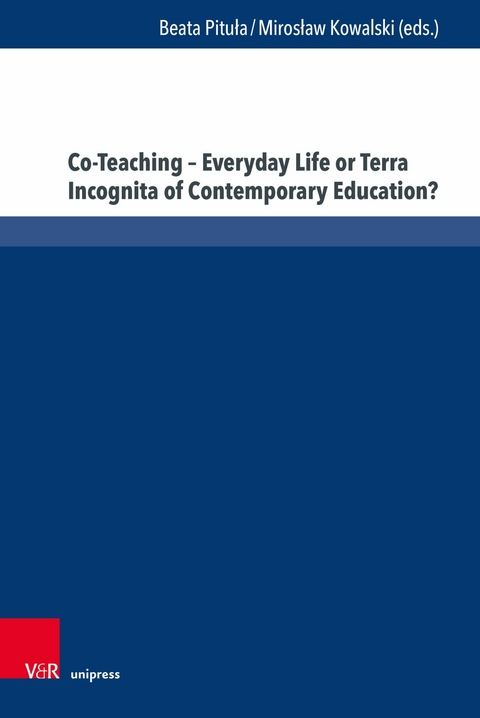
Co-Teaching - Everyday Life or Terra Incognita of Contemporary Education? (eBook)
296 Seiten
Vandenhoeck & Ruprecht Unipress (Verlag)
978-3-8470-1500-0 (ISBN)

Beata Pitu?a is Associate Professor at the Faculty of Mining, Safety Engineering and Industrial Automation of the Silesian University of Technology, Poland.
Beata Pituła is Associate Professor at the Faculty of Mining, Safety Engineering and Industrial Automation of the Silesian University of Technology, Poland.
Title Page 4
Copyright 5
Table of Contents 6
Body 10
Introduction 10
Part I: Teacher creator and implementer of co-teaching 14
Jolanta Szempruch: Teachers' communicative and interpretative competence as a basis for co-teaching 16
Co-teaching as a challenge for contemporary schools 17
Teacher competences 18
The place of interpretive and communicative competences in the structure of teacher competences 21
Development of interpretive and communicative competences in the process of co-teaching 25
References 27
Jolanta Konieczny: Reflective Practitioner Attitude as a Basis for Teachers' Cooperation 30
Introduction 30
Reflective Practitioner 31
Teaching in Cooperation from the Perspective of Cognitive Neuroscience 34
Conclusion 37
References 38
Inetta Nowosad: The potential to learn from each other in the professional development of teachers. An example of Professional Learning Communities (PLC) in Singapore 42
Initiatives preceding the introduction of PLCs 43
Singapore PLC model 46
Discussion and conclusions 48
References 50
Markéta —vamberk —auerová: Co-teaching and other pedagogical approaches to the prevention of burnout syndrom of beginning teachers 54
Introduction 54
Definition of Co-teaching 55
Models of co-teaching implementation in practice 56
Methods of burnout prevention used in co-teaching 58
Balint groups 58
Case studies seminars 60
Self-monitoring 60
Self-reflective diary 61
SWOT analyses 61
Coaching 62
Self-reflective inventory 63
Example of using self-reflexive inventory 63
Self-reflexive conversation 64
Professional portfolio 65
Conclusion 67
References 67
Part II: Co-teaching in the educational practice of schools 70
Zenon Gajdzica: Spatial models in co-teaching versus educational theories – the case of inclusive education 72
Introduction 72
Spatial arrangements in co-teaching 73
Spatial arrangements in co-teaching and the didactic concept 77
Conclusion 79
References 79
Urszula Szu?cik: Co-teaching and art education 82
Introduction 82
Reflection on education 84
Art education and co-teaching 86
Conclusion 89
References 89
Zdzis?awa Janiszewska-Nie?cioruk: Elasticity and diversity of co-teaching forms as crucial conditions for the effectiveness of inclusive education of students with disabilities 92
Introduction 93
Teacher cooperation – a key factor for the effectiveness of inclusive education for pupils with disabilities 95
Disadvantages hindering the inclusion of pupils with disabilities in inclusive education 100
Final thoughts 104
References 105
Anna Potyka / Anna Suchon: Using Team Teaching in Work with Children with Special Educational Needs 108
Introduction 108
The Place of the “Other” in the Society 109
Educational Concepts Regarding Upbringing, Education and Teaching of Children with Special Educational Needs 111
Co-Teaching (Collaborative Teaching) and Relations with Inclusive Education 114
Example of Application of Team Teaching in Work with Children with SEN 119
Task 1 120
Task 6 121
Summary 122
References 123
Legislation 124
Zuzana Svobodová / Jaroslav Vete�ka / Danu�e Dvo?áková: Virtual co-teaching through the eyes of primary and secondary school students 126
Introduction 126
Methodology 133
Results 135
Motivation and Activation 136
Added value 137
Attention and tempo 138
Suitable subjects for virtual co-teaching 138
Barriers to virtual co-teaching 139
Discussion 140
Conclusion 141
References 142
Acknowledgement 144
Martin Kursch / Roman Li�ka / Michaela Tureckiová / Jaroslav K?íž: Efficiency of virtual co-teaching 146
Introduction and theoretical framework 146
Methodology 151
Results 153
Discussion and conclusions 157
References 158
Acknowledgement 160
Part III: Examples of co-teaching in academic education 162
Barbara Grzyb: Project-Based Learning – Synergy of Coaching and Co-teaching 164
Introduction 164
New perception of student education with project-based learning 165
Coaching and co-teaching in performance of tasks by the project-based learning method 168
Project-based learning, coaching and co-teaching in education 171
Summary 173
References 175
Katarzyna Tobór-Osadnik / Anna Bluszcz: Modern trends in higher education – experiences in the implementation of an international didactic project Erasmus+ CBHE (Capacity Building in Higher Education) 178
Introduction 178
Project characteristic 179
New directions of higher education 181
Innovative teaching methodology 184
Mentoring and tutoring 184
Project Based Learning 187
Design thinking 189
Knowledge platform 191
Dual study 193
Summary 195
References 195
Ma?gorzata Wyganowska: Implementation of co-teaching in Project Based Learning at a technical university 198
Introduction 198
Project Based Learning – basic information 199
Co-teaching-implementation in Project Based Learning 201
Success of the Project Based Learning method 202
Description of research methodology 203
Summary 207
References 207
Anna Waligóra: Co-Teaching in the Process of Student Education – Innovative Challenge and Inspiring Practice Using the Example of Model Application in the Proprietary Course Held at the Silesian University of Technology 210
Cooperation of Teachers – Lecturers in the Process of Students' Education 210
Benefits from Implementation of Co-Teaching 213
Co-Teaching Using the Example of Model Implementation in the Proprietary Course Held at the Silesian University of Technology 215
Summary 219
References 220
Ida Skubis: The importance of co-teaching in teaching German varieties 224
Introduction 224
Regional diversity in Austria 226
Standard language in Austria 227
Regional diversity in Switzerland 228
Standard language in Switzerland 229
Sociolinguistic situation in Austria 229
Sociolinguistic situation in Switzerland 230
Co-teaching of German varieties and dialects 232
Own research – German language learners and their knowledge of German varieties and dialects without co-teaching classes 233
Conclusions 235
Summary 235
References 236
Part IV: Reflections on co-teaching 238
Beata Ecler-Noco?: The category of participation in the context of the phenomenon of cooperation in co-teaching 240
Introduction 240
Category of participation according to Karol Wojty?a as a dimension of analysing cooperation in co-teaching 241
Dialogue, solidarity, and opposition as attitudes developing cooperation in co-teaching 243
Conformity and evasion – impairment of the attitude of participation 245
Final reflection 246
References 247
Jolanta Karbowniczek: The connective paradigm a new challenge for early childhood education teachers from a community relations perspective 248
Introduction 248
Connectivism as a changeable and inclusive paradigm in the teaching-learning process 250
The teacher's organisation of the community dimension of the educational environment as a variable and diverse virtual space 253
The connective teacher model in community work with children – terms of reference 256
Summary 265
References 266
Miros?aw Kowalski / ?ukasz Alba?ski: Handbags: Another Look at Everyday Education of Daily Routines and Selves 268
Method 270
Mundane spaces of everyday handbags 270
Territory of possession 273
Family, work and social roles 276
Childhood, playtime and memories 278
Conclusion 280
References 280
Beata Pitu?a: Education in Relation – Is Co-Teaching a Chance for a New School/Academy? 282
Introduction 282
Co-Teaching – Its “Faces” and Results 285
Therefore, is Co-Teaching a Change for New Education? 290
References 292
Autors list 294
| Erscheint lt. Verlag | 14.11.2022 |
|---|---|
| Zusatzinfo | with 22 figures |
| Verlagsort | Göttingen |
| Sprache | englisch |
| Themenwelt | Sozialwissenschaften ► Pädagogik ► Schulpädagogik / Grundschule |
| Schlagworte | 21st Century • Dawid Juraszek • Didactics • Education • Educational practice • Pedagogy • school • Teacher • University |
| ISBN-10 | 3-8470-1500-1 / 3847015001 |
| ISBN-13 | 978-3-8470-1500-0 / 9783847015000 |
| Informationen gemäß Produktsicherheitsverordnung (GPSR) | |
| Haben Sie eine Frage zum Produkt? |
 PDF (Ohne DRM)
Digital Rights Management: ohne DRM
Dieses eBook enthält kein DRM oder Kopierschutz. Eine Weitergabe an Dritte ist jedoch rechtlich nicht zulässig, weil Sie beim Kauf nur die Rechte an der persönlichen Nutzung erwerben.
Dateiformat: PDF (Portable Document Format)
Mit einem festen Seitenlayout eignet sich die PDF besonders für Fachbücher mit Spalten, Tabellen und Abbildungen. Eine PDF kann auf fast allen Geräten angezeigt werden, ist aber für kleine Displays (Smartphone, eReader) nur eingeschränkt geeignet.
Systemvoraussetzungen:
PC/Mac: Mit einem PC oder Mac können Sie dieses eBook lesen. Sie benötigen dafür einen PDF-Viewer - z.B. den Adobe Reader oder Adobe Digital Editions.
eReader: Dieses eBook kann mit (fast) allen eBook-Readern gelesen werden. Mit dem amazon-Kindle ist es aber nicht kompatibel.
Smartphone/Tablet: Egal ob Apple oder Android, dieses eBook können Sie lesen. Sie benötigen dafür einen PDF-Viewer - z.B. die kostenlose Adobe Digital Editions-App.
Buying eBooks from abroad
For tax law reasons we can sell eBooks just within Germany and Switzerland. Regrettably we cannot fulfill eBook-orders from other countries.
aus dem Bereich