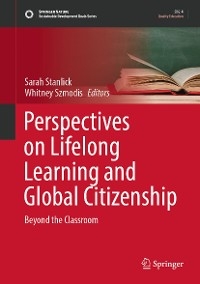
Perspectives on Lifelong Learning and Global Citizenship (eBook)
XVIII, 195 Seiten
Springer International Publishing (Verlag)
978-3-031-00974-7 (ISBN)
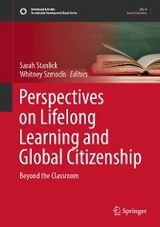
This book lays the groundwork for the future of global citizenship, and it discusses where we are now, where to go from here, and how all of this fits into a lifelong learning context. It incorporates case studies, meta-narratives, and empirical studies to support cosmopolitanism through a lifelong learning lens and is a must read for educators, activists, non-governmental organizations, civil society, and community organizations.
The framing for this book is with the United Nations Sustainable Development Goal 4 in mind: ensuring inclusive and equitable quality education and promoting lifelong learning opportunities for all, with the intent that all learners will acquire the knowledge, skills, and attitudes necessary to promote 'sustainable lifestyles, human rights, gender equality, promotion of a culture of peace and non-violence, global citizenship and appreciation of cultural diversity and of culture's contribution to sustainable development' (UN Sustainable Development Goal, target 4.7). It is through this lens that this book showcases the work of researchers, practitioners, civil society, and thought leaders in global citizenship for lifelong learning.
While this tension between nationalism and cosmopolitanism exists, the wheels of globalization still turn and shape our local, national, and global connections. Through this exploration, this book lifts up examples of global citizenship education done well, across the age spectrum, and in a variety of contexts. The binding factor is the core values, ethics, and moral structure of a world in collaboration toward its larger human and ecological thriving. It unpacks complex topics such as ethical and cultural relativism, accountability and responsibility in a global world, decolonial education and unmaking ideas of 'development', and ethical models for community-based global learning and engagement. What voices are missing in the discussion of global learning and global citizenship education?
Foreword 6
References 13
Contents 15
Contributors 17
1 Introduction 19
Abstract 19
References 25
2 The Educator in Global Citizenship Education: Centering Context and Enabling Being 26
Abstract 26
2.1 Introduction 26
2.2 Locating Ourselves: Making the (Often) Invisible, Visible 27
2.3 Introducing Ourselves as Authors and Educators 28
2.4 Identity Work for GCE Educators 29
2.5 Part One: Why Context Matters for Global Citizenship Education 29
2.5.1 Contesting Global Citizenship 29
2.6 Positioning Global Citizenship Education 31
2.7 Contextualising the UCT Global Citizenship Programme (GCP) 32
2.8 Part Two: Global Citizenship Education in Practice: Why Context Matters 34
2.8.1 2010 To Mid-2015: Genesis of UCT GCP 35
2.8.2 Mid-2015 to Mid-2019: Rupture and Maturation of UCT GCP 36
2.8.3 Mid-2019 to Present: A New Team and Covid-19—A Point of Reflection on Practice 37
2.9 Relational Engagement and Care in the ‘Emergency Remote Teaching’ Context 37
2.10 Creativity and New Opportunities for Thinking About GCE 38
2.11 Part Three: The GCE Educator—Pedagogy, Practice, and Purpose 39
2.11.1 Pathways to Entering the GCE Space—Our Individual Journeys 39
2.12 Our Pedagogical Orientations and Practices—Positioning Ourselves as Educators 41
2.13 Part Four: Enabling Being—A Reimagined Future for GCE Pedagogy and Practice 42
2.13.1 Situating and Enabling Being in GCE 43
2.13.2 Implications for GCE Educators 44
2.14 Conclusion: Envisioning a Future for Global Citizenship Education—A Paradigm Shift and Questioning Purpose 46
References 48
3 Beyond Borders: Employing Empathic Global Citizenship as a Framework for Enhancing Critical Community Engagement 51
Abstract 51
3.1 Introduction 52
3.2 Higher Education Institutions as Drivers of Global Citizenship 53
3.3 Empathic Global Citizenship: A Theoretical and Practical Framework for Enhancing Critical Community Engagement 54
3.3.1 The Empathy Component 56
3.3.2 The Global Citizenship Component 57
3.4 Leveraging Place, Context, and Resources 60
3.4.1 The Borderland Institution with a 21st Century Demographic 60
3.4.2 Integrative Community Engagement 62
3.4.3 Vignettes of Engagement in Action 63
3.5 Conclusion and Future Directions 68
References 69
4 Creating a Fourth Space for Social Impact Collaborations Across Boundaries: Active Project-Based Learning and Internships for GC Education 72
Abstract 72
4.1 Introduction 73
4.1.1 Background 73
4.1.1.1 Service Learning and Wise Practice in WIL 73
4.1.1.2 Co-creation and Ethical Decision-Making 74
4.1.1.3 Structuring Experiences for Impact 74
4.2 Creating a Hybridized Fourth Space for the Fourth Industrial Revolution 74
4.3 Methodology 75
4.4 Data Collection 76
4.4.1 Experience Design 76
4.4.2 Designing Inclusive Online Service Learning Experiences with Impact 76
4.4.3 Designing for Mental Health and Wellbeing: A Safe Online Space 77
4.4.4 Social Impact Project Innovative Solution Design Sprint Framework 77
4.5 Results 78
4.5.1 Survey Results 78
4.5.2 Qualitative Data 79
4.5.3 Qualitative Information: Observer Participant Intern Feedback 79
4.6 Findings and Discussion 81
4.6.2 Findings: Stakeholder Collaboration 83
4.7 Implications and Recommendations 84
4.7.1 Roles and Responsibilities 85
4.7.2 Technology Use 85
4.7.3 Communication 85
4.7.4 Impact on Sprint Team Facilitators 85
4.7.5 Cultivating Industry and Community Partners 86
4.7.6 Recommendations for Learners 86
4.8 Future Directions: Improving and Extending the Model 87
4.9 Conclusion 88
Appendix/Definitions 88
References 89
5 Women’s Human Rights Teaching, Learning and Advocacy Resource: Integrating Global Citizenship Frameworks into Feminist Curricula 92
Abstract 92
5.1 Introduction 93
5.1.1 The Beijing Declaration and Platform for Action 93
5.1.2 New Approaches at the UN 93
5.2 Background 94
5.2.1 The Women’s Human Rights Teaching, Learning, and Advocacy Resource (WHR TLAR) 95
5.3 Global Citizenship 95
5.3.1 Grassroots Advocacy and Global Citizenship Education 97
5.4 Methodology 97
5.4.1 Informal, Anti-colonial Approaches to Global Citizenship Education 97
5.4.2 Participants and Recruitment 98
5.5 The Link Between Global Citizenship and the WHR TLAR 99
5.6 The Current and Future Impact of the WHR TLAR 100
5.6.1 Recommendations 101
5.6.2 What Is Next for the WHR TLAR? 101
5.7 Conclusion 102
References 102
6 A Feminist Socio-Ecological Framework for Transforming Early Learning Programs in Low- and Middle-Income Countries 105
Abstract 105
6.1 Introduction 106
6.1.1 Early Childhood Policy and Programs in International Education Development 107
6.1.2 Gender Socialization in Early Childhood Programming 108
6.2 Theoretical Frameworks 109
6.2.1 Poststructural Feminism 109
6.2.2 Bronfenbrenner and Socio-Ecological Systems 109
6.3 Methodology 110
6.3.1 Policy Documents 110
6.3.2 Analysis 111
6.4 Results 113
6.4.1 Summary Data 113
6.5 Analytical Findings 113
6.6 Holistic Feminist Evaluation: Gaps and Onus 113
6.6.1 Interrogating Multi-level and Interactive Silences 114
6.6.2 Emerging Methodologies and Instruments 115
6.7 Discussion 116
6.7.1 Strengths of the FSE framework 116
6.7.2 Weaknesses of the FSE framework 116
References 117
7 Exploring Social Cognitive Outcomes of a Multiphase Mentoring Program for Girls in Armenia 121
Abstract 121
7.1 Introduction 121
7.1.1 About Nor Luyce 123
7.2 The Nor Luyce Program 123
7.2.1 Introduction to Global Citizenship Connection 124
7.2.2 Alignment with Sustainable Development Goals and Global Citizenship 125
7.2.3 Framing Global Citizenship and Self-efficacy, Interests, and Choice Goals 127
7.3 Literature Review 128
7.3.1 Mentoring as a Construct 128
7.3.2 Nor Luyce Mentoring Structure 128
7.3.3 Social Cognitive Theory 129
7.3.4 Social Cognitive Career Theory 129
7.3.5 Self-efficacy 130
7.3.6 Interests 131
7.3.7 Choice Goals 131
7.3.8 The Nor Luyce Framework 132
7.4 Methodology 133
7.4.1 Participants 133
7.4.2 Self-efficacy 134
7.4.3 Interests 134
7.4.4 Choice Goals 135
7.5 Data Analysis 136
7.5.1 Results 136
7.6 Discussion 141
7.6.1 Self-efficacy, Career Interests, Career Goals 141
7.6.2 Self-efficacy, Academic Interests, Academic Goals 142
7.7 Conclusion 143
References 144
8 The Nexus of Global Citizenship and Community-Controlled Health 146
Abstract 146
8.1 Introduction 146
8.1.1 Global Public Health and the Sustainable Development Goals 147
8.1.2 GC in the Context of NCDs 149
8.1.3 NGOs Putting GC Values into Practice 149
8.2 Literature Review 153
8.3 CLAN’s Five Pillars in Practice: Congenital Adrenal Hyperplasia in Pakistan 156
8.4 Discussion and Next Steps 159
8.5 Conclusion 160
References 160
9 Growing, Learning, Sharing, and Healing Together: Home Garden Networks as a Learning City and Movement to Global Citizenship and Life-Long Learning 162
Abstract 162
9.1 Food Systems: Critical Issues 162
9.2 Personal Reflections 163
9.2.1 The Jasmine Flower Garden 163
9.2.2 The Mekong River Garden 164
9.3 The Home Garden Network Program 164
9.4 The HGN Framework: A Lens for Imagination and Transformation 165
9.5 Food Systems Impact: Health 168
9.6 Food Systems Impact: Environment 169
9.7 Food Systems Impact: Economics 169
9.8 Conclusions 170
References 171
10 A Civics of Interdependence: Advancing Global Solidarity Through Communities of Inquiry and Action 173
Abstract 173
10.1 Introduction 173
10.2 Case Studies 175
10.2.1 Case #1: College Unbound by Nora Pillard Reynolds 175
10.2.2 Spring 2021 Course 175
10.2.2.1 Context 175
10.2.2.2 Toolkit Application 176
10.2.2.3 What Worked 177
10.2.3 Case #2—Haverford College 177
10.2.4 Fall 2020 and Spring 2021 Course 177
10.2.4.1 Context 177
10.2.4.2 Toolkit Application 178
10.2.4.3 What Worked 178
10.2.5 Summer 2020 Center for Peace and Global Citizenship (CPGC) Internship Orientation— 179
10.2.5.1 Context 179
10.2.5.2 Toolkit Application 179
10.2.5.3 What Worked 179
10.2.5.4 Moving Forward 179
10.2.6 Case #3—Dickinson College by Samantha Brandauer 180
10.2.6.1 Context 180
10.2.7 Summer 2020 Course 180
10.2.7.1 Toolkit Application 180
10.2.7.2 What Worked 180
10.2.8 Dickinson in Washington, DC Semester Program 181
10.2.8.1 Toolkit Application 181
10.2.8.2 What Worked 181
10.2.9 Spring 2021 Globally Integrated Semester (GIS) 4-Workshop Series 182
10.2.9.1 Toolkit Application 182
10.2.9.2 What Worked 182
10.2.10 Moving Forward 183
10.2.11 Case Study #4—Gateway Community College by Erin Sabato 184
10.2.12.1 Context 184
10.2.12.2 Toolkit Application 184
10.2.12.3 What Worked 185
10.2.13 Case Study #5—Quinnipiac University by Erin Sabato 186
10.2.14.1 Context 186
10.2.14.2 Toolkit Application 187
10.2.14.3 What Worked 188
10.3 Key Insights 188
10.4 Next Steps 190
References 190
11 Active Experimentation, Embodiment, and High-Impact Practices in GCE: Diving in and Letting Go 193
Abstract 193
11.1 Introduction 193
11.2 Background 194
11.2.1 GCE as a Multifaceted Experience 194
11.2.2 High-Impact Practices 194
11.2.3 Global Citizenship as an Active Practice 195
11.2.4 Play, Embodiment, and Education 195
11.2.5 Empathic Perspective-Taking 196
11.2.6 Students as Colleagues/Importance of Co-creation 196
11.3 Vignettes 197
11.3.1 Vignette #1: Role-Playing and Simulation for GSL Professional Development 197
11.3.2 Vignette #2: Exploring Identity and Self Through Theatre Games in Peru 198
11.3.3 Vignette #3: Nurturing Student-Led Reflective Circles 199
11.3.4 Vignette #4: Conversation Circle with the UN 201
11.4 Discussion 202
11.4.1 Implications for Instructors 204
11.4.2 Implications for Learners 204
11.4.3 Implications for Administrators 205
11.4.4 Questions for Consideration 205
11.5 Conclusion 206
References 206
| Erscheint lt. Verlag | 6.9.2022 |
|---|---|
| Reihe/Serie | Sustainable Development Goals Series | Sustainable Development Goals Series |
| Zusatzinfo | XVIII, 195 p. 28 illus., 19 illus. in color. |
| Sprache | englisch |
| Themenwelt | Sozialwissenschaften ► Pädagogik ► Erwachsenenbildung |
| Schlagworte | Accountability and responsibility in a global world • adult learning • Community Education • Decolonial Education • Ethical and cultural relativism • Global Citizenship • global citizenship education • Global community-based learning • Global grand challenges • Globalization and education • Global Learning • Lifelong Learning and Global Citizenship • Quality education for all • SDG 4 • United Nations Sustainable Development Goals |
| ISBN-10 | 3-031-00974-6 / 3031009746 |
| ISBN-13 | 978-3-031-00974-7 / 9783031009747 |
| Informationen gemäß Produktsicherheitsverordnung (GPSR) | |
| Haben Sie eine Frage zum Produkt? |
 PDF (Wasserzeichen)
DRM: Digitales Wasserzeichen
Dieses eBook enthält ein digitales Wasserzeichen und ist damit für Sie personalisiert. Bei einer missbräuchlichen Weitergabe des eBooks an Dritte ist eine Rückverfolgung an die Quelle möglich.
Dateiformat: PDF (Portable Document Format)
Mit einem festen Seitenlayout eignet sich die PDF besonders für Fachbücher mit Spalten, Tabellen und Abbildungen. Eine PDF kann auf fast allen Geräten angezeigt werden, ist aber für kleine Displays (Smartphone, eReader) nur eingeschränkt geeignet.
Systemvoraussetzungen:
PC/Mac: Mit einem PC oder Mac können Sie dieses eBook lesen. Sie benötigen dafür einen PDF-Viewer - z.B. den Adobe Reader oder Adobe Digital Editions.
eReader: Dieses eBook kann mit (fast) allen eBook-Readern gelesen werden. Mit dem amazon-Kindle ist es aber nicht kompatibel.
Smartphone/Tablet: Egal ob Apple oder Android, dieses eBook können Sie lesen. Sie benötigen dafür einen PDF-Viewer - z.B. die kostenlose Adobe Digital Editions-App.
Buying eBooks from abroad
For tax law reasons we can sell eBooks just within Germany and Switzerland. Regrettably we cannot fulfill eBook-orders from other countries.
aus dem Bereich