


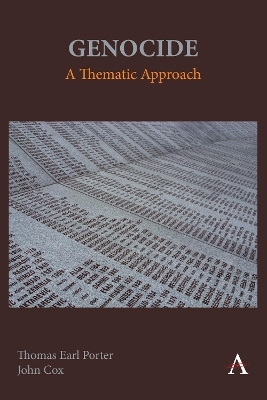
Genocide: A Thematic Approach
Seiten
2025
Anthem Press (Verlag)
978-1-83998-731-1 (ISBN)
Anthem Press (Verlag)
978-1-83998-731-1 (ISBN)
The purpose of this volume is not simply to compile yet another wearying chronicle of the horrors that have been committed by our fellow human beings. It is intended to give the needed context to understand why such violence has been perpetrated in the past and why it continues to occur so frequently in the contemporary world.
The purpose of this volume is not simply to compile yet another wearying chronicle of the horrors that have been committed by our fellow human beings. Most students who register for a course on Genocide assume that it will focus, perhaps exclusively, on the Holocaust—the case with which they are most familiar. Many of them have read Elie Wiesel’s eloquent masterpiece Night in secondary school, and some may have read The Diary of Anne Frank. A few students might even know that a genocide occurred in Rwanda or Darfur. Like most people, however, they equate genocide simply with mass killing, and assume that genocide must by definition entail millions of deaths. Raphael Lemkin, who coined the word “genocide”—meaning literally “to kill a people”— originally defined it “a colonial crime of destroying the national patterns of the oppressed and imposing the national patterns of the oppressors.” This was a process, Lemkin said, deliberately intending to destroy a people’s culture that could sometimes but not necessarily always result in mass murder. Students need to know that after World War II the great powers undermined and co-opted the process of writing the1948 Genocide Convention at the UN—because these nations did not want their own colonial crimes, oppression of minorities, and destructions of cultures to be included in the definition. Instead, they simply used the Holocaust as a template and succeeded in distorting what Lemkin originally meant by “genocide”—the murder of a people by destroying their social and cultural connections.
The purpose of this volume is not simply to compile yet another wearying chronicle of the horrors that have been committed by our fellow human beings. Most students who register for a course on Genocide assume that it will focus, perhaps exclusively, on the Holocaust—the case with which they are most familiar. Many of them have read Elie Wiesel’s eloquent masterpiece Night in secondary school, and some may have read The Diary of Anne Frank. A few students might even know that a genocide occurred in Rwanda or Darfur. Like most people, however, they equate genocide simply with mass killing, and assume that genocide must by definition entail millions of deaths. Raphael Lemkin, who coined the word “genocide”—meaning literally “to kill a people”— originally defined it “a colonial crime of destroying the national patterns of the oppressed and imposing the national patterns of the oppressors.” This was a process, Lemkin said, deliberately intending to destroy a people’s culture that could sometimes but not necessarily always result in mass murder. Students need to know that after World War II the great powers undermined and co-opted the process of writing the1948 Genocide Convention at the UN—because these nations did not want their own colonial crimes, oppression of minorities, and destructions of cultures to be included in the definition. Instead, they simply used the Holocaust as a template and succeeded in distorting what Lemkin originally meant by “genocide”—the murder of a people by destroying their social and cultural connections.
John Cox is Associate Professor of History and Global Studies at the University of North Carolina Charlotte. Thomas Earl Porter is Professor of Russian and Modern European History at North Carolina A&T State University, Greensboro, NC.
Preface, Acknowledgments, Foreword, Introduction, Chapter One - What Should Be the Definition of Genocide?, Chapter Two - “Ethnic Cleansing” Is Genocide, Too, Chapter Three - Racism and Genocide, Chapter Four - Sexual Violence as Genocide, Chapter Five - Genocides of Political Groups, Chapter Six - Genocides of Social Groups, Chapter Seven - Empire and State-Building Through Genocide, Conclusion, Bibliography, Index
| Erscheinungsdatum | 11.03.2025 |
|---|---|
| Verlagsort | London |
| Sprache | englisch |
| Maße | 153 x 229 mm |
| Gewicht | 515 g |
| Themenwelt | Geisteswissenschaften ► Geschichte |
| Sozialwissenschaften ► Politik / Verwaltung | |
| Sozialwissenschaften ► Soziologie | |
| ISBN-10 | 1-83998-731-6 / 1839987316 |
| ISBN-13 | 978-1-83998-731-1 / 9781839987311 |
| Zustand | Neuware |
| Informationen gemäß Produktsicherheitsverordnung (GPSR) | |
| Haben Sie eine Frage zum Produkt? |
Mehr entdecken
aus dem Bereich



aus dem Bereich
eine kleine Soziologie des Heavy Metal
Buch | Softcover (2023)
Kohlhammer (Verlag)
CHF 29,90


