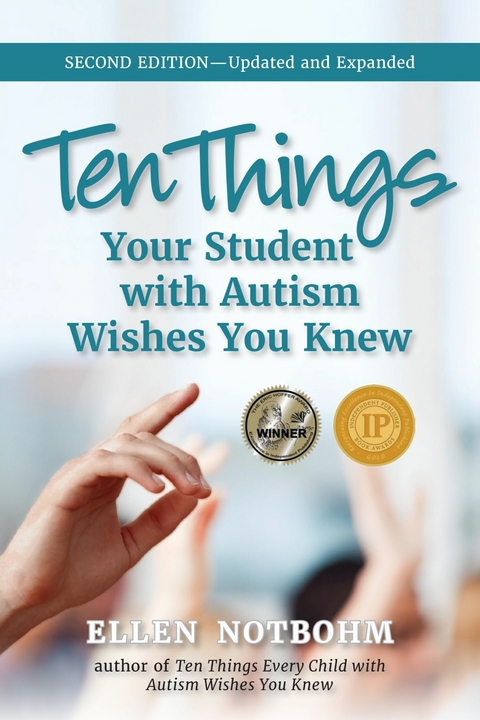
Ten Things Your Student with Autism Wishes You Knew (eBook)
109 Seiten
Future Horizons (Verlag)
978-1-957984-02-5 (ISBN)
Winner of the IPBA Gold Medal for Nonfiction Series (with Ten Things Every Child with Autism Wishes You Knew) and Winner of the Eric Hoffer Book Award for Reference/Education.
In this exciting companion to the beloved classic Ten Things Your Student with Autism Wishes You Knew, the unique perspective of an autistic child's voice describes for teachers, in the classroom and in the larger community, how to understand thinking and processing patterns common in autism, how to shape an environment conducive to their learning style, and how to communicate with autistic learners of all ages in functional, meaningful ways.
It's the guidebook every educator and family member, worldwide, needs to create effective and inclusive settings where child and adult are both teachers and learners. This vibrantly updated and expanded edition includes an imaginative, all-new guide adaptable for group discussion, self-reflection, or self-expression, an afterword from the author's autistic son, and added perspective from autistic adults about their experiences in education. Continuously in print for 16 years, and translated into multiple languages, Ten Things Your Student with Autism Wishes You Knew brings fresh perspective to a new generation of educators and autistic learners.
Chapter One
Learning Is Circular
We’re all both teachers and students.
The notion that learning is circular is neither new nor unique. Many of Bryce’s teachers told me they learned a great deal from him and that they learn continually from all the children they teach. Th is seems not only natural to me, but exhilarating.
Yet I remember one mom, in the early days after my son’s diagnosis, who bridled at these kinds of remarks. “I’m so tired of hearing teachers say they’ve learned so much from my kid! I want them to teach him, not learn from him.” Reading between her lines, I heard an anxious urgency, the vastness of all she felt her son needed to learn colliding with the finite limitations of a six-hour school day. For parents and teachers alike (and the many who are both), we’ve all been frequent visitors to that impatient place, but we need to be ever-aware that it’s counterproductive. In the classroom, in the home, and in the community, parents and teachers must, to the greatest extent we can, take advantage of learning opportunities as they present themselves. Passing up those opportunities in the name of saving time will eventually only slow the teaching process. How could it be otherwise?
Because I’ve learned side by side with so many outstanding teachers over the years, I’ve lived the power of circular learning in action, where teaching and learning energies zoom the circuits back and forth between all individuals of all ages and all stations in education and in life. It started right at the beginning, when Bryce entered preschool. The very gifted “Teacher Christine” Hunt personified circular learning. Before our year together was out, she was insisting that I write a book. Then she romped on me for seven years until I did.
No less a teacher was Veda Nomura, the occupational therapist who was part of Bryce’s team of teachers. Veda patiently guided not just Bryce but me as well to understanding the devilishly complicated landscape of sensory integration. It was one of the toughest propositions I ever confronted in my life. When I finally succeeded, I had Veda on a pedestal so high as to induce vertigo.
So I was particularly smitten with Veda’s contribution to a wall display in Teacher Christine’s classroom. Each child and adult had contributed a photo of themselves, with a caption that filled in the phrase “I am learning to .” Bryce wrote that he was learning to ride a training-wheel bike. Veda wrote: “I’m learning to raise teenagers.” Her statement brought home to me that no matter how knowledgeable and capable any one of us may seem, we’re all still learning, still searching for the best way to handle new challenges.
Many books, articles, and posts about autism refer to its “mystery,” but I don’t like that word. I’m not interested in whodunit. I want to know what comes next. And because I want to know what comes next, I don’t like the implication of the word “mystery” if it suggests that “unknown” is synonymous with “unknowable.” Just as a good mystery dissolves in the hands of a good detective, autism is knowable. We start by knowing that children with autism aren’t a monolithic population. No two are exactly alike, and no single approach is a sure thing. Achieving success with an autistic child is often a matter of discovering what doesn’t work as much as discovering what does, and either discovery may come to light with something as simple (and yet complex) as reframing or juxtapositioning our questions. It can be exhausting and exasperating, but never does it constitute failure. “Results!” Thomas Edison said. “Why, man, I have gotten a lot of results. I know several thousand things that won’t work.” In this same frame of mind, many parents and teachers, stymied by an autistic child’s inability to express what they need but determined to find an inroad, finally made that successful connection with the child by asking the usual what-do-you-want? question in reverse— what do you not want, what do you not like, what should I not do? Reversing the perspective reversed the mystery.
German philosopher Martin Heidegger tells us, “Teaching is more difficult than learning because what teaching calls for is this: to let learn.” That’s an explosive, double-barreled concept, but it’s the absolute embodiment of circular learning. As adults, we bear the burden. We must relinquish all our conceits and presumptions to let ourselves learn what we need to know to be able to teach an autistic child, whose thoughts originate in a thinking and processing architecture and frame of reference distinctly dissimilar to our own. Venturing into a place where we don’t know the lay of the land and don’t have all the answers can be intimidating, no question. “If, as a teacher you find that an uncomfortable place to be, I get it,” says your autistic student. “That’s how I feel quite a lot of the time, when so often I don’t know the answers.” This holds true for professionals and parents. But it’s not a reason to not go there or not set the example of exploring our abilities and boundaries. A friend of ours once left a comfortable teaching job at a so-called nice school to take a job across town as assistant principal at a so-called tough school. When we asked him why, he said he considered it “an acceptable challenge.” Discomfort can be a good thing when we embrace it as impetus to squirm to the next level of growth, at any age.
And then, when we have let ourselves learn well, we need to let our student learn. By its nature, this cannot be a pain-free process for us or for the child. The best among us will question whether we got it right, whether or what we could have done better. Did we hurt the child, who already struggles so because of their autism, unintentionally and/or needlessly?
I can still scarcely bear to think about all the mistakes I made with my son during those early stages of learning—from him, not from books—about his autism. But for all the times I berated myself mercilessly, there was a teacher on the other end of the phone saying, “This happens to all of us, Ellen. As parents and as teachers. He will forgive you if you forgive yourself.”
Bryce and I both learned to push the boundaries of our resilience, and we learned from each other. Freely admitting my mistakes to him was a powerful learning tool. No one’s infallible, and increasingly it struck me as odd that we require children to respect authority without considering that they might respect us more if we were honest about our humanity, to stop seeing that respect as an entitlement, but to require ourselves to earn our child’s respect, every day. I never hesitated (and still don’t) to apologize to my children when I was wrong. Whether it’s because I misjudged, was careless, didn’t have the right information, or simply should have known better, it was and still is more meaningful for them to pull them into the circle of life-learning where we can approach mistakes with curiosity rather than self-flagellation and say, “Whoa! That didn’t work. I wonder what we could try next?” or “We learned something from that, didn’t we? We’ll know better what to do next time.”
Our autistic student relies on us, the adults in his life, to learn about him from each other, too. Reading through my mailbox can be poignant. Parents tell me how much they have to share with their child’s educators about his autism, if only the educators would listen and respect a parent’s wisdom born of experience. Educators lament parents who resist, reject, disbelieve, and deny their professional observations and suggestions, even those based on what they learn from experience with the child during the school day.
Circular learning
is striving to bring something out of every learner. That learner isn’t just the student; it’s you, and me, and everyone with whom they will interact.
Circular learning challenges us to lay aside our egos, preconceptions, and ingrained perspectives to become child-centered in our approach, to embrace the process as much as outcome, and to have the courage and confidence to step outside the lane lines, to willingly bump down a road less traveled. It challenges us to place less value on test scores and the top-down approach, and instead turn our efforts toward relationship-building, collaboration, and reigniting the thrill of exploration. Circular learning acknowledges that true teaching isn’t about putting information into the minds of our students; rather, it’s striving to bring something out of every learner. That learner isn’t just the student; it’s you, and me, and everyone with whom they will interact.
From Day One, I accepted that I had to be a full partner and fellow learner in Bryce’s education. I knew intuitively that my mission was to prepare him to live to the greatest degree possible as a capable, independent adult. And yet when a child is so young and the obstacles thrown up by autism seem so threatening, it’s only natural that we cling to lifeboats who come along in the form of wise and effective teachers. One such person for me was Nola Shirley, one of Bryce’s first paraeducators. More than one teacher referred to her as a miracle worker, and we’ll hear more about her secret of success later in the book. For now, we step into her circle of learning at the parent-as-learner stop.
Far from limiting herself to teaching only Bryce, she played a major role in teaching me, a parent, about independence too. She had seen Bryce through three years of early education before judging, reluctantly,...
| Erscheint lt. Verlag | 2.8.2022 |
|---|---|
| Reihe/Serie | 10 Things |
| Ten Things | Ten Things |
| Sprache | englisch |
| Themenwelt | Sachbuch/Ratgeber ► Gesundheit / Leben / Psychologie ► Familie / Erziehung |
| Schulbuch / Wörterbuch ► Lernhilfen | |
| Schulbuch / Wörterbuch ► Unterrichtsvorbereitung ► Förder- / Sonderschule | |
| Sozialwissenschaften ► Pädagogik | |
| Schlagworte | 1 in 68 • 504 • ASD • ASD Level • asperger’s • aspergers • Asperger Syndrome • aspie • Autism • autism and ADHD:autism • Autism Spectrum • Autistic Students • Children with Special Needs • child with autism • education autism • Ellen Notbhom • high functioning • high-functioning • Kanner's syndrome • Kanner syndrome • Life Skill • low functioning • low-functioning • neurodiversity • neurodiversity in the classroom • pdd-nos • Pervasive Developmental Disorder • pervasive development disorder • resource • Social Behaviors in the classroom • Social Relationships in the classroom • Social Skills • social thinking • social understanding • Special education • SPED • Student • Teacher • teacher tools autism • teaching autistic children • Teen • Therapist • therapy |
| ISBN-10 | 1-957984-02-3 / 1957984023 |
| ISBN-13 | 978-1-957984-02-5 / 9781957984025 |
| Informationen gemäß Produktsicherheitsverordnung (GPSR) | |
| Haben Sie eine Frage zum Produkt? |
 EPUB (Adobe DRM)
Kopierschutz: Adobe-DRM
Adobe-DRM ist ein Kopierschutz, der das eBook vor Mißbrauch schützen soll. Dabei wird das eBook bereits beim Download auf Ihre persönliche Adobe-ID autorisiert. Lesen können Sie das eBook dann nur auf den Geräten, welche ebenfalls auf Ihre Adobe-ID registriert sind.
Details zum Adobe-DRM
Dateiformat: EPUB (Electronic Publication)
EPUB ist ein offener Standard für eBooks und eignet sich besonders zur Darstellung von Belletristik und Sachbüchern. Der Fließtext wird dynamisch an die Display- und Schriftgröße angepasst. Auch für mobile Lesegeräte ist EPUB daher gut geeignet.
Systemvoraussetzungen:
PC/Mac: Mit einem PC oder Mac können Sie dieses eBook lesen. Sie benötigen eine
eReader: Dieses eBook kann mit (fast) allen eBook-Readern gelesen werden. Mit dem amazon-Kindle ist es aber nicht kompatibel.
Smartphone/Tablet: Egal ob Apple oder Android, dieses eBook können Sie lesen. Sie benötigen eine
Geräteliste und zusätzliche Hinweise
Buying eBooks from abroad
For tax law reasons we can sell eBooks just within Germany and Switzerland. Regrettably we cannot fulfill eBook-orders from other countries.
aus dem Bereich