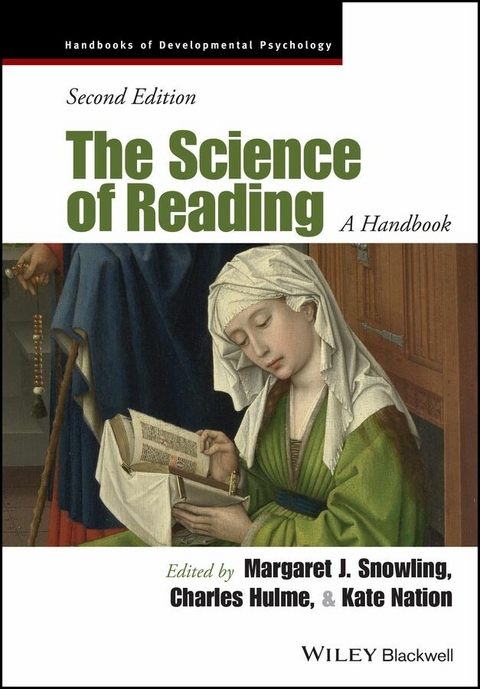
The Science of Reading (eBook)
John Wiley & Sons (Verlag)
978-1-119-70513-0 (ISBN)
Provides an overview of state-of-the-art research on the science of reading, revised and updated throughout
The Science of Reading presents the most recent advances in the study of reading and related skills. Bringing together contributions from a multidisciplinary team of experts, this comprehensive volume reviews theoretical approaches, stage models of reading, cross-linguistic studies of reading, reading instruction, the neurobiology of reading, and more. Divided into six parts, the book explores word recognition processes in skilled reading, learning to read and spell, reading comprehension and its development, reading and writing in different languages, developmental and acquired reading disorders, and the social, biological, and environmental factors of literacy.
The second edition of The Science of Reading is extensively revised to reflect contemporary theoretical insights and methodological advances. Two entirely new chapters on co-occurrence and complexity are accompanied by reviews of recent findings and discussion of future trends and research directions. Updated chapters cover the development of reading and language in preschools, the social correlates of reading, experimental research on sentence processing, learning to read in alphabetic orthographies, comorbidities that occur frequently with dyslexia, and other central topics.
- Demonstrates how different knowledge sources underpin reading processes using a wide range of methodologies
- Presents critical appraisals of theoretical and computational models of word recognition and evidence-based research on reading intervention
- Reviews evidence on skilled visual word recognition, the role of phonology, methods for identifying dyslexia, and the molecular genetics of reading and language
- Highlights the importance of language as a foundation for literacy and as a risk factor for developmental dyslexia and other reading disorders
- Discusses learning to read in different types of writing systems, with a language impairment, and in variations of the home literacy environment
- Describes the role of contemporary analytical tools such as dominance analysis and quantile regression in modelling the development of reading and comprehension
Part of the acclaimed Wiley Blackwell Handbooks of Developmental Psychology series, the second edition of The Science of Reading: A Handbook remains an invaluable resource for advanced students, researchers, and specialist educators looking for an up-to-date overview of the field.
Margaret J. Snowling is Professor of Psychology and President of St. John's College, University of Oxford. She is Fellow of the British Academy, Fellow of the Academy of Medical Sciences and Fellow of the Academy of Social Sciences. She is Past President of the Society for the Scientific Study of Reading and served on Sir Jim Rose's Expert Advisory Group on provision for Dyslexia. She was appointed CBE for services to science and the understanding of dyslexia in 2016.
Charles Hulme is Professor of Psychology and Education Research Fellow at Brasenose College, University of Oxford. He is Fellow of the British Academy, Fellow of the Academy of Social Sciences, and a Fellow of Academia Europaea. He is an expert on reading, language, and memory processes and their development. He received the Marion Welchman International Award for Contributions to the study of Dyslexia from the British Dyslexia Association in 2019.
Kate Nation is Professor of Experimental Psychology at the University of Oxford and a Fellow of St. John's College. She is a Fellow of the Academy of Social Sciences. Her research concerned with language processing has been recognized by the British Psychological Society and the Experimental Psychology Society. She received the Celebrating Impact Prize from the Economic and Social Research Council in 2020.
Provides an overview of state-of-the-art research on the science of reading, revised and updated throughout The Science of Reading presents the most recent advances in the study of reading and related skills. Bringing together contributions from a multidisciplinary team of experts, this comprehensive volume reviews theoretical approaches, stage models of reading, cross-linguistic studies of reading, reading instruction, the neurobiology of reading, and more. Divided into six parts, the book explores word recognition processes in skilled reading, learning to read and spell, reading comprehension and its development, reading and writing in different languages, developmental and acquired reading disorders, and the social, biological, and environmental factors of literacy. The second edition of The Science of Reading is extensively revised to reflect contemporary theoretical insights and methodological advances. Two entirely new chapters on co-occurrence and complexity are accompanied by reviews of recent findings and discussion of future trends and research directions. Updated chapters cover the development of reading and language in preschools, the social correlates of reading, experimental research on sentence processing, learning to read in alphabetic orthographies, comorbidities that occur frequently with dyslexia, and other central topics. Demonstrates how different knowledge sources underpin reading processes using a wide range of methodologies Presents critical appraisals of theoretical and computational models of word recognition and evidence-based research on reading intervention Reviews evidence on skilled visual word recognition, the role of phonology, methods for identifying dyslexia, and the molecular genetics of reading and language Highlights the importance of language as a foundation for literacy and as a risk factor for developmental dyslexia and other reading disorders Discusses learning to read in different types of writing systems, with a language impairment, and in variations of the home literacy environment Describes the role of contemporary analytical tools such as dominance analysis and quantile regression in modelling the development of reading and comprehensionPart of the acclaimed Wiley Blackwell Handbooks of Developmental Psychology series, the second edition of The Science of Reading: A Handbook remains an invaluable resource for advanced students, researchers, and specialist educators looking for an up-to-date overview of the field.
Margaret J. Snowling is Professor of Psychology and President of St. John's College, University of Oxford. She is Fellow of the British Academy, Fellow of the Academy of Medical Sciences and Fellow of the Academy of Social Sciences. She is Past President of the Society for the Scientific Study of Reading and served on Sir Jim Rose's Expert Advisory Group on provision for Dyslexia. She was appointed CBE for services to science and the understanding of dyslexia in 2016. Charles Hulme is Professor of Psychology and Education Research Fellow at Brasenose College, University of Oxford. He is Fellow of the British Academy, Fellow of the Academy of Social Sciences, and a Fellow of Academia Europaea. He is an expert on reading, language, and memory processes and their development. He received the Marion Welchman International Award for Contributions to the study of Dyslexia from the British Dyslexia Association in 2019. Kate Nation is Professor of Experimental Psychology at the University of Oxford and a Fellow of St. John's College. She is a Fellow of the Academy of Social Sciences. Her research concerned with language processing has been recognized by the British Psychological Society and the Experimental Psychology Society. She received the Celebrating Impact Prize from the Economic and Social Research Council in 2020.
List of Contributors
Preface
Acknowledgements
Part 1: Skilled Reading
1. Progress in Reading Science: Word Identification, Comprehension, and Universal Perspectives
Charles Perfetti and Anne Helder
2. Models of Word Reading: What Have We Learned?
Mark S. Seidenberg, Molly Farry-Thorn and Jason D. Zevin
3. Word Recognition l: Visual and Orthographic Proccesses
Jonathan Grainger
4. Word Recognition ll: Orthography-Phonology
Marc Brysbaert
5. Word Recognition lll: Orthography-Meaning
Kathleen Rastle
Part 2: Learning to Read and Spell
6. The Foundations of Literacy
Lorna G. Hamilton and Emma Hayiou-Thomas
7. Learning to Read Words
Anne Castles and Kate Nation
8. Learning to Spell Words
Nenagh Kemp and Rebecca Treiman
9. Individual Differences in Learning to Read Words
Donald L. Compton, Laura M. Steacy, Yaacov Petscher, Valeria M. Rigobon, Ashley A. Edwards, and Nuria Guiterrez
10. Teaching Children to Read
Robert Savage
Part 3: Reading Comprehension
11. Reading Comprehension: Discourse
Paul van den Broek and Panayiota Kendeou
12. Reading Comprehension: Sentence Processing
Simon Liversedge, Chuanli Zang, and Feifei Liang
13. Modelling the Development of Reading Comprehension
Arne Lervag and Monika Melby-Lervag
14. Children's Reading Comprehension Difficulties
Kate Cain
Part 4: Reading and Writing in Different Languages
15. Reading and Reading Disorders in Alphabetic Orthographies
Marketa Caravolas
16. Reading and Reading Disorders in Chinese
Catherine McBride, Xiangzhi Meng, Junren Lee and Dora Jue Pan
17. Reading the Akshara Writing System
Sonali Nag
Part 5: Reading Disorders
18. Acquired Disorders of Reading
Anna Woollams, Matt Lambon-Ralph and Karalyn Patterson
19. Developmental Dsylexia
Richard K. Wagner, Fotena A. Zirps and Sarah G. Wood
20. Comorbidity of Reading Disorders
Kristina Moll
21. Learning to Read with a Language or Hearing Impairment
Suzanne M. Adlof, Jessica Chan, Krystal Werfel and Hugh W. Catts
Part 6: Social and Biological Correlates of Reading
22. The Genetics of Dyslexia: Learning from the Past to Shape the Future
Silvia Paracchini
23. Genetic and Environmental Influences on Learning to Read
Callie W. Little and Sara A. Hart
24. The Neurobiology of Literacy
Jason Yeatman
Glossary
Index
CHAPTER ONE
Progress in Reading Science : Word Identification, Comprehension, and Universal Perspectives
Charles Perfetti and Anne Helder
Like the flow of a stream, skilled reading is a mix of fast and slow currents. The rapid identification of words and their meanings co‐occur with almost‐as‐rapid meaning integration processes. Moving along simultaneously is a current of deeper, more contextualized comprehension and interpretation. Understanding how these overlapping currents work to produce skilled reading is one goal of a systems approach to reading.
In 1972, Philip Gough published a paper titled “One Second of Reading” (Gough, 1972). During this second, Gough’s estimations of various visual and coding processes implied that 9 words were read. This is the rapid current of ‘online’ reading observable by the tools of reading science, which have supported much of its progress. In what follows, we highlight advances in the study of skilled reading, from word identification to comprehension, emphasizing language and writing system influences, the convergence of brain and behavior data, with brief links to reading difficulties and learning to read.
We begin by replacing our metaphor of stream currents with a static representation of what reading science seeks to explain, drawing on the Reading Systems Framework (RSF) (Perfetti & Stafura, 2014). Although a dynamic model may capture the reality of reading as it happens, a component systems model allows us to describe this reality more clearly. The RSF, illustrated in Figure 1.1, organizes the knowledge sources (collectively, the knowledge systems) that drive both word identification and comprehension. The lexicon – knowledge about word forms and their meanings – is central in connecting these two systems. We apply the framework to examine research progress, describing three significant advances.
Figure 1.1 The Reading Systems Framework
(modified from Perfetti & Stafura, 2014)
consisting of word‐identification, comprehension, and knowledge systems, with a central role for the lexicon.
Reading and Reading Science in Historical Context
Humans have been reading for around 3,500 years. Or at least writing has been around for about that long, which is all we have to go on. Reading science is much younger. Although reports of patients with acquired reading disorders appeared earlier (Berlin, 1887; Kussmaul, 1878), Cattell’s (1886) experiments on the time it takes to read words and letter strings mark the beginning of experimental reading research. The broader research findings published by E. B. Huey (1908), who acknowledged contemporary research by Erdmann and Dodge, are the most substantial landmark for a beginning of reading science. Indeed, most of Huey’s observations in the Psychology and Pedagogy of Reading remain foundational for reading science: word perception, the “inner voice” in silent reading, meaning, and “interpretation,” the evolution of writing and the alphabetic principle. Notably omitted was dyslexia, a slight that was repaid by Orton (1925) when he ignored Huey’s book and its research in his classic work “Word Blindness.”
Much of the progress since has been enabled by tools that reveal the intricate and interleaved processes and knowledge interactions that occur rapidly in reading: Eye tracking, Event Related Potentials (ERPs) and chronometric behavioral measures can detect the processes that constitute the rapid stream of reading. The products of these processes – the slower stream of reading – are exposed by behavioral output measures, and by imaging tools that identify brain areas associated with these processes. Beyond laboratory tools, the development of computational modeling has added precision to theoretical accounts and large language corpora provide statistical tools for the modeling of reading processes.
Advance 1: The Word‐identification System in Skilled Alphabetic Reading
Visual processing and models of eye movements
We begin with the lower left portion of the Reading Systems Framework, the visual input that initiates the identification of a printed word. Pre‐dating modern‐day observations that the brain was not designed for reading (e.g., Dehaene, 2009), Huey (1908) pointed out that reading is “intensely artificial.” “The human eye and the human mind, the most delicate products of evolution, were evolved in adaptation to conditions quite other than those of reading” (p. 8).
The core visual constraint is that the acuity needed to identify a specific letter within a word is limited to one to two degrees of visual angle at normal viewing distance. Within this narrow window, only a single word or two (with the help of parafoveal viewing) can be identified during an eye fixation, although less precise visual information is available peripherally.
As detailed by Liversedge et al. (this volume), readers adapt to this limitation by making frequent eye‐fixations, directly fixating on between 60% and 80% of content words (Rayner et al., 2005). They also adjust their fixation rates (and the number of regressions) in response to text difficulty and reading goals, one of the key regulatory strategies in reading. Word fixations vary in duration, generally allowing three to five words to be fixated within a second of reading (Rayner et al., 2004, 2005). With assistance from word properties, context, and parafoveal viewing, a reader may approximate the reading rate implied by Gough’s (1972) one second of reading. The familiarity of a word, its predictability from context (Rayner et al., 2004), and the structure of the sentence (Clifton & Staub, 2011) all exert an effect on eye movement measures. Some measures reflect the more passive, automatized aspects of word identification (e.g., fixation durations), whereas others also reflect regulatory processes that help the reader make sense of the text (e.g., regressions). Together, eye‐tracking measures reflect how context and the linguistic properties of words affect how easily they are read and understood.
Skilled readers control their eye movements to accommodate the perceptual constraints on word identification while maintaining reading efficiency. How this is accomplished is the target of eye‐movement control models. Serial processing models assume that only a single word is in visual attention, for example, the EZ Reader model (Reichle et al., 1998, 2003). To accomplish rapid reading rates with serial processing, the brain must signal an eye movement before the word has been identified completely because the movement lags behind the brain’s launch signal. Thus, EZ Reader assumes a signal that word identification is imminent (not complete) is what prompts an eye movement. This signal comes earlier for a familiar word or one predictable from context. An alternative solution to perceptual constraints is to allow parallel processing on adjacent words (SWIFT model, Engbert et al., 2005). A more recent model allows for parallel processing of words and provides specific word identification mechanisms (Snell et al., 2018). The question of parallel versus serial processing of words remains a point of contention (see Grainger, and Liversedge et al., this volume).
Orthographic processing and models of word identification
The word‐identification system codes visual input as familiar orthographic units. The skilled reader has acquired an inventory of orthographic units – graphs, to use a neutral term – and connected them to language units (the word‐identification system in Figure 1.1)—allowing words to be identified.
From word superiority to interactive activation.
One of the most intriguing problems in reading science is how the reader’s knowledge of orthographic units is used in skilled reading (Grainger, this volume). The long‐standing answer is that readers come to recognize a word as a whole unit rather than a string of letters. J.M. Cattell’s famous experiments (1886; reviewed in Huey 1908) were intended to demonstrate this. After viewing a briefly exposed string of letters, Cattell attempted to report all the letters in the string. When the letters spelled a word, he could report more letters than when he viewed a random letter string.
In fact, Cattell’s experiments could not distinguish perception of the whole word from memory for some of its letters. Remembering enough letters would prompt retrieval of a word that contains them, making the report of the letter string a mix of perception, memory, and a bias to respond with words. Nevertheless, Cattell’s explanation (and Huey’s) stood unchallenged until the independent publications of experiments by Reicher (1969) and Wheeler (1970).
Reicher (1969) and Wheeler (1970) controlled for response bias by asking participants which of two letters had been briefly presented (and masked) in a particular position. For example, given the string lake, probing whether k or t had appeared in the third position would not produce a word bias, because either letter completes a word. The publication of these experiments stimulated a generation...
| Erscheint lt. Verlag | 12.5.2022 |
|---|---|
| Reihe/Serie | Blackwell Handbooks of Developmental Psychology |
| Blackwell Handbooks of Developmental Psychology | Wiley Blackwell Handbooks of Developmental Psychology |
| Sprache | englisch |
| Themenwelt | Geisteswissenschaften ► Psychologie |
| Sozialwissenschaften ► Pädagogik ► Sonder-, Heil- und Förderpädagogik | |
| Schlagworte | Bildungswesen • Developmental Psychology • Education • Entwicklungspsychologie • Lesefähigkeit u. Dyslexie • Lese- und Schreibfähigkeit • Lese- u. Schreibfähigkeit • Literacy & Reading • literacy research • literacy science • Psychologie • Psychology • Reading & Dyslexia • Reading Comprehension • Reading Development • reading disorders • Reading education • reading neurobiology • reading processes • science of reading overview • science of reading research • science of reading reviews |
| ISBN-10 | 1-119-70513-4 / 1119705134 |
| ISBN-13 | 978-1-119-70513-0 / 9781119705130 |
| Informationen gemäß Produktsicherheitsverordnung (GPSR) | |
| Haben Sie eine Frage zum Produkt? |
 EPUB (Adobe DRM)
Kopierschutz: Adobe-DRM
Adobe-DRM ist ein Kopierschutz, der das eBook vor Mißbrauch schützen soll. Dabei wird das eBook bereits beim Download auf Ihre persönliche Adobe-ID autorisiert. Lesen können Sie das eBook dann nur auf den Geräten, welche ebenfalls auf Ihre Adobe-ID registriert sind.
Details zum Adobe-DRM
Dateiformat: EPUB (Electronic Publication)
EPUB ist ein offener Standard für eBooks und eignet sich besonders zur Darstellung von Belletristik und Sachbüchern. Der Fließtext wird dynamisch an die Display- und Schriftgröße angepasst. Auch für mobile Lesegeräte ist EPUB daher gut geeignet.
Systemvoraussetzungen:
PC/Mac: Mit einem PC oder Mac können Sie dieses eBook lesen. Sie benötigen eine
eReader: Dieses eBook kann mit (fast) allen eBook-Readern gelesen werden. Mit dem amazon-Kindle ist es aber nicht kompatibel.
Smartphone/Tablet: Egal ob Apple oder Android, dieses eBook können Sie lesen. Sie benötigen eine
Geräteliste und zusätzliche Hinweise
Buying eBooks from abroad
For tax law reasons we can sell eBooks just within Germany and Switzerland. Regrettably we cannot fulfill eBook-orders from other countries.
aus dem Bereich