


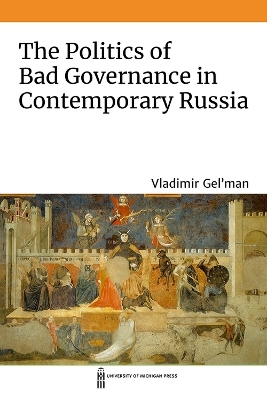
The Politics of Bad Governance in Contemporary Russia
Seiten
2022
The University of Michigan Press (Verlag)
978-0-472-07562-1 (ISBN)
The University of Michigan Press (Verlag)
978-0-472-07562-1 (ISBN)
Human history is in reality a history of corrupt governments
In this book, Vladimir Gel’man considers bad governance as a distinctive politico-economic order that is based on a set of formal and informal rules, norms, and practices quite different from those of good governance. Some countries are governed badly intentionally because the political leaders of these countries establish and maintain rules, norms, and practices that serve their own self-interests. Gel’man considers bad governance as a primarily agency-driven rather than structure-induced phenomenon. He addresses the issue of causes and mechanisms of bad governance in Russia and beyond from a different scholarly optics, which is based on a more general rationale of state-building, political regime dynamics, and policy-making. He argues that although these days, bad governance is almost universally perceived as an anomaly, at least in developed countries, in fact human history is largely a history of ineffective and corrupt governments, while the rule of law and decent state regulatory quality are relatively recent matters of modern history, when they emerged as side effects of state-building. Indeed, the picture is quite the opposite: bad governance is the norm, while good governance is an exception. The problem is that most rulers, especially if their time horizons are short and the external constraints on their behavior are not especially binding, tend to govern their domains in a predatory way because of the prevalence of short-term over long-term incentives. Contemporary Russia may be considered as a prime example of this phenomenon. Using an analysis of case studies of political and policy changes in Russia after the Soviet collapse, Gel’man discusses the logic of building and maintaining the politico-economic order of bad governance in Russia and paths of its possible transformation in a theoretical and comparative perspective.
In this book, Vladimir Gel’man considers bad governance as a distinctive politico-economic order that is based on a set of formal and informal rules, norms, and practices quite different from those of good governance. Some countries are governed badly intentionally because the political leaders of these countries establish and maintain rules, norms, and practices that serve their own self-interests. Gel’man considers bad governance as a primarily agency-driven rather than structure-induced phenomenon. He addresses the issue of causes and mechanisms of bad governance in Russia and beyond from a different scholarly optics, which is based on a more general rationale of state-building, political regime dynamics, and policy-making. He argues that although these days, bad governance is almost universally perceived as an anomaly, at least in developed countries, in fact human history is largely a history of ineffective and corrupt governments, while the rule of law and decent state regulatory quality are relatively recent matters of modern history, when they emerged as side effects of state-building. Indeed, the picture is quite the opposite: bad governance is the norm, while good governance is an exception. The problem is that most rulers, especially if their time horizons are short and the external constraints on their behavior are not especially binding, tend to govern their domains in a predatory way because of the prevalence of short-term over long-term incentives. Contemporary Russia may be considered as a prime example of this phenomenon. Using an analysis of case studies of political and policy changes in Russia after the Soviet collapse, Gel’man discusses the logic of building and maintaining the politico-economic order of bad governance in Russia and paths of its possible transformation in a theoretical and comparative perspective.
Vladimir Gel’man is Professor at the European University at St. Petersburg and University of Helsinki.
List of Figures
List of Tables
Preface and Acknowledgements
Chapter 1. The Politics of Bad Governance – A Framework for Analysis
Chapter 2. Post-Soviet Bad Governance: A Vicious Circle?
Chapter 3. Authoritarian Modernization: Illusions and Temptations
Chapter 4. Opportunities and Constraints: Policy Reforms in the 2000s
Chapter 5. The Technocratic Traps of Policy Reforms
Chapter 6. Success Stories amid Bad Governance
Chapter 7. The Politics of Bad Governance: Russia in Comparative Perspective
References
| Erscheinungsdatum | 01.12.2022 |
|---|---|
| Zusatzinfo | 9 figures, 4 tables |
| Verlagsort | Ann Arbor |
| Sprache | englisch |
| Maße | 152 x 229 mm |
| Themenwelt | Sozialwissenschaften ► Politik / Verwaltung |
| Wirtschaft ► Volkswirtschaftslehre ► Makroökonomie | |
| Wirtschaft ► Volkswirtschaftslehre ► Wirtschaftspolitik | |
| ISBN-10 | 0-472-07562-4 / 0472075624 |
| ISBN-13 | 978-0-472-07562-1 / 9780472075621 |
| Zustand | Neuware |
| Informationen gemäß Produktsicherheitsverordnung (GPSR) | |
| Haben Sie eine Frage zum Produkt? |
Mehr entdecken
aus dem Bereich



aus dem Bereich
Buch | Softcover (2024)
Schäffer-Poeschel (Verlag)
CHF 48,95
Kompakt und prüfungsrelevant für Wirtschaftswissenschaftler
Buch | Softcover (2021)
Vahlen, Franz (Verlag)
CHF 16,65
Kontroversen, Daten und Fakten zur Nachhaltigkeit
Buch | Softcover (2025)
Kohlhammer (Verlag)
CHF 54,60


