


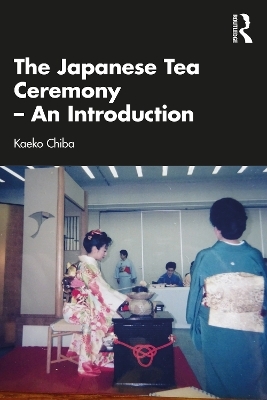
The Japanese Tea Ceremony – An Introduction
Seiten
2022
Routledge (Verlag)
978-1-032-16467-0 (ISBN)
Routledge (Verlag)
978-1-032-16467-0 (ISBN)
This book provides a comprehensive introduction to chado, the Japanese tea ceremony. Unlike other books on the subject which focus on practice or historical background or specific issues, this book considers the subject from multiple perspectives.
This book provides a comprehensive introduction to chado, the Japanese tea ceremony. Unlike other books on the subject, which focus on practice or historical background or specific issues, this book considers the subject from multiple perspectives. It discusses Japanese aesthetics and philosophy, outlines how the tea ceremony has developed, emphasizing its strong links to Zen Buddhism and the impact of other religion influences, and examines how chado reflects traditional gender and social status roles in Japan. It goes on to set out fully the practice of chado, exploring dress, utensils, location – the garden and the tea house – and the tea itself and accompanying sweets. Throughout, the book is illustrated both with images and with examples of practice. The book will be of interest to a wide range of people interested in chado – university professors and students, tourists and people interested in traditional Japanese arts.
This book provides a comprehensive introduction to chado, the Japanese tea ceremony. Unlike other books on the subject, which focus on practice or historical background or specific issues, this book considers the subject from multiple perspectives. It discusses Japanese aesthetics and philosophy, outlines how the tea ceremony has developed, emphasizing its strong links to Zen Buddhism and the impact of other religion influences, and examines how chado reflects traditional gender and social status roles in Japan. It goes on to set out fully the practice of chado, exploring dress, utensils, location – the garden and the tea house – and the tea itself and accompanying sweets. Throughout, the book is illustrated both with images and with examples of practice. The book will be of interest to a wide range of people interested in chado – university professors and students, tourists and people interested in traditional Japanese arts.
Kaeko Chiba is Associate Professor of International Liberal Arts at Akita International University, Japan.
Introduction 1. Philosophy and aesthetics 2. History and iemoto 3. Religion and belief 4. Utensils and artisan 5. Tea, sweets and kaiseki 6. Kimono 7. Garden and house 8. How to have tea and sweets 9. Exploration 10. Future
| Erscheinungsdatum | 01.12.2022 |
|---|---|
| Zusatzinfo | 10 Tables, color; 106 Halftones, color; 106 Illustrations, color |
| Verlagsort | London |
| Sprache | englisch |
| Maße | 156 x 234 mm |
| Gewicht | 640 g |
| Themenwelt | Kunst / Musik / Theater |
| Sozialwissenschaften ► Soziologie ► Spezielle Soziologien | |
| ISBN-10 | 1-032-16467-0 / 1032164670 |
| ISBN-13 | 978-1-032-16467-0 / 9781032164670 |
| Zustand | Neuware |
| Informationen gemäß Produktsicherheitsverordnung (GPSR) | |
| Haben Sie eine Frage zum Produkt? |
Mehr entdecken
aus dem Bereich



aus dem Bereich
Bullshit als politische Strategie
Buch | Softcover (2025)
Kohlhammer (Verlag)
CHF 33,55
eine Einführung
Buch | Softcover (2024)
De Gruyter Oldenbourg (Verlag)
CHF 41,90
Antisemitismus und postkoloniale Debatte auf der documenta fifteen
Buch | Softcover (2025)
Campus (Verlag)
CHF 41,95


