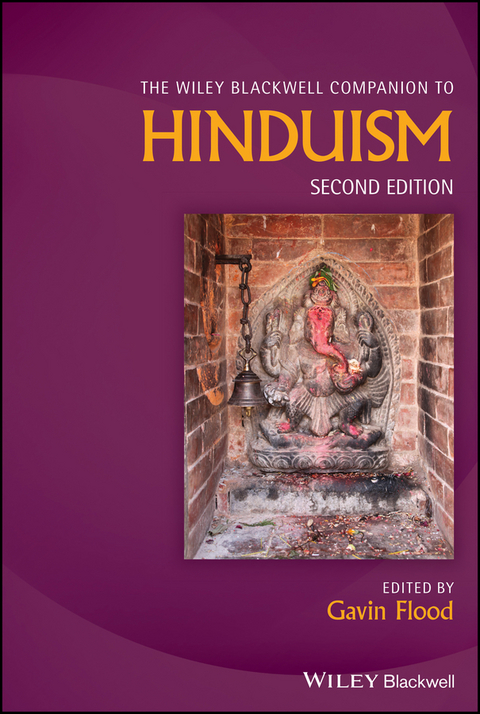
The Wiley Blackwell Companion to Hinduism (eBook)
John Wiley & Sons (Verlag)
9781119144885 (ISBN)
An accessible and up-to-date survey of scholarly thinking about Hinduism, perfect for courses on Hinduism or world religions
The Wiley-Blackwell Companion to Hinduism examines the historical trajectories that have led to the modern religion of Hinduism. Covering main themes such as philosophy, practice, society, and science, this comprehensive volume brings together a variety of approaches and perspectives in Hindu Studies to help readers better appreciate the richness, complexity, and diversity of Hinduism. Essays by acknowledged experts in the field present historical accounts of all major traditions, analyze key texts, engage with Hindu theology and philosophy, address contemporary questions of colonialism and identity, and more. Throughout the text, the authors highlight the links, common threads, and issues that reoccur in the history of Hinduism.
Fully revised and updated, the second edition of the Companion incorporates the most recent scholarship and reflects the trend away from essentialist understandings of Hinduism. New chapters examine the Goddess tradition, Hindu diaspora, Hinduism and inter-religious comparison, Hindu philosophy, and Indian astronomy, medicine, language, and mathematics. This edition places further emphasis on the importance of region-specific studies in analyzing Hinduism, discusses important theoretical issues, and offers fresh perspectives on current discourse in Hindu society and politics.
- Provides a thorough overview of major texts, their histories, and the traditions that preserve them
- Describes the major textual traditions in Sanskrit with examples in different Indian vernacular languages
- Addresses major issues and contemporary debates about the nature and study of Hinduism
- Discusses the importance of systematic, rational thinking in Indian sciences, philosophy, and theology
- Examines key socio-political themes in Hinduism that are of particular relevance to the modern world
The Wiley-Blackwell Companion to Hinduism, Second Edition is an excellent text for undergraduate courses on Hinduism in Religious Studies and Philosophy departments, and an invaluable resource for scholars and researchers in Hindu Studies.
Gavin Flood, FBA is Professor of Hindu Studies and Comparative Religion at Oxford University, Academic Director of the Oxford Centre for Hindu Studies, Senior Research Fellow at Campion Hall. He is the author of Religion and the Philosophy of Life and many other publications.
An accessible and up-to-date survey of scholarly thinking about Hinduism, perfect for courses on Hinduism or world religions The Wiley-Blackwell Companion to Hinduism examines the historical trajectories that have led to the modern religion of Hinduism. Covering main themes such as philosophy, practice, society, and science, this comprehensive volume brings together a variety of approaches and perspectives in Hindu Studies to help readers better appreciate the richness, complexity, and diversity of Hinduism. Essays by acknowledged experts in the field present historical accounts of all major traditions, analyze key texts, engage with Hindu theology and philosophy, address contemporary questions of colonialism and identity, and more. Throughout the text, the authors highlight the links, common threads, and issues that reoccur in the history of Hinduism. Fully revised and updated, the second edition of the Companion incorporates the most recent scholarship and reflects the trend away from essentialist understandings of Hinduism. New chapters examine the Goddess tradition, Hindu diaspora, Hinduism and inter-religious comparison, Hindu philosophy, and Indian astronomy, medicine, language, and mathematics. This edition places further emphasis on the importance of region-specific studies in analyzing Hinduism, discusses important theoretical issues, and offers fresh perspectives on current discourse in Hindu society and politics. Provides a thorough overview of major texts, their histories, and the traditions that preserve them Describes the major textual traditions in Sanskrit with examples in different Indian vernacular languages Addresses major issues and contemporary debates about the nature and study of Hinduism Discusses the importance of systematic, rational thinking in Indian sciences, philosophy, and theology Examines key socio-political themes in Hinduism that are of particular relevance to the modern world The Wiley-Blackwell Companion to Hinduism, Second Edition is an excellent text for undergraduate courses on Hinduism in Religious Studies and Philosophy departments, and an invaluable resource for scholars and researchers in Hindu Studies.
Gavin Flood is Professor of Hindu Studies and Comparative Religion at Oxford University, Academic Director of the Oxford Centre for Hindu Studies, and Senior Research Fellow at Campion Hall. He is the author of several books including Religion and the Philosophy of Life.
List of Contributors x
About the Editor xii
Preface to the First Edition and Acknowledgements xiii
Preface to the Second Edition xv
Introduction: Establishing the Boundaries xvi
Gavin Flood
Part I Theoretical Issues 1
1 Colonialism and the Construction of Hinduism 3
Gauri Viswanathan
2 Orientalism and Hinduism 21
David Smith
Part II Text and Tradition 37
The Sanskrit Textual Traditions 39
3 Vedas and Upaniads 41
Michael Witzel
4 The Dharmasastras 69
Ludo Rocher
5 The Sanskrit Epics 81
John Brockington
6 The Puraas 92
Freda Matchett
7 The Bhagavad Gita: Genesis of the Text, Its Messages, and Its Impact on the Mahabharata and on Indian Religions and Philosophy 105
Mislav Je?ic
Textual Traditions in Regional Languages 129
8 Tamil Hindu Literature 131
Norman Cutler
9 The Literature of Hinduism in Malayalam 143
Rich Freeman
10 North Indian Hindi Devotional Literature 163
Nancy M. Martin
Major Historical Developments 179
11 The Saiva Traditions 181
Gavin Flood
12 History of Vaiava Traditions: An Esquisse 209
Ge´rard Colas
13 Hinduism and the Goddess: Sakta Traditions 245
Bjarne Wernicke-Olesen
14 The Householder Tradition in Hindu Society 275
T.N. Madan
15 The Renouncer Tradition 290
Patrick Olivelle
Regional Traditions 305
16 The Teyyam Tradition of Kerala 307
Rich Freeman
17 The Month of Kartik and Women's Ritual Devotions to Krishna in Benares 323
Tracy Pintchman
18 Hindu Diasporas and Gods on the Move: Sacred Sites and Pilgrimage in Hindu Europe 338
Knut A. Jacobsen
Part III Systematic Thought 353
The Indian Sciences 355
19 Introduction 357
Frits Staal
20 The Science of Language 359
Frits Staal
21 Indian Mathematics 370
Takao Hayashi
22 Calendar, Astrology, and Astronomy 384
Michio Yano
23 The Science of Medicine 399
Dominik Wujastyk
Philosophy and Theology 415
24 The Classical Worldview: Early Foundations of Hindu Philosophy 417
Jessica Frazier
25 Hinduism and the Proper Work of Reason 448
Jonardon Ganeri
26 Restoring "Hindu Theology" as a Category in Indian Intellectual Discourse 479
Francis Clooney SJ
27 Mantra 505
André Padoux
28 Realism and Non-Realism in Indian Philosophy 517
Ionut Moise
29 Hinduism Compared 536
Reid B. Locklin
Part IV Society, Politics, and Nation 551
30 On the Relationship between Caste and Hinduism 553
Declan Quigley
31 Modernity, Reform, and Revival 565
Dermot Killingley
32 The Goddess and the Nation: Subterfuges of Antiquity, the Cunning of Modernity 580
Sumathi Ramaswamy
33 Gender in a Devotional Universe 595
Vasudha Narayanan
Index 612
Introduction
Establishing the Boundaries
Gavin Flood
That religion is still of central importance in today’s world can hardly be doubted, as we see in political contestation and violent conflict throughout the world. In South Asia religion is at the center of controversy and ideological battles and questions about what it is to be a Hindu in the twenty-first century are vibrant. Questions concerning the relation of Hinduism to state and global politics, to the individual, and to the politics of identity are of great relevance to Hindus everywhere. On the one hand we have seen the world shrink through globalization along with the late modern erosion of tradition, while on the other we have seen the reinvigoration of some traditions and the reanimation of traditional forms of knowledge (such as Ayurveda and Yoga). Secularists in India would wish to see the complete erosion of religion in the public sphere of governance and its relegation to the private realm, while many religious nationalists would wish to see even more growth in the influence of religion in the political and public arena. These debates are enacted through media and public discourse from academic to popular realms.
It is in the context of such vital issues that scholars in this book examine Hinduism in its widest sense, looking not only at questions of contemporary identity politics but also at historical questions and presenting historical accounts of particular texts and traditions. We certainly understand the present through the past, but we also wish to understand the past for the sake of increasing human knowledge. There is therefore great diversity in the following pages that seek both to account for the contemporary situation and to explain the historical trajectories that have led to the modern, global religion we call “Hinduism.” From ancient Tamil texts to contemporary politics, all the essays gathered here bear a relation to that nebulous abstraction and raise many questions. Are we dealing with a single religion, an essence manifested in different forms? Or is Hinduism a diversity of distinct traditions sharing certain common features with no single feature being shared by them all? Or are we dealing with a fragmented, cultural reality of widely diverse beliefs and practices, inappropriately classified as a single religion? All of these positions have been adopted in understanding Hinduism. The answers to these questions will depend upon the historical period in question and the methods employed in their study. Closely connected to the scope of the field are questions about how to study Hinduism, whether anthropology, philology, history of religions, theology, literary studies, archeology, or art history are appropriate methods, and questions about the different theoretical assumptions and implications of their use. The purpose of this introduction is therefore both to problematize “Hinduism” and to provide a context for the essays that follow.
What Is Hinduism?
A simple, if perhaps deceptively simple, response to this question is to say that Hinduism is a term denoting the religion of the majority of people in India and Nepal and of some communities in other continents who refer to themselves as “Hindu.” There are over 900 million people classed as Hindu in India by the census of India in 2011, which is just under 80% of the population, the remainder being classified as Muslim, Sikh, Christian, Jain, Buddhist, and “other religions and persuasions.”1 Hindus are the majority population in India, Nepal, and Mauritius and the total Hindu population of the world is about a billion, 15% of the global population.2 Most Hindus are in India, which is in a vast continent with 18 official languages and many dialects. But if we begin to dig deeper, we see that the question is not so straightforward. Because the term denotes such a striking variety of beliefs, practices, and historical trajectories, some would wish to claim that the abstraction “Hinduism” is meaningless and without referent. But others, and this is particularly important in the contemporary politics of Hindu identity, would claim that Hinduism is indeed a unified field of belief, practice, and history, intimately linked to nationhood and the historical struggle of a people against its colonizers. On this view, Hinduism has an essence manifested in multiple forms. Others argue that while Hinduism does not denote a religion with clearly defined boundaries in a way that we might be able to define Christianity or Islam, it nevertheless denotes a group of traditions united by certain common features, such as shared ritual patterns, a shared revelation, a belief in reincarnation (saṃsāra), liberation (mokṣa), and a particular form of endogamous social organization or caste. This family resemblance approach nevertheless still requires judgments about which forms are prototypical and which are not, judgments which are themselves based on some pre-understanding of the tradition. Many would wish to claim, for example, that caste is not a necessary part of Hinduism whereas other features, such as devotion to a deity, are. “What is Hinduism?” is therefore a complex question the response to which ranges from claiming that Hinduism in a unified, coherent field of doctrine and practice to claiming that it is a fiction, a colonial construction based on the mis-categorization of indigenous cultural forms.
Defining the parameters of the term is not simply an exercise for scholars but is closely related to the questions, as Brian Smith observes, of “who speaks for Hinduism?” and “who defines Hinduism?” (Smith 2000, 741–742). This debate goes way beyond academic formulations and arguments in the academy into the politics of cultural identity and questions about power. But before we inquire into these questions of value, what of the term itself?
“Hindu” comes from a Persian word hind, or in Arabic al-hind, for the area of the Indus valley. This word is in turn derived from the Indo-Aryan sindhu meaning “ocean” or “river,” and from the eighth century, when Muslims settled in the Indus valley, Persian authors distinguished between Muslims and the non-Muslim “Hindus,” although it is not strictly true that the term was not used by those non-Muslims themselves. Sanskrit sources, however, are much later. In fifteenth-century Kashmir the Sanskritized term hindukaḥ is employed by the Śaiva historian Śrīvara to distinguish Muslims from non-Muslims (Sanderson 156 note 2) and the term was used in Sanskrit and Bengali Vaiṣṇava sources in the sixteenth century to denote those who were not “Yavanas” or Muslims (O’Connell 1973, 340–344). In these sources it seems to refer to groups united by certain common cultural practices, such as cremation of the dead and veneration of the cow, not practiced by the Muslims. Towards the end of the eighteenth century “Hindu” or “Hindoo” was adopted by the British to refer to the people of “Hindustan,” the area of northwest South Asia, who were not Muslim, Sikh, Christian, or Jain, and the “ism” was added to “Hindu” in the early nineteenth century. Indeed, Rammohun Roy was probably the first Hindu to use the term in 1816 (Killingley in this volume: 570. The term became widely adopted during the nineteenth century in the context of establishing a national identity that would become opposed to colonialism and in the creation of a religion that could match Christianity and meet it on a basis of equality (see Killingley and Viswanathan in this volume).
Many scholars have argued that the ascription of “Hinduism” to the multiplicity of South Asian traditions was an exercise in power and that the representation of India in western scholarship in terms of mysticism, caste, and kingship is an expression of the West’s desire for domination. On this view India as the West’s exotic other became identified with despotism, imagination, superstition, and irrationality in contrast to the democracy, reason, and science of the West arising out of the Enlightenment (Inden 1990; Balagangadhara 1994; King 1999). This postcolonial reading of Western scholarship’s engagement with India reveals a complex history, traced by Gauri Viswanathan in the present volume, which shows both positive and negative evaluations are nevertheless based on foundational assumptions about the nature of the West’s other. Others have argued not from the perspective of postcolonialism, but on the foundation of Western, philological scholarship itself, that the term “Hinduism” is a misnomer, an attempt to unify into a single religion what in fact is a number of distinct religions (for example, von Stietencron 1997, 32–53). Yet others argue that part of this error lies in the inappropriate use of the category “religion” in relation to the diversity of South Asian cultural forms, for that term has particular, Christian theological connotations (Staal 1989, 388–406; Fitzgerald 2000, 134–155). On this view, religion is a category that entails assumptions that belief has primacy over practice, that a person can only belong to one religion, that tradition stems from textual, written revelation, and that a religion is necessarily coherent.
But in spite of these criticisms there are nevertheless Hindu analogues to categories of revelation, tradition, theology, and practice, although these arguably do not point to a unitary referent. We might say, then, that Hinduism...
| Erscheint lt. Verlag | 13.5.2022 |
|---|---|
| Reihe/Serie | Blackwell Companions to Religion |
| Blackwell Companions to Religion | Wiley Blackwell Companions to Religion |
| Sprache | englisch |
| Themenwelt | Geisteswissenschaften ► Religion / Theologie ► Judentum |
| Sozialwissenschaften ► Soziologie ► Mikrosoziologie | |
| Schlagworte | Anthropologie • Anthropology • Comparative & World Religions • Hinduism • hinduism history • Hinduism research • Hinduismus • hindu philosophy • Hindu politics • Hindu sciences • Hindu society • Hindu Studies • Hindu studies essays • Hindu studies scholarship • Hindu studies textbook • Hindu texts • Hindu Theology • hindu traditions • Religion • Religion & Theology • Religion u. Theologie • Social & Cultural Anthropology • Soziale u. kulturelle Anthropologie • Vergleichende Religionswissenschaft |
| ISBN-13 | 9781119144885 / 9781119144885 |
| Informationen gemäß Produktsicherheitsverordnung (GPSR) | |
| Haben Sie eine Frage zum Produkt? |
 EPUB (Adobe DRM)
Kopierschutz: Adobe-DRM
Adobe-DRM ist ein Kopierschutz, der das eBook vor Mißbrauch schützen soll. Dabei wird das eBook bereits beim Download auf Ihre persönliche Adobe-ID autorisiert. Lesen können Sie das eBook dann nur auf den Geräten, welche ebenfalls auf Ihre Adobe-ID registriert sind.
Details zum Adobe-DRM
Dateiformat: EPUB (Electronic Publication)
EPUB ist ein offener Standard für eBooks und eignet sich besonders zur Darstellung von Belletristik und Sachbüchern. Der Fließtext wird dynamisch an die Display- und Schriftgröße angepasst. Auch für mobile Lesegeräte ist EPUB daher gut geeignet.
Systemvoraussetzungen:
PC/Mac: Mit einem PC oder Mac können Sie dieses eBook lesen. Sie benötigen eine
eReader: Dieses eBook kann mit (fast) allen eBook-Readern gelesen werden. Mit dem amazon-Kindle ist es aber nicht kompatibel.
Smartphone/Tablet: Egal ob Apple oder Android, dieses eBook können Sie lesen. Sie benötigen eine
Geräteliste und zusätzliche Hinweise
Buying eBooks from abroad
For tax law reasons we can sell eBooks just within Germany and Switzerland. Regrettably we cannot fulfill eBook-orders from other countries.
aus dem Bereich