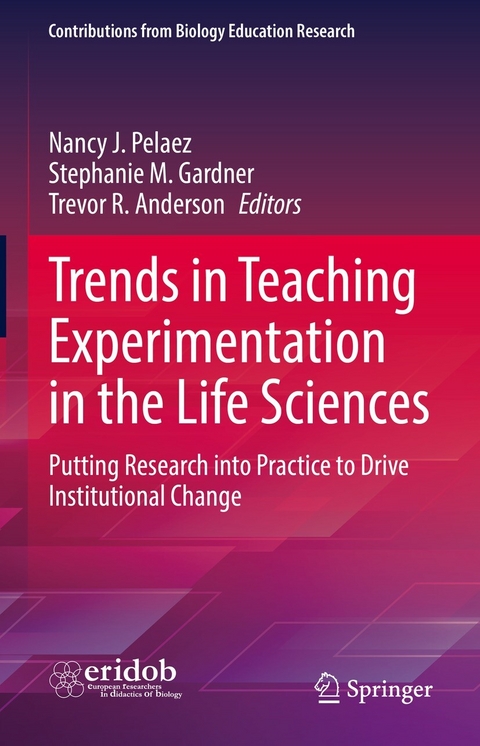
Trends in Teaching Experimentation in the Life Sciences (eBook)
561 Seiten
Springer International Publishing (Verlag)
978-3-030-98592-9 (ISBN)
This book is a guide for educators on how to develop and evaluate evidence-based strategies for teaching biological experimentation to thereby improve existing and develop new curricula. It unveils the flawed assumptions made at the classroom, department, and institutional level about what students are learning and what help they might need to develop competence in biological experimentation.
Specific case studies illustrate a comprehensive list of key scientific competencies that unpack what it means to be a competent experimental life scientist. It includes explicit evidence-based guidelines for educators regarding the teaching, learning, and assessment of biological research competencies. The book also provides practical teacher guides and exemplars of assignments and assessments. It contains a complete analysis of the variety of tools developed thus far to assess learning in this domain.
This book contributes to the growth of public understanding of biological issues including scientific literacy and the crucial importance of evidence-based decision-making around public policy. It will be beneficial to life science instructors, biology education researchers and science administrators who aim to improve teaching in life science departments.
Chapters 6, 12, 14 and 22 are available open access under a Creative Commons Attribution 4.0 International License via link.springer.com.
Dr. Nancy Pelaez is a Professor Emerita of Biology who founded the Biology Education Area as one of six research focus area in the Department of Biological Sciences at Purdue University. She holds a B.S. in Biology summa cum laude from Tulane University, a k-12 California teaching credential in both Life Science and Physical Science from Mills College, and a Ph.D. in Physiology and Biophysics from Indiana University School of Medicine as a Howard Hughes Medical Institute fellow. With more than 45 refereed publications in the field, Pelaez, who was elected Chair of Section Q (Education) for the American Association for the Advancement of Science (AAAS), has been honored with the American Physiological Society Guyton Educator of the Year Award, a Fulbright Award to Vienna, Austria, and as AAAS Fellow.
Dr. Stephanie M. Gardner is an Associate Professor in the Department of Biological Sciences at Purdue University. She earned her doctorate in Physiology from the University of Wisconsin-Madison and conducted her postdoctoral training in Neuroscience at Johns Hopkins School of Medicine. As a Visiting Assistant Professor at Dickinson College and Purdue University, her research interests shifted toward biology education. Her research group examines how students and faculty engage in science practices including mechanistic reasoning and creating visualizations to understand and communicate data and experimental concepts. Dr. Gardner leads professional development workshops around inclusive and innovative instruction for faculty and graduate students. She is the co-director of the CURE - Purdue faculty development program to increase access to research for more and diverse undergraduate students. She has served on several biology education research journal editorial boards including as a monitoring editor at CBE-Life Sciences Education since 2018.
Dr. Trevor R. Anderson is a biochemistry education researcher and Professor Emeritus of Chemistry in the Divisions of Chemical Education and Biochemistry in the Department of Chemistry at Purdue University. He was also a Senior Research Associate in the School of Life Science, University of KwaZulu-Natal, South Africa. He published in the areas of biochemistry student reasoning and visualization and has been invited to convene and present numerous plenary and keynote talks and workshops to the international scientific community. Central to his faculty development activities has been his workshops on scholarship, his design of curriculum change models, and his authorship of the Bridging-the-Gap series in Biochemistry & Molecular Biology Education (BAMBEd), aimed at encouraging scholarship in teaching and learning through the application of educational research to teaching practice. For 22 years, he served on the Education Committee of the International Union of Biochemistry and Molecular Biology (IUBMB) and the editorial board of BAMBEd.
| Erscheint lt. Verlag | 11.5.2022 |
|---|---|
| Reihe/Serie | Contributions from Biology Education Research | Contributions from Biology Education Research |
| Zusatzinfo | XXXIII, 561 p. 1 illus. |
| Sprache | englisch |
| Themenwelt | Sozialwissenschaften ► Pädagogik ► Erwachsenenbildung |
| Schlagworte | Assessing Biological Experimentation in Higher Education • Assessment of Biological Experimentation in Higher Education • Biological Experimentation in Curriculum • Developing Strategies for Teaching Biological Experimentation • Evidence-based Strategies for Teaching Life Science • Guidelines for Biological Experimentation • Guidelines for Teaching Life Science Education • Learning Biological Experimentation in Higher Education • Teaching Biological Experimentation in Higher Education • Teaching Life Science in Higher Education |
| ISBN-10 | 3-030-98592-X / 303098592X |
| ISBN-13 | 978-3-030-98592-9 / 9783030985929 |
| Informationen gemäß Produktsicherheitsverordnung (GPSR) | |
| Haben Sie eine Frage zum Produkt? |
 PDF (Wasserzeichen)
DRM: Digitales Wasserzeichen
Dieses eBook enthält ein digitales Wasserzeichen und ist damit für Sie personalisiert. Bei einer missbräuchlichen Weitergabe des eBooks an Dritte ist eine Rückverfolgung an die Quelle möglich.
Dateiformat: PDF (Portable Document Format)
Mit einem festen Seitenlayout eignet sich die PDF besonders für Fachbücher mit Spalten, Tabellen und Abbildungen. Eine PDF kann auf fast allen Geräten angezeigt werden, ist aber für kleine Displays (Smartphone, eReader) nur eingeschränkt geeignet.
Systemvoraussetzungen:
PC/Mac: Mit einem PC oder Mac können Sie dieses eBook lesen. Sie benötigen dafür einen PDF-Viewer - z.B. den Adobe Reader oder Adobe Digital Editions.
eReader: Dieses eBook kann mit (fast) allen eBook-Readern gelesen werden. Mit dem amazon-Kindle ist es aber nicht kompatibel.
Smartphone/Tablet: Egal ob Apple oder Android, dieses eBook können Sie lesen. Sie benötigen dafür einen PDF-Viewer - z.B. die kostenlose Adobe Digital Editions-App.
Buying eBooks from abroad
For tax law reasons we can sell eBooks just within Germany and Switzerland. Regrettably we cannot fulfill eBook-orders from other countries.
aus dem Bereich