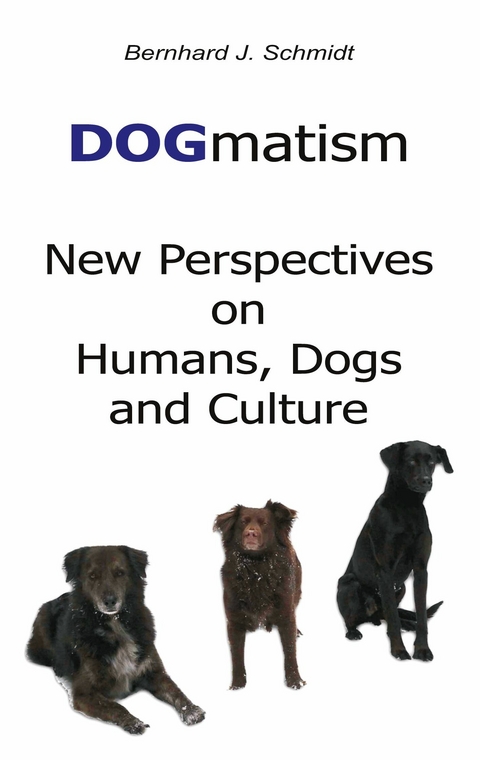
DOGmatism (eBook)
164 Seiten
Books on Demand (Verlag)
978-3-7562-8007-0 (ISBN)
Born in 1962 in Dortmund, Germany, Studied philosophy, psychology and neurophysiology Science and social psychologist
2. INTRODUCTION
If you want to gain knowledge about yourself as a person, there are three possibilities. On the one hand, you can observe yourself and your fellow species and test how psychology does it. But this approach has a big problem.
„Die große Schwierigkeit jeder Menschenbetrachtung liegt darin, dass wir, die Beobachter also, selbst Menschen sind; daß unser Gehirn, als Werkzeug der Beobachtung, selbst Gegenstand dieser Beobachtung ist. Wir sind von Jugend an von Menschen umgeben, so daß uns die Gesellschaft und alles, was sie uns aufprägt, recht selbstverständlich vorkommt. Es ist uns beinahe unmöglich, uns über dieses so Selbstverständliche zu wundern, es aus einer anderen, unbeeinflußten Blickrichtung zu sehen, aus uns selbst herauszutreten ... uns selbst fremd zu werden.“ (Hass 1968) 1
On the other hand, we can also deal with our closest relatives, the great apes, as, for example, Wolfgang Köhler did. However, the great apes have the disadvantage that our last common ancestors lived a very long time ago. And monkeys and humans have lived little to no life together. The population of monkeys is limited to a few habitats. The third possibility is to look at the dog and, above all, our relationship with the dog. After all, we have lived with dogs for a very long time and have adapted to each other. The wolf came to man at a time, and that is often overlooked, when a very high selection pressure weighed on both man and wolf. Errors in behavior or a lack of adaptation, i.e., among other things, a lack of learning, were immediately "punished" by the selection. And it is because of our preference for artifacts that we attach our development as humans to stone, iron and bronze ... and not to immaterial advances. These include, for example, mastery of fire, cooperation with wolves, as well as the development of language, writing and numbers - all as cultural aids.
For an understanding of our common development, i.e. of wolf / dog and human, it is also necessary to leave the transfigurations of nature that have been spread through many films, especially by the Disney Studios. Even if people started breeding dogs late, from the end of the 19th century, it is very likely that they selected them very early, by killing, drowning, eating ... And this as a supplement to the natural selection, from which both humans and wolves / dogs were affected. If we want to understand each other, then we have to understand how we develop together with dogs. And if we want to understand our dogs, then we have to understand ourselves. Errors about us and our characteristics automatically lead, as they do now, to errors about the nature and needs of dogs.
1 The invisible wall
There is a very strong, but hardly visible wall that dogmatically prevents the understanding of ourselves as well as our relationship to nature. In order to be able to understand us, our dogs and the relationship to them, even their needs and abilities, the removal of this dogmatic wall is necessary. As already presented more comprehensively in Schmidt (2020), it is the theological-philosophical dogma that has emerged over centuries that separates us as human beings from our environment. The wall that arises from the fact that western people perceive themselves as the we-less, body-less and history-less I, as acting independently, rationally and consciously. This misunderstanding and the resulting separations have repercussions even in medicine. Barbara Natterson-Horowitz (2012) describes this in detail in her book „Zoobiquity“.
„… a veterinarians’ inside joke:
What do you call a physician?
A veterinarian who can treat only one species.“
(Natterson-Horowitz 2012)
Even here it becomes clear that our understanding of our relationship to nature has changed significantly not only over centuries, but even over a few decades. Because just a few decades ago it was quite common in the country for a doctor, if one was available at all, to treat both animals and humans. The separation of veterinary medicine from human medicine took place quite late, but nevertheless with problematic consequences for human medicine, as Natterson-Horowitz explains in detail.
„As Darwin shrewdly observed, „we do not like to consider [animals] our equals.“ And yet, all of biology, the foundation of medicine itself, relies on the fact that we are animals. Indeed, we share the vast majority of our genetic code with other creatures.“
(Natterson-Horowitz 2012)
The modern, urbanized and literate, and thus ultimately doubly “decontextualized” human being, finds it difficult to see themselves as part of nature, that is, as an animal with a little awareness and reason. Of course, this also massively disrupts our understanding of our social partner dog as part of nature.
2 Equation with two unknowns
In the current literature on dogs, regardless of whether it is scientific or relating to dog training, it is noticeable that the human being is usually absent, simply does not appear, is not treated and considered in his role in the interaction. But the relationship between humans and dogs has two - more or less unknown - variables. There is a complex interplay, mutual interaction and influence that determine the relationship. Both the relationship between dog and owner, as well as between mankind and “dogkind”.
2.1 Dog and owner
The current dog trainings based on behaviorism represent a perspective comparable to a music theory, which would claim that you only have to press the right key on the piano at the right time - and that is how music is created. And with this method you can also teach everyone to make music. Well - that would be enough for, for example, "All my ducklings". But no musician would seriously deny that there are great differences in the qualities of both the instruments and the musicians. Nobody would doubt that there are better and worse instruments and also better and worse musicians. That there are people who - without instruction and without the ability to read notes - simply have music 'in their blood'. And also people who are best off keeping their hands off the music and instruments because they 'lack harmony'. The fact that these many differences in our relationship with dogs are not taken into account is more than problematic. Especially since, unlike the instruments with their different qualities, the dog "plays along" in the interaction between humans and dogs and does not behave passively.
This cooperation of the dog in connection with its adaptability, which is still to be discussed, makes it possible for a large part of the people to live happily with a dog in the first place. And that without being "great musicians". But there are also those who would be better off buying a cat, a goldfish ... but not buying or keeping a dog, please. That shouldn't be overlooked either.
2.2 Mankind and „Dogkind“
What is certain is that there would be no dogs without people. It was definitely a long way from wolf to dog as we know it today. From the shy wild animal, frightened to death by sudden captivity, to a social cooperation partner.
„Examples of animals dying when they've been captured or restrained abound. In species as varied as Irish hares, white-tailed deer, cotton-top tamarins, and antelopes, this combination can equal death. Experts on pikas, the rabbitlike "tundra bunnies" of South America, have learned the hard way that holding a captured pika firmly around its middle can scare it to death. ... And the risk exists not just for flighty prey animals. Top carnivores like brown bears, lynxes, wolverines, and gray wolves have died after being trapped.“
(Natterson-Horowitz 2012)
On the other hand, it is not certain, and probably never will, to what extent the development of mankind over the millennia has been influenced by living together with dogs. The dog is not simply a domesticated wild animal, but is a cooperation partner with whom people have populated the entire earth. For thousands of years, humans and dogs have lived together in a wide variety of habitats. They have not only adapted to each other, but also to these environments together.
It is therefore far too simplistic to only consider the dog's human-dependent development. A beautiful example of an interplay between animals that can almost be called cultural can be found even in the case of the fish.
„Eine Reihe von Meeresfischen hat sich darauf spezialisiert, andere Fische von Parasiten zu befreien (I. Eibl-Eibesfeldt 1955 a, 1959, J. E. Randall 1958, C. Limbaugh 1961), unter anderen der Putzerlippfisch. Dieser Fisch lädt seine Wirte durch ein besonderes Wippschwimmen (Putzertanz) dazu ein, sich putzen zu lassen. Er fordert sie ferner durch Anstoßen mit der Schnauze auf, zusammengefaltete Flossen aufzurichten, den Kiemendeckel abzuheben oder auch das Maul zu öffnen, so daß er hineinschlüpfen kann. Während der Putzerfisch seinen Wirt absucht, betrillert er ihn mit den Bauchflossen, so daß der Wirt stets weiß, wo er gerade geputzt wird. Man sieht deutlich, daß er darauf reagiert, indem er die Flossen stillhält, an die der Putzer stößt. Umgekehrt laden die Wirte ihre Putzer durch Maulöffnen zum Putzen ein, und sie teilen ihnen auch mit, wann sie genug haben, indem sie das Maul ruckartig halb schließen und gleich wieder öffnen. Auf dieses...
| Erscheint lt. Verlag | 4.5.2022 |
|---|---|
| Sprache | englisch |
| Themenwelt | Sozialwissenschaften ► Politik / Verwaltung |
| ISBN-10 | 3-7562-8007-1 / 3756280071 |
| ISBN-13 | 978-3-7562-8007-0 / 9783756280070 |
| Informationen gemäß Produktsicherheitsverordnung (GPSR) | |
| Haben Sie eine Frage zum Produkt? |
 EPUB (Adobe DRM)
Größe: 337 KB
Kopierschutz: Adobe-DRM
Adobe-DRM ist ein Kopierschutz, der das eBook vor Mißbrauch schützen soll. Dabei wird das eBook bereits beim Download auf Ihre persönliche Adobe-ID autorisiert. Lesen können Sie das eBook dann nur auf den Geräten, welche ebenfalls auf Ihre Adobe-ID registriert sind.
Details zum Adobe-DRM
Dateiformat: EPUB (Electronic Publication)
EPUB ist ein offener Standard für eBooks und eignet sich besonders zur Darstellung von Belletristik und Sachbüchern. Der Fließtext wird dynamisch an die Display- und Schriftgröße angepasst. Auch für mobile Lesegeräte ist EPUB daher gut geeignet.
Systemvoraussetzungen:
PC/Mac: Mit einem PC oder Mac können Sie dieses eBook lesen. Sie benötigen eine
eReader: Dieses eBook kann mit (fast) allen eBook-Readern gelesen werden. Mit dem amazon-Kindle ist es aber nicht kompatibel.
Smartphone/Tablet: Egal ob Apple oder Android, dieses eBook können Sie lesen. Sie benötigen eine
Geräteliste und zusätzliche Hinweise
Buying eBooks from abroad
For tax law reasons we can sell eBooks just within Germany and Switzerland. Regrettably we cannot fulfill eBook-orders from other countries.
aus dem Bereich