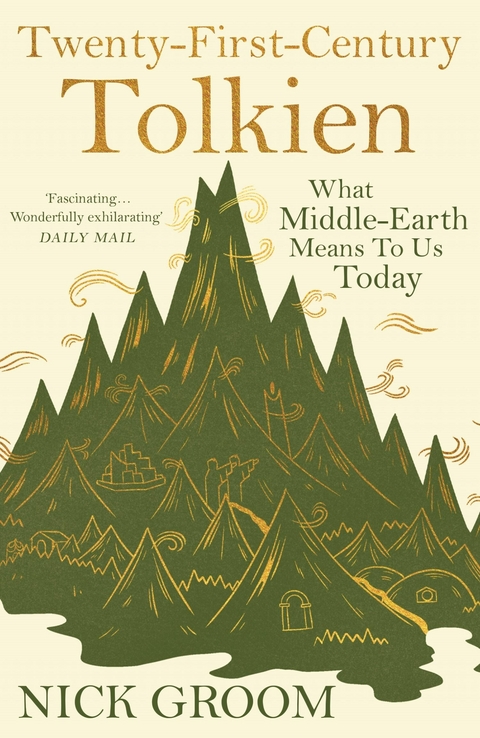
Twenty-First-Century Tolkien (eBook)
448 Seiten
Atlantic Books (Verlag)
9781838956998 (ISBN)
Nick Groom is Professor in English at the University of Exeter, and Director of ECLIPSE (Exeter Centre for Literatures of Identity, Place, and Sustainability). He has written widely on literature, music, and contemporary art in both academic and popular publications, and is the author of several books including Introducing Shakespeare and The Forger's Shadow. He lives on Dartmoor. TheUnion Jack was published by Atlantic in 2006.
'Fascinating.... Wonderfully exhilarating.' Mail on SundayFinalist for The Tolkien Society Best Book AwardAn engaging, original and radical reassessment of J.R.R. Tolkien, revealing how his visionary creation of Middle-Earth is more relevant now than ever before. What is it about Middle-Earth and its inhabitants that has captured the imagination of millions of people around the world? And why does Tolkien's visionary creation continue to fascinate and inspire us eighty-five years on from its first appearance?Beginning with Tolkien's earliest influences and drawing on key moments from his life, Twenty-First-Century Tolkien is an engaging and radical reinterpretation of the beloved author's work. Not only does it trace the genesis of the original books, it also explores the later adaptations and reworkings that cemented his reputation as a cultural phenomenon, including Peter Jackson's blockbuster films of The Lord of the Rings and The Hobbit and the highly anticipated TV series The Rings of Power. Delving deep into topics such as friendship, failure, the environment, diversity, and Tolkien's place in a post-Covid age, Nick Groom takes us on an unexpected journey through Tolkien's world, revealing how it is more relevant now than ever before.
Nick Groom is currently Professor of Literature in English at the University of Macau, having previously held positions at the universities of Bristol, Chicago, Stanford and Exeter, where he holds an Honorary Professorship. His previous books include The Forger's Shadow, The Union Jack, The Seasons, The Gothic and The Vampire.
Foreword
The love that dare not speak its name.
Lord Alfred Douglas, ‘Two Loves’ (1894)
This is a book unlike other books on Tolkien and his visionary creation of Middle-Earth. To begin: I first read The Lord of the Rings aged thirteen, and was totally enraptured by Middle-Earth. The finest analogy I have found to my experience is in the words of the much-loved and greatly lamented writer Terry Pratchett, who described his first encounter with The Lord of the Rings in the most reverential terms: he read it as a teenager, babysitting on New Year’s Eve – ‘I have never since then so truly had the experience of being inside the story.’1
This book is about being inside the story, a wild story. It is not an (apparently) straightforward introduction to Tolkien’s world – not only are there plenty of such primers, guides, and encyclopedias, but they tend to get rapidly bogged down in the minutiae of Tolkien’s ‘legendarium’ or ‘mythos’ (his complex architecture of gods and goddesses, the intricate lore of the many peoples of Middle-Earth, and their entangled histories and tales across thousands of years). Within a few pages, these books are preaching to the converted and are lost in the arcana of the ‘Ainur’ and ‘Maiar’, and purveying imaginary deities to perplexed readers rather than doing what they should be doing, which is, simply, explaining the value of the writing. Neither is this book an academic study of the challenges that Tolkien’s work poses to his readers in such areas as the twists and turns of invented languages and alphabets, or the workings of Catholic theology. Such extreme erudition stifles the appreciation of the works as literature, and as a wider culture – indeed, this work could be deemed worthy but worthless; of undoubted scholarly significance, but of interest only to the cognoscenti.
In contrast, Twenty-First-Century Tolkien takes as its starting point the Tolkien phenomenon today: a multi-media mix and fix of literature, art, music, radio, cinema, gaming, fandom, and popular culture – a never-ending Middle-Earth. We cannot return to a purely literary Middle-Earth independent of, primarily, Sir Peter Jackson’s extraordinary films. We should therefore accept that any assessment of newly published works drawn from the Tolkien archives – as well as new adaptations of his tales and imagined histories – are inevitably going to be deeply coloured by the multifaceted twenty-first-century Tolkien ‘industry’, for want of a better term.
In that respect at least, Tolkien can be compared with Shakespeare: he is not simply an author and a body of work, but a vast and growing field of cultural activity and products. This ‘discourse’ – and I will try not to use that word again – combines Tolkien’s earliest influences and sources (from Beowulf to Peter Pan), biographical details (two world wars and half a century of university politics – mainly at Oxford), and an astonishingly rich variety of texts (poetry, drama, fiction, literary criticism, philological scholarship, and so forth) with the dazzling efflorescence of adaptations that began in his lifetime and have since expanded to Himalayan proportions. Even before the publication of the final volume of The Lord of the Rings (itself one of the bestselling books of all time), Tolkien had received a proposal for a BBC radio adaptation. The rage for adaptation is, however, seen most markedly, of course, in six films that in the past two decades have each grossed close on $1 billion.2 This stratospheric ascent has also happened remarkably quickly. In the case of Shakespeare it took at least a century for the reputation of th’ immortal Swan of Avon to take flight and another century for the Bard to become an international icon and the foundation of a global market; in the case of Tolkien it was already happening in his lifetime and was cemented within thirty years of his death. Since then, things have accelerated even more rapidly: the unparalleled worldwide success of Harry Potter, in tandem with the Tolkien film franchise, was achieved within a dizzying five years. We will never see such a phenomenon again. Never again.
This book is published to coincide with another major intercession in this passionately debated and zealously defended – and protected – artistic world. The Amazon Prime Video TV series of The Rings of Power is, at a rumoured $1 billion, the most expensive television series yet made; it premièred on 2 September 2022. The Rings of Power is set in the ‘Second Age’, thus pre-dating the events of The Lord of the Rings by several thousand years, yet including some of the same immortal characters – principally the rebel Elf warrior-queen Galadriel. This material is gleaned from the appendices of The Lord of the Rings (which run to 150 pages) and from passing evidence in the text (and, less so, in The Hobbit) such as that provided by songs and in fragments of historical detail. It is also worth pointing out that some episodes from the novel have in any case never been filmed (or been developed as games), so there may well be an opportunity to incorporate these incidents as well.
The viewers of this new series – and indeed the vast majority of those who enjoy Tolkien’s books, and the radio series, films, games, and artwork inspired by his work – have at best only a passing interest in Tolkien’s Anglo-Saxon and mediaeval learning, the composition of his works, his obsessively detailed invented languages, or his Roman Catholicism. Any popular book on Tolkien needs to grasp this nettle: Tolkien is not only for the academics, the fans, and the self-styled experts, but has a far broader appeal. A straightforward example: among the ‘castaways’ on BBC Radio 4’s Desert Island Discs who selected The Lord of the Rings to accompany the Bible and the works of Shakespeare are figures as diverse as primatologist Dr Jane Goodall, mountaineer Sir Edmund Hillary, botanist David Bellamy, and folksinger Mary O’Hara – none of whom are philologists specializing in Old English.3
The appeal of Middle-Earth can best be addressed and enhanced, then, by moving Tolkien away from the dusty antiquarian and highly specialized commentaries and towards more contemporary ways of understanding the extraordinary creative achievement of his work. His writing is enthrallingly intricate, tentative and absorbing. This speaks to us today. Tolkien’s open and experimental approaches can demonstrate his striking relevance for the most pressing issues confronting the Human condition in the twenty-first century. Writing predominantly in the 1930s and 1940s, Tolkien clearly could not anticipate the crises of the present, but through often surprisingly prescient episodes and especially in the retelling and reinvention of his characters and narratives in different formats, his work is becoming a touchstone of current concerns. More and more, we are beginning to think through Tolkien.
So while there is always room for Tolkien purists – not least because through the volumes of Middle-Earth writings and specialist websites, Tolkien has become a culture that requires keen-eyed custodians, curators, and critics – mention of Tolkien or Middle-Earth or The Lord of the Rings is no longer rooted in the books. Rather, the books are the source of a radical typology of characters and places and plots that can be reinvented across film, television, and computer gaming, as well as art and music, LARP (live-action role-play) and tourism, and many other activities.4 There are, for instance, some 100,000 hits on the online art gallery DeviantArt simply for the word ‘Hobbit’.5
Consequently, the huge anticipated global audience for the Amazon Prime Video TV series may well benefit from a book on Tolkien that cuts across the past eighty-five years since the inaugural publication of The Hobbit to identify why the books and media adaptations have been so popular. The answer to this is definitely not that Tolkien invented, say, a highly complex language system for Elves (although this does have some curious implications), but rather, I suggest, because his writing is creatively open-ended, humane (and yet intensely aware of non-Human perspectives), and environmentally sensitive. In a word, Tolkien, in his many guises, offers a richly rewarding re-enchantment of the world – something we desperately need after a global pandemic, repeated national and international lockdowns, and growing social isolation, as well as in the wider, apocalyptic contexts of political extremism and instability, climate change, and ecological disasters such as snowballing species extinction. Tolkien’s vision increasingly has value today: more than ever, this is the Tolkien moment.
Twenty-First-Century Tolkien will accordingly consider areas such as uncertainty and the indeterminate, failure, friendship, the contradictions of his environmental imagination, the significance of things and objects (both inanimate and animate), and the weird and eerie in the books and films and games (and, more broadly, in Tolkien’s other work) – as well as Tolkien in a post-Covid age. I begin with the multiple Tolkiens that existed, then survey his often frantic professional life and attempts to write for the press, and outline his love of Anglo-Saxon and mediaeval sources, before turning to the thorny...
| Erscheint lt. Verlag | 1.9.2022 |
|---|---|
| Zusatzinfo | B&W illustrations |
| Verlagsort | London |
| Sprache | englisch |
| Themenwelt | Literatur ► Essays / Feuilleton |
| Geschichte ► Teilgebiete der Geschichte ► Kulturgeschichte | |
| Geisteswissenschaften ► Sprach- / Literaturwissenschaft ► Anglistik / Amerikanistik | |
| Geisteswissenschaften ► Sprach- / Literaturwissenschaft ► Literaturwissenschaft | |
| Sozialwissenschaften | |
| Schlagworte | beren and luthien • bilbo baggins • children of hurin • Fantasy • fellowship of the ring • Gandalf • Goblins • Gollum • Hobbit • Hobbits • Lord of the Rings • Middle Earth • Orcs • return of the king • Rings of Power • second age • Silmarillion • two towers • Unfinished Tales |
| ISBN-13 | 9781838956998 / 9781838956998 |
| Informationen gemäß Produktsicherheitsverordnung (GPSR) | |
| Haben Sie eine Frage zum Produkt? |
 EPUB (Wasserzeichen)
DRM: Digitales Wasserzeichen
Dieses eBook enthält ein digitales Wasserzeichen und ist damit für Sie personalisiert. Bei einer missbräuchlichen Weitergabe des eBooks an Dritte ist eine Rückverfolgung an die Quelle möglich.
Dateiformat: EPUB (Electronic Publication)
EPUB ist ein offener Standard für eBooks und eignet sich besonders zur Darstellung von Belletristik und Sachbüchern. Der Fließtext wird dynamisch an die Display- und Schriftgröße angepasst. Auch für mobile Lesegeräte ist EPUB daher gut geeignet.
Systemvoraussetzungen:
PC/Mac: Mit einem PC oder Mac können Sie dieses eBook lesen. Sie benötigen dafür die kostenlose Software Adobe Digital Editions.
eReader: Dieses eBook kann mit (fast) allen eBook-Readern gelesen werden. Mit dem amazon-Kindle ist es aber nicht kompatibel.
Smartphone/Tablet: Egal ob Apple oder Android, dieses eBook können Sie lesen. Sie benötigen dafür eine kostenlose App.
Geräteliste und zusätzliche Hinweise
Buying eBooks from abroad
For tax law reasons we can sell eBooks just within Germany and Switzerland. Regrettably we cannot fulfill eBook-orders from other countries.
aus dem Bereich