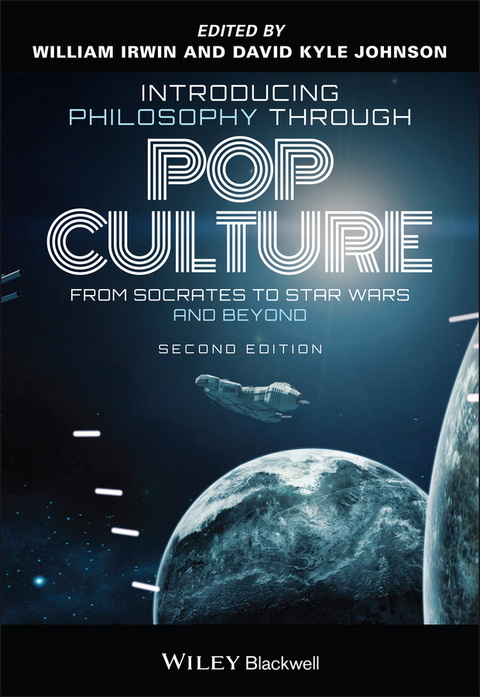
Introducing Philosophy Through Pop Culture (eBook)
John Wiley & Sons (Verlag)
978-1-119-75718-4 (ISBN)
Can Wonder Woman help us understand feminist philosophy? How Does Wakandan technology transcend anti-Blackness? What can Star Trek teach us about the true nature of reality?
Introducing Philosophy Through Pop Culture makes important philosophical concepts and the work of major philosophers relevant, fun, and exciting. Using engaging examples from film and television, this easy-to-read book covers everything from basic metaphysics and epistemology to abstract and complex philosophical ideas about ethics and the meaning of life. You don't have to be a pop culture expert to benefit from this book-even a general awareness of cultural icons like Superman or Harry Potter will be more than enough for you to learn about a wide range of philosophical notions, thinkers, and movements.
The expanded second edition offers timely coverage of important topics such as race, gender, personal identity, social justice, and environmental ethics. New essays explore the philosophical underpinnings of The Good Place, Game of Thrones, Black Panther, Star Wars, The Avengers, South Park, The Lego Movie, The Big Bang Theory, and more. This edition is supported by a new website with links to primary philosophical texts, information about all the popular culture discussed, and additional resources for teachers, students, and general readers alike.
- Features a selection of key essays from the bestselling Blackwell Philosophy and Pop Culture Series
- Draws on examples from popular media including The Matrix, Lost, Doctor Strange, The Hobbit, Westworld, and Star Trek
- Explains philosophical concepts such as relativism, skepticism, existentialist ethics, logic, social contract theory, utilitarianism, and mind-body dualism
- Discusses the ideas of Socrates, Aristotle, Plato, Descartes, Nietzsche, Heidegger, Marx, Mill, Kierkegaard, and other important thinkers
Introducing Philosophy Through Pop Culture is an excellent supplementary textbook for introductory philos for introductory philosophy courses and a valuable resource for general readers wanting to learn about philosophy and its connections with pop culture.
WILLIAM IRWIN is a Professor of Philosophy at King's College, Wilkes-Barre, Pennsylvania. He originated the philosophy and pop culture genre of books with Seinfeld and Philosophy in 1999. He is General Editor of the Blackwell Philosophy and Pop Culture Series and the author of The Meaning of Metallica: Ride the Lyrics.
DAVID KYLE JOHNSON is a Professor of Philosophy at King's College, Wilkes-Barre, Pennsylvania. He is Editor of Inception and Philosophy and Black Mirror and Philosophy, and is Editor-in-Chief of The Palgrave Handbook of Popular Culture as Philosophy.
Can Wonder Woman help us understand feminist philosophy? How Does Wakandan technology transcend anti-Blackness? What can Star Trek teach us about the true nature of reality? Introducing Philosophy Through Pop Culture makes important philosophical concepts and the work of major philosophers relevant, fun, and exciting. Using engaging examples from film and television, this easy-to-read book covers everything from basic metaphysics and epistemology to abstract and complex philosophical ideas about ethics and the meaning of life. You don t have to be a pop culture expert to benefit from this book even a general awareness of cultural icons like Superman or Harry Potter will be more than enough for you to learn about a wide range of philosophical notions, thinkers, and movements. The expanded second edition offers timely coverage of important topics such as race, gender, personal identity, social justice, and environmental ethics. New essays explore the philosophical underpinnings of The Good Place, Game of Thrones, Black Panther, Star Wars, The Avengers, South Park, The Lego Movie, The Big Bang Theory, and more. This edition is supported by a new website with links to primary philosophical texts, information about all the popular culture discussed, and additional resources for teachers, students, and general readers alike. Features a selection of key essays from the bestselling Blackwell Philosophy and Pop Culture Series Draws on examples from popular media including The Matrix, Lost, Doctor Strange, The Hobbit, Westworld, and Star Trek Explains philosophical concepts such as relativism, skepticism, existentialist ethics, logic, social contract theory, utilitarianism, and mind-body dualism Discusses the ideas of Socrates, Aristotle, Plato, Descartes, Nietzsche, Heidegger, Marx, Mill, Kierkegaard, and other important thinkers Introducing Philosophy Through Pop Culture is an excellent supplementary textbook for introductory philos for introductory philosophy courses and a valuable resource for general readers wanting to learn about philosophy and its connections with pop culture.
WILLIAM IRWIN is a Professor of Philosophy at King's College, Wilkes-Barre, Pennsylvania. He originated the philosophy and pop culture genre of books with Seinfeld and Philosophy in 1999. He is General Editor of the Blackwell Philosophy and Pop Culture Series and the author of The Meaning of Metallica: Ride the Lyrics. DAVID KYLE JOHNSON is a Professor of Philosophy at King's College, Wilkes-Barre, Pennsylvania. He is Editor of Inception and Philosophy and Black Mirror and Philosophy, and is Editor-in-Chief of The Palgrave Handbook of Popular Culture as Philosophy.
Notes on Contributors
Robert Arp works for the US Army at Fort Leavenworth and teaches philosophy courses at several schools online. He has edited and co‐edited nearly two dozen books, as well as authored and co‐authored some three dozen chapters, in the pop culture and philosophy realm.
Steve Bein is Associate Professor of Philosophy at the University of Dayton, where he is a specialist in Asian philosophies. He is a regular contributor to volumes on philosophy and pop culture, including chapters on Star Trek, Wonder Woman, LEGO, Blade Runner, Disney, Mr. Rogers, Batman, and the forthcoming Black Panther and Philosophy. He’s also a novelist, and his sci‐fi short stories have been used in philosophy and science fiction courses across the US. His philosophy books include Purifying Zen and Compassion and Moral Guidance.
Jeremy David Bendik‐Keymer holds the Beamer‐Schneider Professorship in Ethics in the Department of Philosophy at Case Western Reserve University in Cleveland, Ohio, where the land is occupied only through violated indigenous treaties from the late eighteenth century. His books include The Ecological Life: Discovering Citizenship and a Sense of Humanity and The Wind ~ An Unruly Living, and Involving Anthroponomy in the Anthropocene: On Decoloniality.
Arno Bogaerts finished his studies in philosophy and ethics at the Vrije Universiteit Brussel in Belgium, where he wrote several essays focusing on the superhero genre. He is a writer and editor for the Belgian comic book website Brainfreeze and has contributed chapters to The Avengers and Philosophy and Superman and Philosophy. Currently, Bogaerts owns and manages a rock bar and is thinking about getting yet another Superman tattoo.
Timothy E. Brown is Assistant Professor of Bioethics and Humanities at the University of Washington. Dr. Brown is a founding member of and long‐term contributor to the Neuroethics Thrust within the Center for Neurotechnology at UW. He also leads diversity, equity, and inclusion efforts with the International Neuroethics Society. Dr. Brown works at the intersection of biomedical ethics, philosophy of technology, (black/latinx/queer) feminist thought, and esthetics. His research explores the potential impact of neurotechnologies – systems that record and stimulate the nervous system – on end users' sense of agency and embodiment. His work also interrogates neurotechnologies for their potential to exacerbate or create social inequities, in order to establish best practices for the design of future devices and techniques.
Paul A. Cantor is Clifton Waller Barrett Professor of English at the University of Virginia. He has also taught at Harvard University in both the English and the Government departments. He has published widely on popular culture, including his books Gilligan Unbound: Pop Culture in the Age of Globalization, The Invisible Hand in Popular Culture: Liberty vs. Authority in American Film and TV, and Pop Culture and the Dark Side of the American Dream: Con Men, Gangsters, Drug Lords, and Zombies.
Roy T. Cook is Professor of Philosophy at the University of Minnesota – Twin Cities. He works primarily on the philosophy of mathematics, logic, and the aesthetics of popular culture. He is the author of The Dictionary of Philosophical Logic, Key Concepts in Philosophy: Paradoxes, The Yablo Paradox: An Essay on Circularity; and editor or co‐editor of The Arche Papers on the Mathematics of Abstraction, The Art of Comics: A Philosophical Approach (with Aaron Meskin), The Routledge Companion to Comics (with Frank Bramlett and Aaron Meskin), LEGO and Philosophy: Constructing Reality Brick‐by‐Brick (with Sondra Bacharach), and Hilary Putnam on Logic and Mathematics (with Geoffrey Hellman).
Richard Davies studied and taught Philosophy at Trinity College, Cambridge (Ph.D. 1992). He now lives in Italy, where he is a professor of Theoretical Philosophy at the University of Bergamo. He has written books and articles on a range of topics, most recently on women in Plato's Republic, on the interpretation of logical symbolism and on the notion of a fallacy.
William J. Devlin is Professor of Philosophy at Bridgewater State University, offering classes in existentialism, nineteenth‐century philosophy, philosophy of science, and philosophy of film. His publications in philosophy and popular culture include chapters in Westworld and Philosophy, Game of Thrones and Philosophy, Lost and Philosophy, and South Park and Philosophy.
George A. Dunn has taught philosophy in both the United States and China. He is currently a special research fellow with the Institute for Globalizing Civilization in Hangzhou China. He has edited or co‐edited several volumes in the Philosophy and Pop Culture series. His latest book is A New Politics for Philosophy: Essays on Plato, Nietzsche, and Strauss.
Jeff Ewing is a film and culture analyst whose work has appeared in Forbes, Looper, and numerous other periodicals. In addition to publishing various chapters exploring the philosophical underpinnings of popular culture, he has co‐edited Alien and Philosophy and Stranger Things and Philosophy. Beyond print, Jeff hosts a podcast dedicated to exploring the deeper ideas behind our favorite monsters and monster movies, Humanoids from the Deep Dive.
John R. Fitzpatrick was a lecturer in philosophy at the University of Tennessee at Chattanooga and the author of John Stuart Mill's Political Philosophy and Starting With Mill.
Dara Fogel is a philosopher, author, and educator. She holds a doctorate in Philosophy from the University of Oklahoma and has taught philosophy, religious studies, and humanities at several universities and colleges in the Southwest. She has published four books, including her bestselling steampunk conspiracy series, the GrailChase Chronicles, and one non‐fiction. A confirmed geek, she bridges the gaps between popular culture, cutting edge sciences, mysticism, philosophy and dramaturgy, to bring a deeper perspective of self‐knowledge and ancient wisdom to new audiences.
Robert K. Garcia is an Associate Professor of Philosophy at Baylor University, where he works in analytic metaphysics and philosophy of religion. He is the co‐editor of Is Goodness without God Good Enough? and is writing a book on C. S. Lewis's views about the uniqueness of persons.
Lucia Carrillo González is a philosophy secondary teacher in Andalucia, Spain and is very passionate about the role of philosophy in the education system. Her main area of research is metaphysics, specifically truth‐making and possibilities.
Matt Hummel works as a paralegal for the Public Defender Agency in Evansville, IN. He is also an adjunct instructor of Legal Studies, Legal Ethics, and Criminal Justice Ethics at Ivy Tech Community College. He has published two chapters in the Blackwell Pop Culture and Philosophy series as well as a blog entry for Black Mirror and Philosophy.
William Irwin is Herve A. LeBlanc Distinguished Service Professor in the Philosophy Department at King's College (PA) and the General Editor of The Blackwell Philosophy and Pop Culture Series. Irwin originated the popular culture and philosophy genre of books in 1999 with Seinfeld and Philosophy. He co‐edited The Simpsons and Philosophy and edited The Matrix and Philosophy, Metallica and Philosophy, and Black Sabbath and Philosophy. Irwin is the author of The Free Market Existentialist: Capitalism without Consumerism and has published two novels.
Henry Jacoby taught philosophy for nearly 40 years, most of them at East Carolina University in Greenville, North Carolina, before his retirement in 2020. He is the editor of House and Philosophy, and Game of Thrones and Philosophy, and the author of Why Philosophy Matters. He now spends his time practicing kung fu, playing guitar, and writing horror novels. He lives in Goldsboro, North Carolina with his wife Kathryn, their dog Benjen, and their two cats, Kameko and Grynx.
David Kyle Johnson is a professor of philosophy at King's College (PA), and he also produces lecture series for The Teaching Company's The Great Courses (such as Sci‐Phi: Science Fiction as Philosophy, The Big Questions of Philosophy, and Exploring Metaphysics). Kyle is the editor‐in‐chief of The Palgrave Handbook of Popular Culture as Philosophy and also regularly edits volumes for the Blackwell‐Wiley Philosophy and Pop Culture series. Most recently this includes Black Mirror and Philosophy: Dark Reflections. He also maintains two blogs for Psychology Today: Plato on Pop (with William Irwin) and A Logical Take.
David Kahn is the author of Case, Spandex, Briefcase: Leadership Lessons from Superheroes. As a Human Resource Executive, executive coach, and speaker, David concentrates on incorporating the principles of positive culture, leadership, and organizational development to improve business strategies and, ultimately, performance.
Ruby Komic is a pop‐culture‐overthinker from Melbourne, Australia. In 2021, she completed her Master of Arts in Philosophy, at...
| Erscheint lt. Verlag | 10.3.2022 |
|---|---|
| Sprache | englisch |
| Themenwelt | Geisteswissenschaften ► Philosophie ► Allgemeines / Lexika |
| Geisteswissenschaften ► Philosophie ► Geschichte der Philosophie | |
| Geisteswissenschaften ► Philosophie ► Philosophie der Neuzeit | |
| Sozialwissenschaften | |
| Schlagworte | Cultural Studies • Einführungen in die Philosophie • Introductions to Philosophy • Kulturwissenschaften • <p>intro to philosophy • movie philosophy in movies • philosophers and pop culture </p> • Philosophie • Philosophy • philosophy basics • philosophy concepts pop culture • Philosophy fundamentals • philosophy in television • philosophy pop culture • philosophy pop culture essays • popular culture • Volkskultur |
| ISBN-10 | 1-119-75718-5 / 1119757185 |
| ISBN-13 | 978-1-119-75718-4 / 9781119757184 |
| Informationen gemäß Produktsicherheitsverordnung (GPSR) | |
| Haben Sie eine Frage zum Produkt? |
 EPUB (Adobe DRM)
Kopierschutz: Adobe-DRM
Adobe-DRM ist ein Kopierschutz, der das eBook vor Mißbrauch schützen soll. Dabei wird das eBook bereits beim Download auf Ihre persönliche Adobe-ID autorisiert. Lesen können Sie das eBook dann nur auf den Geräten, welche ebenfalls auf Ihre Adobe-ID registriert sind.
Details zum Adobe-DRM
Dateiformat: EPUB (Electronic Publication)
EPUB ist ein offener Standard für eBooks und eignet sich besonders zur Darstellung von Belletristik und Sachbüchern. Der Fließtext wird dynamisch an die Display- und Schriftgröße angepasst. Auch für mobile Lesegeräte ist EPUB daher gut geeignet.
Systemvoraussetzungen:
PC/Mac: Mit einem PC oder Mac können Sie dieses eBook lesen. Sie benötigen eine
eReader: Dieses eBook kann mit (fast) allen eBook-Readern gelesen werden. Mit dem amazon-Kindle ist es aber nicht kompatibel.
Smartphone/Tablet: Egal ob Apple oder Android, dieses eBook können Sie lesen. Sie benötigen eine
Geräteliste und zusätzliche Hinweise
Buying eBooks from abroad
For tax law reasons we can sell eBooks just within Germany and Switzerland. Regrettably we cannot fulfill eBook-orders from other countries.
aus dem Bereich