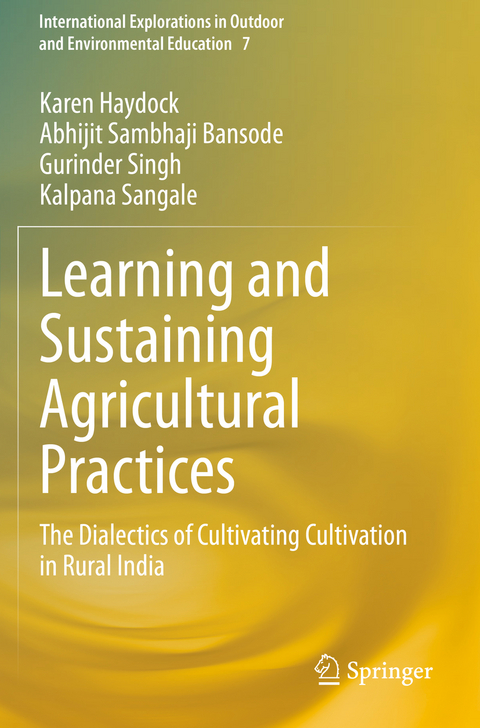
Learning and Sustaining Agricultural Practices
Springer International Publishing (Verlag)
978-3-030-64067-5 (ISBN)
lt;p>Karen Haydock is retired from the faculty of Homi Bhabha Centre for Science Education (Tata Institute of Fundamental Research), Mumbai, and is a Senior Fellow of the Indian Council of Social Science Research at Tata Institute of Social Sciences, Mumbai, India. Her research focusses on understanding school-level learning/teaching of natural and social sciences and art (particularly evolution, agriculture, and environmental science) in a few places in urban and rural India. Her research is related to her work developing materials and methods and teaching both children and teachers. She is also an artist, and has written and illustrated numerous books for children.
Abhijit Bansode is working on his PhD in Development Studies at Tata Institute of Social Sciences, Mumbai, where he previously completed his MPhil in Development Studies and MA in Social Work in Dalit and Tribal Studies and Action. He obtained his BA in Political Science (First Class) from the University of Mumbai. His MA and PhD research has focussed on studying the nutritional status of Tribal children in different districts of Maharashtra.
Gurinder Singh is a research scholar pursuing his Ph.D. in Science Education at Homi Bhabha Centre for Science Education, Mumbai. Gurinder's Ph.D thesis, looks into the process and dynamics of student questioning and its role in doing science. He is interested in studying student talks/discussions/arguments and investigation/exploration initiated by students' authentic questions (questions for which they do not know the answers) and how such an understanding can help in constructing meaningful contexts for classrooms in which students' questions acquire a central role. Before joining the Ph.D. program, he taught Physics for about 8 years at secondary and senior secondary schools in Ludhiana, Punjab (which is his hometown), and Mathematics briefly in UK. He has a Bachelor of Education and Master of Science in Physics. He is working with Navnirmiti, a Mumbai based NGO, for projects on teaching of Science and Mathematics to middle school students of government schools. In these projects he is mainly involved in teacher training programs and development of science modules.Introduction: Who are we, and what are we doing?.- Chapter 1. The Superficial Appearances.- Chapter 2. Dialectical Conflicts. Chapter 3. Formal Education vs Learning Cultivation.- Chapter 4. The Historical Development of Education Related to Agriculture in India.- Chapter 5. The Historical Development of Paddy Cultivation.- Chapter 6. A Deeper Understanding of the Process of Doing Paddy Cultivation.- Chapter 7. What is actually happening in formal education?.- Chapter 8. Conclusions and Implications.
| Erscheinungsdatum | 31.03.2022 |
|---|---|
| Reihe/Serie | International Explorations in Outdoor and Environmental Education |
| Zusatzinfo | XXXIII, 313 p. 50 illus. |
| Verlagsort | Cham |
| Sprache | englisch |
| Maße | 155 x 235 mm |
| Gewicht | 534 g |
| Themenwelt | Sozialwissenschaften ► Pädagogik ► Erwachsenenbildung |
| Schlagworte | Agrarian Transition • Agricultural Crisis in India • Agricultural geography • Case Study of Farm in India • Dialectics of Cultivation Vs Education • Green Revolution and Education • Historical Dialectical Materialism • History of Agricultural Education in India • History of Rice Cultivation • Learning Traditional Paddy Cultivation • Marxist Understanding of Agriculture • Preservation of Rice Diversity • School Education Related to Agriculture • The Agrarian Question in India • Vocational Education and Skilling India |
| ISBN-10 | 3-030-64067-1 / 3030640671 |
| ISBN-13 | 978-3-030-64067-5 / 9783030640675 |
| Zustand | Neuware |
| Informationen gemäß Produktsicherheitsverordnung (GPSR) | |
| Haben Sie eine Frage zum Produkt? |
aus dem Bereich