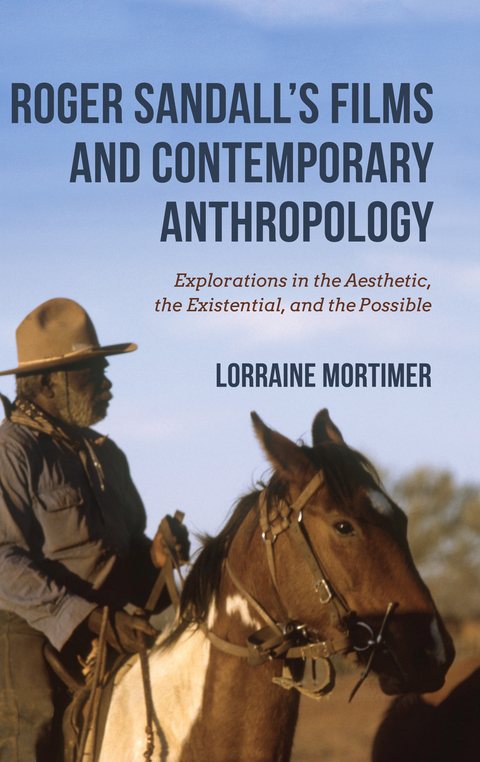
Roger Sandall's Films and Contemporary Anthropology (eBook)
352 Seiten
Indiana University Press (Verlag)
978-0-253-04395-5 (ISBN)
1. This book explores the extensive documentary and ethnographic work of filmmaker Roger Sandall, who won First Prize for Documentary at the Venice Film Festival in 1968, yet whose documentary work remains largely unknown.
2. This book will be significant to anthropologists in that it demonstrates the importance and potential of film for anthropological research.
3. The author has also worked extensively with representatives from the Australian Aboriginal peoples represented in the films and has received their approval and support of the work.
In this book Lorraine Mortimer reunites film and anthropology through the works of Roger Sandall, a New Zealand-born filmmaker and Columbia University graduate, who was part of the vibrant avant-garde and social documentary film culture in New York in the 1960s.
In Roger Sandall's Films and Contemporary Anthropology, Lorraine Mortimer argues that while social anthropology and documentary film share historic roots and goals, particularly on the continent of Australia, their trajectories have tended to remain separate. This book reunites film and anthropology through the works of Roger Sandall, a New Zealand-born filmmaker and Columbia University graduate, who was part of the vibrant avant-garde and social documentary film culture in New York in the 1960s. Mentored by Margaret Mead in anthropology and Cecile Starr in fine arts, Sandall was eventually hired as the one-man film unit at the newly formed Australian Institute of Aboriginal Studies in 1965. In the 1970s, he became a lecturer in anthropology at the University of Sydney. Sandall won First Prize for Documentary at the Venice Film Festival in 1968, yet his films are scarcely known, even in Australia now. Mortimer demonstrates how Sandall's films continue to be relevant to contemporary discussions in the fields of anthropology and documentary studies. She ties exploration of the making and restriction of Sandall's aboriginal films and his nonrestricted films made in Mexico, Australia, and India to the radical history of anthropology and the resurgence today of an expanded, existential-phenomenological anthropology that encompasses the vital connections between humans, animals, things, and our environment.
Lorraine Mortimer is Honorary Associate in the Department of Anthropology at the University of Sydney and has taught in Sociology/Anthropology and Cinema Studies. She is the translator of Edgar Morin's The Cinema or The Imaginary Man: An Essay in Sociological Anthropology and author of Terror and Joy: The Films of Dušan Makavejev.
Acknowledgments
Introduction
1. Trusting the Material: Maíz (1962)
2. Environments Fit for the Spirit: The Flahertys, Sandall, and some Anarchist Anthropology
3. They Were Still Participants: The Ritual Films (1966-1976)
4. The Colors of the Infinite: Camels and the Pitjantjara (1969)
5. "What You Thinkin' About, Little Horse?": Coniston Muster: Scenes from a Stockman's Life (1972)
6. Harmony and Fire: Making a Bark Canoe (1969) and Ngatjakula: A Walbiri Fire Ceremony (1967 and 1977)
7. More Optional and More Fragile: Weddings (1976)
8. In the Floating Desert with Jayasinhji Jhala Part 1: The Tragada Bhavai: A Rural Theater Troupe of Gujarat (1981), A Zenana: Scenes and Recollections (1982), and The Bharvad Predicament (1987)
9. In the Floating Desert with Jayasinhji Jhala Part 2: Close Encounters of No Kind (2002), and Nomads
A (Relative) Conclusion
Appendix I: Roger Sandall's Filmed Material Held at the Australian Institute of Aboriginal and Torres Strait Islander Studies
Appendix II: Roger Sandall's Films Made (Produced, Directed and Edited), Film Awards, and Special Screenings
Appendix III: Innovation in Sound Recording Made During the Filming of the AIAS Ritual Films According to David MacDougall
Appendix IV: Availability of Sandall's Non-Restricted Films
Filmography
Bibliography
Index
| Erscheint lt. Verlag | 12.9.2019 |
|---|---|
| Zusatzinfo | 30 b&w illus. |
| Verlagsort | Bloomington |
| Sprache | englisch |
| Maße | 160 x 160 mm |
| Themenwelt | Kunst / Musik / Theater ► Film / TV |
| Kunst / Musik / Theater ► Theater / Ballett | |
| Sozialwissenschaften ► Ethnologie | |
| Sozialwissenschaften ► Kommunikation / Medien ► Medienwissenschaft | |
| Sozialwissenschaften ► Soziologie | |
| Schlagworte | Aboriginal • Aboriginal Men's ceremonies • Aboriginal Stockman • AIATSIS • Althusserian structuralism • Amanda Ravetz • André Bazin • André Gorz • Animal/Human Connections • Anna Grimshaw • Anthropology • Areyonga • Arnhem Land • A.R. Radcliffe-Brown • Aspiration to the Universal • Australia • Australian Afghans • avant-garde • A Zenana: Scenes and Recollections • Baldwin Spencer • Catherine Berndt • Cecile Starr • Cecil Holmes • Central Australian Cattle Stations • Cézanne • Charles Pépin • Commodification of Marriage • Coniston Johnny • Coniston Muster • Dance • Darby Jampijinpa Ross • Darwin • David Graeber • David MacDougall • Designer Tribalism • Documentary Film • DONNA HARAWAY • Dorothy Cinquemani • Dorothy Smith • Drought • Duns Scotus • Dwelling • Edgar Morin • Emmanuel Kant • Environment • Epistemology • Frances Flaherty • Frank Gillen • George O’Neil • Gerard Manley Hopkins • Ghoogali Brahmin • Hierarchy • Hindu • Honest Reporting • Isabelle Stengers • Islam • Jayasinhji Jhala • Jean Marshall • Jean Rouch • John Marshall • John Morton • Judith MacDougall • Ju/’hoansi • Ken Maddock • Killer Stories • Kim McKenzie • King Aitsinhji • kinship • Lacanian Structuralism • Lila Abu-Lughod • Literature • Louisiana Story • Marcel Mauss • Margaret Mead • Marilyn Waring • Namibia • Nanook of the North • Nature • nature film • Nena O’Neill • Ngatjakula: A Walbiri Fire Ceremony • Nicolas Peterson • Nicolas Rothwell • Observational Cinema • Ontolo • Ontological Primacy of the Real |
| ISBN-10 | 0-253-04395-6 / 0253043956 |
| ISBN-13 | 978-0-253-04395-5 / 9780253043955 |
| Informationen gemäß Produktsicherheitsverordnung (GPSR) | |
| Haben Sie eine Frage zum Produkt? |
 PDF (Adobe DRM)
Kopierschutz: Adobe-DRM
Adobe-DRM ist ein Kopierschutz, der das eBook vor Mißbrauch schützen soll. Dabei wird das eBook bereits beim Download auf Ihre persönliche Adobe-ID autorisiert. Lesen können Sie das eBook dann nur auf den Geräten, welche ebenfalls auf Ihre Adobe-ID registriert sind.
Details zum Adobe-DRM
Dateiformat: PDF (Portable Document Format)
Mit einem festen Seitenlayout eignet sich die PDF besonders für Fachbücher mit Spalten, Tabellen und Abbildungen. Eine PDF kann auf fast allen Geräten angezeigt werden, ist aber für kleine Displays (Smartphone, eReader) nur eingeschränkt geeignet.
Systemvoraussetzungen:
PC/Mac: Mit einem PC oder Mac können Sie dieses eBook lesen. Sie benötigen eine
eReader: Dieses eBook kann mit (fast) allen eBook-Readern gelesen werden. Mit dem amazon-Kindle ist es aber nicht kompatibel.
Smartphone/Tablet: Egal ob Apple oder Android, dieses eBook können Sie lesen. Sie benötigen eine
Geräteliste und zusätzliche Hinweise
Buying eBooks from abroad
For tax law reasons we can sell eBooks just within Germany and Switzerland. Regrettably we cannot fulfill eBook-orders from other countries.
aus dem Bereich