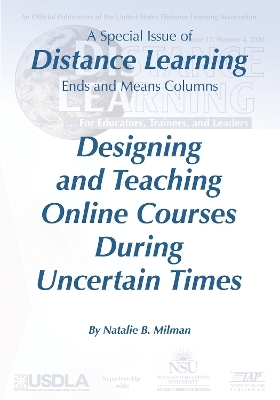
Distance Learning Vol 17 Issue 4
Information Age Publishing (Verlag)
9781648024467 (ISBN)
Distance Learning is for leaders, practitioners, and decision makers in the fields of distance learning, e-learning, telecommunications, and related areas. It is a professional journal with applicable information for those involved with providing instruction to all kinds of learners, of all ages, using telecommunications technologies of all types. Stories are written by practitioners for practitioners with the intent of providing usable information and ideas.Articles are accepted from authors, new and experienced, with interesting and important information about the effective practice of distance teaching and learning.
This special issue of Distance Learning consists of several Ends and Means articles that I have written or coauthored and that I have organized using the three major elements of the community of inquiry (CoI) framework. The last section has articles written by other authors who incorporated CoI.
Introduction to the Special Issue.
Section 1: Social Presence—Supporting Students.
Introduction to Section 1; Natalie B. Milman.
What is Student Well-Being? A Definition for Those who Teach Students in Blended and Online Higher Education Settings; Beth Tuckwiller and Natalie B. Milman.
Fostering Blended and Online Students' Well-Being; Natalie B. Milman and Beth Tuckwiller.
Teaching Online Postsecondary Students With a Disability, Chronic Health Condition, or Mental or Emotional Illness: Resources for Instructors; Natalie B. Milman.
How can Online Instructors Better Support Their Students; Natalie B. Milman.
Section 2: Cognitive Presence—Engaging Students.
Introduction to Section 2; Natalie B. Milman.
Scaffolding Student Facilitation of Online Discussions; Natalie B. Milman.
Strategies for Participating in Online Conferences and Discussions; Natalie B. Milman.
What is Engagement? Natalie B. Milman.
Motivating the Online Learner Using Keller's ARCS Model; Natalie B. Milman and Jeffrey Wessmiller.
Designing Active Learning Experiences in Online Courses; Natalie B. Milman.
Section 3: Teaching Presence—Designing Online Education.
Introduction to Section 3; Natalie B. Milman.
Transforming Traditional, Face-To-Face Courses to Online or Blended Learning Environments: Advice for Faculty and Instructional Designers; Marjorie Bazluki and Natalie B. Milman.
Crafting the Right Online Discussion Questions Using the Revised Bloom's Taxonomy as a Framework; Natalie B. Milman.
Differentiating Instruction in Online Environments; Natalie B. Milman.
The Flipped Classroom Strategy: What is it and How Can it Best be Used? Natalie B. Milman.
Navigating Online Virtual Group Work: Tips for Instructors and Students. Natalie B. Milman.
Resources and Factors to Consider When Designing New Online Programs. Natalie B. Milman.
Designing Asynchronous Online Discussions for Quality Interaction in Asynchronous Online Courses; Natalie B. Milman.
Tips for Success: The Online Instructor's (Short) Guide to Making Assignment Descriptions More Transparent; Natalie B. Milman.
Section 4: Community Of Inquiry Articles By Other Distance Learning Authors.
Introduction to Section 4; Natalie B. Milman.
Social Places in Virtual Spaces: Creating a Social Learning Community in Online Courses; Sheila Bolduc-Simpson and Mark Simpson.
The Potential of Asynchronous Video in Online Education; Michael E. Griffiths and Charles R. Graham.
Increasing Social Presence Online: Five Strategies for Instructors; Charlotte Jones-Roberts.
Chats and Shared Understanding: How Instructors Can Help Learners Use Academic Chat Rooms; David S. Stein and Constance E. Wanstreet.
E-Coaching Success Strategies for Synchronous Discussions; David S. Stein and Constance E. Wanstreet.
| Erscheinungsdatum | 12.12.2021 |
|---|---|
| Reihe/Serie | Distance Learning Journal |
| Sprache | englisch |
| Maße | 178 x 254 mm |
| Gewicht | 435 g |
| Themenwelt | Sozialwissenschaften ► Pädagogik ► Allgemeines / Lexika |
| Sozialwissenschaften ► Soziologie ► Empirische Sozialforschung | |
| ISBN-13 | 9781648024467 / 9781648024467 |
| Zustand | Neuware |
| Informationen gemäß Produktsicherheitsverordnung (GPSR) | |
| Haben Sie eine Frage zum Produkt? |
aus dem Bereich