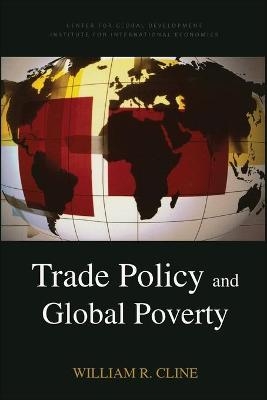
Trade Policy and Global Poverty
The Peterson Institute for International Economics (Verlag)
978-0-88132-365-8 (ISBN)
- Lieferbar (Termin unbekannt)
- Versandkostenfrei
- Auch auf Rechnung
- Artikel merken
The stakes of the poor in trade policy are large: Free trade can help 500 million people escape poverty and inject $200 billion annually into the economies of developing countries, according to author William R. Cline. This book provides a comprehensive analysis of the potential for trade liberalization to spur growth and reduce poverty in developing countries. It quantifies the impact on global poverty of industrial-country liberalization, as well as liberalization by the developing countries. Half or more of the annual gains from trade would come from the removal of industrial-country protection against developing-country exports. By removing their trade barriers, industrial countries could convey economic benefits to developing countries worth about twice the amount of their annual development assistance. By helping developing countries grow through trade, moreover, industrial countries could lower costs to consumers for imports and realize other economic efficiencies. The study estimates that free trade could reduce the number of people earning less than $2 per day by about 500 million over 15 years. This would cut the world poverty level by 25 percent.
Cline judges that the developing countries were right to risk collapse of the Doha Round at the Cancun ministerial meeting in September 2003 by insisting on much deeper liberalization of agriculture than the industrial countries were then willing to offer. The study calls for a two-track strategy: first, deep multilateral liberalization involving phased but complete elimination of industrial-county protection and deep reduction of protection by at least the middle-income developing countries, albeit on a more gradual schedule; and second, immediate free entry for imports from "high risk" low-income countries (heavily indebted poor countries, least developed countries, and sub-Saharan Africa), coupled with a 10-year tax holiday for direct investment in these countries.
William R. Cline has been a senior fellow at the Peterson Institute for International Economics since 1981. During 1996-2001 while on leave from the Institute, Dr. Cline was deputy managing director and chief economist of the Institute of International Finance (IIF) in Washington, DC. From 2002 through 2011 he held a joint appointment with the Peterson Institute and the Center for Global Development, where he is currently senior fellow emeritus. Before joining the Peterson Institute, he was senior fellow, the Brookings Institution (1973-81); deputy director of development and trade research, office of the assistant secretary for international affairs, US Treasury Department (1971-73); Ford Foundation visiting professor in Brazil (1970-71); and lecturer and assistant professor of economics at Princeton University (1967-70).
| Erscheint lt. Verlag | 16.6.2004 |
|---|---|
| Verlagsort | Washington |
| Sprache | englisch |
| Maße | 168 x 233 mm |
| Gewicht | 480 g |
| Themenwelt | Sozialwissenschaften ► Soziologie |
| Wirtschaft ► Volkswirtschaftslehre ► Makroökonomie | |
| ISBN-10 | 0-88132-365-9 / 0881323659 |
| ISBN-13 | 978-0-88132-365-8 / 9780881323658 |
| Zustand | Neuware |
| Informationen gemäß Produktsicherheitsverordnung (GPSR) | |
| Haben Sie eine Frage zum Produkt? |
aus dem Bereich