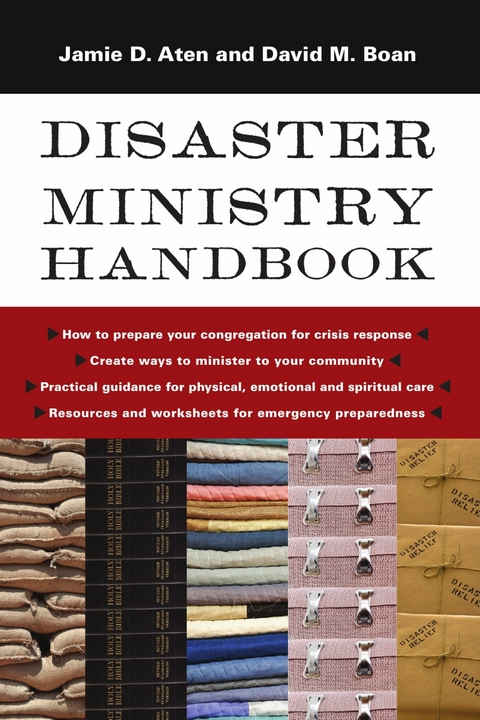
Disaster Ministry Handbook (eBook)
321 Seiten
InterVarsity Press (Verlag)
978-0-8308-9768-1 (ISBN)
Jamie D. Aten (PhD, Indiana State University) is the founder and codirector of the Humanitarian Disaster Institute, and Dr. Arthur P. Rech and Mrs. Jean May Rech Associate Professor of Psychology at Wheaton College (Wheaton, Illinois).
FEMA Community Preparedness AwardWhen disasters happen, people turn to local churches as centers for response and assistance. When floods or tornadoes devastate an area, or when shootings and violence shock a community, knowing what to do can be the difference between calm and chaos, courage and fear, life and death. But few churches plan in advance for what they should do until the storm hits. Don't get caught unprepared. If a natural disaster or human tragedy strikes your community, your church can minister to the hurting. Jamie Aten and David Boan, codirectors of the Humanitarian Disaster Institute, provide a practical guide for disaster preparedness. Disaster ministry is a critically important work of the church, preparing for the unthinkable, providing relief to survivors, caring for the vulnerable and helping communities recover. Filled with resources for emergency planning and crisis management, this book provides best practices for local congregations. By taking action in advance, your church can help prevent harm and save lives during a disaster. The time to plan is now. Be prepared.
Jamie D. Aten (PhD, Indiana State University) is the founder and codirector of the Humanitarian Disaster Institute, and Dr. Arthur P. Rech and Mrs. Jean May Rech Associate Professor of Psychology at Wheaton College (Wheaton, Illinois). Previously he served as the assistant director of the Katrina Research Center and as assistant professor of psychology at the University of Southern Mississippi. Aten has been awarded close to $2 million in external funding by numerous state, federal and nonprofit organizations for psychology of religion and disaster research. He has published numerous peer-reviewed articles and book chapters and co-edited several books, including two American Psychological Association Books bestsellers. He is also an American Psychological Association?s Division 36 (Psychology of Religion) Margaret Gorman Early Career Award winner and Mutual of America Merit Finalist Award winner. David Boan (PhD, Biola University) is associate professor of psychology at Wheaton College and codirector of the college's Humanitarian Disaster Institute, where he leads basic and applied research on international relief efforts. He is the author of many peer-reviewed publications and lives with his wife Andrea and two children in Wheaton, Illinois.
chapter one
Introduction
My wife, young daughter and I (Jamie) moved from the Chicago area to South Mississippi just six days before Hurricane Katrina struck the Gulf Coast. We did not have phone service or a decent television signal, so we were unaware of the ever so rapidly and dangerously increasing storm that was headed our way. We attended a large church just down the road from our home. After the warm welcome and greetings that followed the bellowing choir’s opening praise song, the pastor walked solemnly to the podium. With his jaw set, and in a slow southern drawl, he began his message by saying, “If you remember Camille, you know what I’m about to say.” My wife looked at me and asked, “Who is Camille?” to which I replied jokingly, “She must be in the Old Testament.” Unfortunately, we quickly learned about Hurricane Camille (which hit the Gulf Coast almost thirty years earlier) and were soon introduced to her counterpart—one of the worst natural disasters to ever strike our nation—Hurricane Katrina.
Being new to the area, as soon as the service ended I began nervously introducing myself to those in the pews around us. I wanted to know if this was something to be worried about. How do you prepare for a hurricane? I was from the North. I had never worried about hurricanes before. To my questions, I received answers like, “At worst, it’s going to be like camping for a day or two,” or, “You know, every year those news folks get up and tell us to take cover and get everyone upset, and for nothing, ’cause nothing happens. So I wouldn’t worry too much about it.” Despite their trying to reassure us, something did not feel right. So from church my family and I drove to my work office for Internet access. In my mind’s eye I can still see my wife sitting at my desk, pulling up the national weather station live radar while my daughter sat on my lap. Looking at the radar on the screen, I thought, We must be zoomed in on the image, but we were not. I had never seen anything like this before. From my office we headed home to try and get ready for the fast-approaching storm.
I soon found myself standing in our living room thinking and trying to remember all the things I had ever heard about preparedness and disasters. I recalled being an elementary child sitting under my desk with my hands over my head and my head between my knees. Okay, so that’s not going to help, I thought to myself. Think, Jamie. Just think. What else have you learned? Then I remembered all those post-9/11 public service ads that seemed to be everywhere at the time. So I ran to the kitchen and pulled open the junk drawer (you know, the one with twenty pens that don’t work and everything else you do not know what to do with). Eureka! I found it. I am ready, I thought to myself. I reached into the back of the drawer and pulled out a brand-new roll of duct tape. I quickly made my way through the house, duct tape in hand. I remembered that almost everything I had watched, read or heard about preparedness after 9/11 said, “Have duct tape.”
There I was, standing in the middle of the living room looking out our window knowing a threat was rapidly approaching. And all I could think was, Now what? Though I had a resource that was supposedly able to help me, I had no idea what to do with it.
My story is not unique. Most people do not know how to effectively prepare for or respond to disasters. Moreover, in conducting research around the globe, David and I have found a great deal of variability among how ready churches are for disasters. Some churches in high-risk areas are relatively prepared, and others little or not at all. We have found an alarming trend: most churches realize there are threats but few do anything ahead of time to actually prepare for disasters. Though we have found many churches volunteer and help other churches in communities that are affected by disasters, most are not ready for a disaster that could directly impact their congregation or community. However, there is good news. There are numerous practical steps congregations can take to prepare for and recover from disasters.
Purpose
Thus, the purpose of this book is to help churches learn how to plan, launch and sustain disaster ministries. Throughout this handbook we will provide best practices and lessons learned that will help your church and community to be more resilient in the face of catastrophes, crises and emergencies. David and I (Jamie) will also share numerous examples throughout the book to help you apply what you are learning. Many will come from my own personal Hurricane Katrina experience and from my time living in Mississippi. We will also provide examples from the work that David and I have done through Wheaton College’s Humanitarian Disaster Institute (HDI) all over the world with churches impacted by disasters and humanitarian crises. Then we will introduce discussion questions and tools that will help you and your congregation build on this knowledge so that you can develop an effective disaster ministry. Overall, this handbook is designed to help you navigate disasters, from emergency planning through the recovery process. The handbook gives congregations and denominations or associations the critical concepts and components of effective emergency planning and response.
Why This Handbook
Since the 1980s there has been roughly a 400 percent increase in natural disasters.1 The world’s five costliest natural disasters have occurred in the past twenty years, with three of those disasters striking in the last eight years alone. There have also been nearly 5,000 terrorist events annually over the last ten years.2 As we write in HDI’s Ready Faith: Planning Guide,
Natural disasters such as floods, earthquakes, fires and tornadoes can strike a community with little or no warning. An influenza pandemic, or other infectious disease, can spread from person to person causing serious illness across the country or around the globe in a very short time. Mass shootings have increased in frequency. The harrowing events of September 11 and subsequent terrorist attempts have ushered in a new awareness of terrorist threats. The unfortunate reality is that many congregations in this country may be touched either directly or indirectly by a disaster of some kind at any time.3
In brief, you might think of a disaster as anything that disrupts civic society. (See next chapter for more in-depth description and definitions.)
In our research4 and the research of others,5 it has been found that many people turn to faith and to local congregations for answers and assistance when disaster strikes. You may have never thought about your church’s role in responding to a disaster in your own community. But if your doors are open after a disaster strikes your area, people will come to you for help.6 “Knowing what to do when faced with a crisis can be the difference between calm and chaos, between courage and fear, between life and death.”7 If you are going to be ready, the time to plan is now. When a crisis strikes, it is too late to get prepared and too late to start working with those in need. By taking action now you can save lives and prevent harm during a disaster as you extend your ministry to those who need help.
Another reason you should read this handbook is because it will help your church respond to our biblical calling to justice. In the most basic view, this is a book about justice. We will make the case that the vulnerable suffer disproportionately from all types of disasters. Further, the vulnerable often go unrecognized as vulnerable, or for a host of reasons are not helped by many public programs. This is a place where the church belongs and needs to be present. You may have heard it said that “disasters don’t discriminate.” There is some truth to this, that regardless of financial status, race, ethnicity, gender and so on, disasters can impact anyone. However, the longer that we have been doing this research, the more our eyes have been opened to how disasters reveal injustices. The poor, fragile, very old and young, people with the fewest resources and connections are actually at more risk and have a more difficult time recovering than others. Therein lies an opportunity for the church, as well as one of the basic reasons we wrote this handbook.
Who Should Read This Handbook
On a practical level, the handbook is for anyone who is part of or works with congregations and has a heart for disaster ministry—whether a pastor, lay leader, professional in relief and development, or academic researcher. The material is designed to speak to the questions and issues that congregations face when they consider a disaster ministry. The material in this handbook does not require or assume any particular set of skills or knowledge. All that is needed is a desire to help others and a prayerful attitude.
Why Congregations Should Have a Disaster Ministry
Churches see serving those in need as a basic expression of Christ’s love. When disaster strikes a community, near or far, church members want to do something to express their concern and care. Add to that the fact that disasters are on the rise, and you see a rapidly growing number of disaster ministries. Further, as population density increases, the potential impact of disasters in terms of the human toll drastically increases. At the same time, government resources are facing cuts and there is a growing recognition that...
| Erscheint lt. Verlag | 2.3.2016 |
|---|---|
| Verlagsort | Lisle |
| Sprache | englisch |
| Themenwelt | Religion / Theologie ► Christentum ► Kirchengeschichte |
| Religion / Theologie ► Christentum ► Pastoraltheologie | |
| Sozialwissenschaften ► Soziologie | |
| Schlagworte | Attack • Christian • Church • Community • Counseling • Crisis • Crisis Management • crisis prevention • disaster • Disaster Recovery • Disease • Earthquake • Ebola • Emergency • Emergency planning • Evacuation Plan • FEMA • Ferguson • fire • Flood • Grief • Hurricane • ministry • natural disaster • Pandemic • Red Cross • Relief • response • Salvation Army • school shooting • shock • Shooting • terrorism • Tornado • Trauma • Tsunami • Vulnerable • world relief |
| ISBN-10 | 0-8308-9768-2 / 0830897682 |
| ISBN-13 | 978-0-8308-9768-1 / 9780830897681 |
| Informationen gemäß Produktsicherheitsverordnung (GPSR) | |
| Haben Sie eine Frage zum Produkt? |
 EPUB (Adobe DRM)
Kopierschutz: Adobe-DRM
Adobe-DRM ist ein Kopierschutz, der das eBook vor Mißbrauch schützen soll. Dabei wird das eBook bereits beim Download auf Ihre persönliche Adobe-ID autorisiert. Lesen können Sie das eBook dann nur auf den Geräten, welche ebenfalls auf Ihre Adobe-ID registriert sind.
Details zum Adobe-DRM
Dateiformat: EPUB (Electronic Publication)
EPUB ist ein offener Standard für eBooks und eignet sich besonders zur Darstellung von Belletristik und Sachbüchern. Der Fließtext wird dynamisch an die Display- und Schriftgröße angepasst. Auch für mobile Lesegeräte ist EPUB daher gut geeignet.
Systemvoraussetzungen:
PC/Mac: Mit einem PC oder Mac können Sie dieses eBook lesen. Sie benötigen eine
eReader: Dieses eBook kann mit (fast) allen eBook-Readern gelesen werden. Mit dem amazon-Kindle ist es aber nicht kompatibel.
Smartphone/Tablet: Egal ob Apple oder Android, dieses eBook können Sie lesen. Sie benötigen eine
Geräteliste und zusätzliche Hinweise
Buying eBooks from abroad
For tax law reasons we can sell eBooks just within Germany and Switzerland. Regrettably we cannot fulfill eBook-orders from other countries.
aus dem Bereich