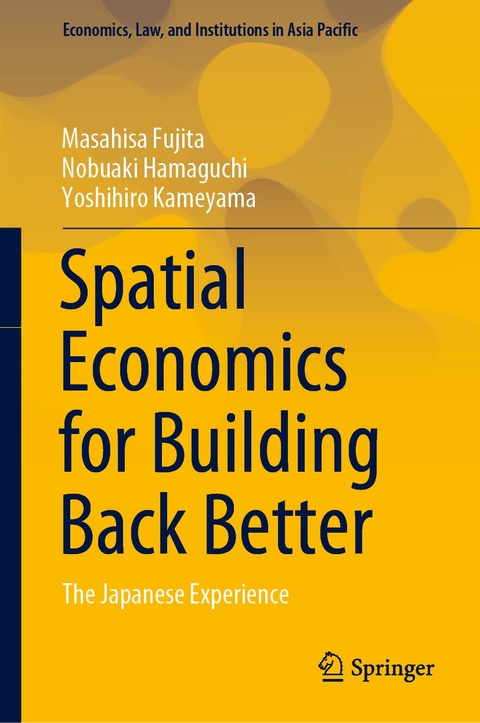
Spatial Economics for Building Back Better (eBook)
329 Seiten
Springer Singapore (Verlag)
9789811649516 (ISBN)
The central theme of this book is national land and infrastructure design in the age of the declining population and the recovery from the Great East Japan Earthquake in the affected regions in Japan. Based on the theory of spatial economics and evidence from Japanese history, the authors show that the growing economy with a population increase develops into a multi-cored and complex structure. In the population decline phase, however, such construction will be destabilized because of agglomeration economies in the central core. Then, a catastrophic shock that strikes may provoke the decline of the lower-rank-size provincial cities and their eventual disappearance if they compete only in lower prices of staple products. Not only is the practice bad for the residents; it also leads to lower national welfare resulting from the loss of diversity and overcrowded big cities. The authors argue that small local towns can recover and will be sustained if they will endeavor in innovative production by making good use of local natural resources and social capital. Under the ongoing declining population in Japan, an undesirable concentration in Tokyo will proceed further with increasing social cost and risk. The recent novel coronavirus pandemic has highlighted that concern.
The central theme of this book is national land and infrastructure design in the age of the declining population and the recovery from the Great East Japan Earthquake in the affected regions in Japan. Based on the theory of spatial economics and evidence from Japanese history, the authors show that the growing economy with a population increase develops into a multi-cored and complex structure. In the population decline phase, however, such construction will be destabilized because of agglomeration economies in the central core. Then, a catastrophic shock that strikes may provoke the decline of the lower-rank-size provincial cities and their eventual disappearance if they compete only in lower prices of staple products. Not only is the practice bad for the residents; it also leads to lower national welfare resulting from the loss of diversity and overcrowded big cities. The authors argue that small local towns can recover and will be sustained if they will endeavor in innovative production by making good use of local natural resources and social capital. Under the ongoing declining population in Japan, an undesirable concentration in Tokyo will proceed further with increasing social cost and risk. The recent novel coronavirus pandemic has highlighted that concern.
| Erscheint lt. Verlag | 17.10.2021 |
|---|---|
| Reihe/Serie | Economics, Law, and Institutions in Asia Pacific | Economics, Law, and Institutions in Asia Pacific |
| Zusatzinfo | XXI, 329 p. 104 illus., 41 illus. in color. |
| Sprache | englisch |
| Original-Titel | 復興の空間経済学 人口減少時代の地域再生 |
| Themenwelt | Naturwissenschaften ► Geowissenschaften ► Geografie / Kartografie |
| Recht / Steuern ► Öffentliches Recht ► Verwaltungsverfahrensrecht | |
| Sozialwissenschaften ► Politik / Verwaltung ► Staat / Verwaltung | |
| Sozialwissenschaften ► Soziologie ► Empirische Sozialforschung | |
| Sozialwissenschaften ► Soziologie ► Spezielle Soziologien | |
| Wirtschaft ► Volkswirtschaftslehre ► Wirtschaftspolitik | |
| Schlagworte | Disaster Recovery • NEG • New Economic Geography • Population decline • Spatial Economics • Tsunami Impact |
| ISBN-13 | 9789811649516 / 9789811649516 |
| Informationen gemäß Produktsicherheitsverordnung (GPSR) | |
| Haben Sie eine Frage zum Produkt? |
 PDF (Wasserzeichen)
DRM: Digitales Wasserzeichen
Dieses eBook enthält ein digitales Wasserzeichen und ist damit für Sie personalisiert. Bei einer missbräuchlichen Weitergabe des eBooks an Dritte ist eine Rückverfolgung an die Quelle möglich.
Dateiformat: PDF (Portable Document Format)
Mit einem festen Seitenlayout eignet sich die PDF besonders für Fachbücher mit Spalten, Tabellen und Abbildungen. Eine PDF kann auf fast allen Geräten angezeigt werden, ist aber für kleine Displays (Smartphone, eReader) nur eingeschränkt geeignet.
Systemvoraussetzungen:
PC/Mac: Mit einem PC oder Mac können Sie dieses eBook lesen. Sie benötigen dafür einen PDF-Viewer - z.B. den Adobe Reader oder Adobe Digital Editions.
eReader: Dieses eBook kann mit (fast) allen eBook-Readern gelesen werden. Mit dem amazon-Kindle ist es aber nicht kompatibel.
Smartphone/Tablet: Egal ob Apple oder Android, dieses eBook können Sie lesen. Sie benötigen dafür einen PDF-Viewer - z.B. die kostenlose Adobe Digital Editions-App.
Buying eBooks from abroad
For tax law reasons we can sell eBooks just within Germany and Switzerland. Regrettably we cannot fulfill eBook-orders from other countries.
aus dem Bereich