


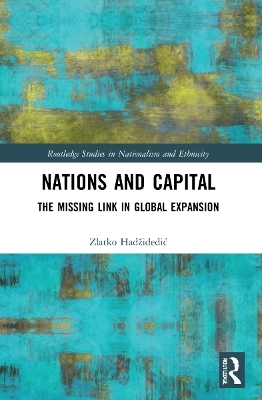
Nations and Capital
The Missing Link in Global Expansion
Seiten
2023
Routledge (Verlag)
9781032159720 (ISBN)
Routledge (Verlag)
9781032159720 (ISBN)
Nations and Capital: The Missing Link in Global Expansion is a groundbreaking analysis of the ultimate reasons for the emergence of nations and nationalism, as a socio-political and geopolitical instrument in the global expansion of capitalism.
Capitalism survives by adapting. Marx exposed its reliance on exploiting labour to generate profit. Polanyi warned that its hunger to commodify everything—nature, work, and even human bonds—destroys societies, sparking chaos. Yet capitalism endures, mutating through crises. Why?
Nations and Capital reveals the missing mechanism: nationalism.
Where Marx saw revolution, and Polanyi foresaw self-destruction as capitalism’s endgames, this book uncovers nationalism as the system’s ultimate safeguard. When markets erode trust or class conflict threatens profits, nationalism steps in—manufacturing loyalty, dividing the oppressed, and recasting exploitation as collective destiny. Capitalism doesn’t merely use nationalism; it depends on it to fragment resistance, privatize solidarity, and keep us fighting each other instead of the system devouring us all.
When neoliberalism irreversibly ripped society’s fabric, capitalism didn’t abandon nationalism: hyper-capitalism, today’s system of limitless extraction, abandons democracy instead and turns to authoritarian nationalism. This shift isn’t a rupture but a revelation: nationalism was never a phase; it is capitalism’s life support, mutating to sustain accumulation, from colonial empires to digital oligopolies.
Why does this matter? Because tomorrow’s crises—global economic collapse, the breakup of international order, pandemics—will be met with nationalism’s toxic embrace unless we confront its role as capitalism’s oxygen. Written from Bosnia and Herzegovina—a periphery where global capital and nationalist oligarchies joined forces to entrench ethnic partition—this theory of nationalism sees what thinkers in capitalism’s core could not: nationalism is not a byproduct of industrial capitalism's need for labour’s cultural homogeneity (Gellner) or print capitalism's construction of “imagined communities” (Anderson). It is the lifeblood of a system that cannot survive without converting solidarity into division, belonging into exclusion, and hope into fear.
Marx and Polanyi gave us the diagnosis. Nations and Capital completes it: understanding capitalism’s survival requires understanding nationalism as the other side of capitalism’s coin.
Capitalism survives by adapting. Marx exposed its reliance on exploiting labour to generate profit. Polanyi warned that its hunger to commodify everything—nature, work, and even human bonds—destroys societies, sparking chaos. Yet capitalism endures, mutating through crises. Why?
Nations and Capital reveals the missing mechanism: nationalism.
Where Marx saw revolution, and Polanyi foresaw self-destruction as capitalism’s endgames, this book uncovers nationalism as the system’s ultimate safeguard. When markets erode trust or class conflict threatens profits, nationalism steps in—manufacturing loyalty, dividing the oppressed, and recasting exploitation as collective destiny. Capitalism doesn’t merely use nationalism; it depends on it to fragment resistance, privatize solidarity, and keep us fighting each other instead of the system devouring us all.
When neoliberalism irreversibly ripped society’s fabric, capitalism didn’t abandon nationalism: hyper-capitalism, today’s system of limitless extraction, abandons democracy instead and turns to authoritarian nationalism. This shift isn’t a rupture but a revelation: nationalism was never a phase; it is capitalism’s life support, mutating to sustain accumulation, from colonial empires to digital oligopolies.
Why does this matter? Because tomorrow’s crises—global economic collapse, the breakup of international order, pandemics—will be met with nationalism’s toxic embrace unless we confront its role as capitalism’s oxygen. Written from Bosnia and Herzegovina—a periphery where global capital and nationalist oligarchies joined forces to entrench ethnic partition—this theory of nationalism sees what thinkers in capitalism’s core could not: nationalism is not a byproduct of industrial capitalism's need for labour’s cultural homogeneity (Gellner) or print capitalism's construction of “imagined communities” (Anderson). It is the lifeblood of a system that cannot survive without converting solidarity into division, belonging into exclusion, and hope into fear.
Marx and Polanyi gave us the diagnosis. Nations and Capital completes it: understanding capitalism’s survival requires understanding nationalism as the other side of capitalism’s coin.
Zlatko Hadžidedić is the Director at the Center for Nationalism Studies in Sarajevo, Bosnia and Herzegovina (www.nationalismstudies.org). He is the author of Forced to be Free: The Paradoxes of Liberalism and Nationalism (2013).
Introduction PART ONE: NATIONS AS NATIONALISM Chapter I Chapter II Chapter III Chapter IV Chapter V PART TWO: NO CAPITALISM WITHOUT NATIONALISM Chapter VI Chapter VII Chapter VIII Chapter IX
| Erscheinungsdatum | 04.02.2022 |
|---|---|
| Reihe/Serie | Routledge Studies in Nationalism and Ethnicity |
| Verlagsort | London |
| Sprache | englisch |
| Maße | 156 x 234 mm |
| Gewicht | 453 g |
| Themenwelt | Geisteswissenschaften ► Geschichte |
| Geisteswissenschaften ► Philosophie | |
| Sozialwissenschaften ► Politik / Verwaltung ► Politische Systeme | |
| Sozialwissenschaften ► Politik / Verwaltung ► Politische Theorie | |
| ISBN-13 | 9781032159720 / 9781032159720 |
| Zustand | Neuware |
| Informationen gemäß Produktsicherheitsverordnung (GPSR) | |
| Haben Sie eine Frage zum Produkt? |
Mehr entdecken
aus dem Bereich


aus dem Bereich
Das politische System der USA und die Zukunft der Demokratie
Buch | Hardcover (2025)
C.H.Beck (Verlag)
CHF 39,20
Russland, Europa, Amerika
Buch | Softcover (2025)
C.H.Beck (Verlag)
CHF 25,20


