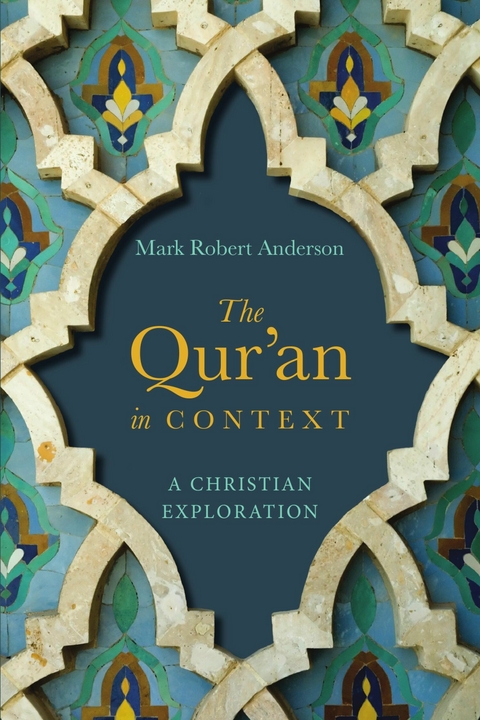
The Qur'an in Context (eBook)
341 Seiten
IVP Academic (Verlag)
9780830893430 (ISBN)
Mark Anderson studied theology at Westminster Theological Seminary and has an MA in Islamic Studies from McGill University. For nearly a decade he lived, studied, and taught in Egypt and Jordan. He writes and lectures on Islam and the Qur?an and is the author of Faithsongs: Ancient Psalms for Today (2010).
Mark Robert Anderson is the author of Faithsongs: Ancient Psalms for Today and lives in Vancouver, Canada. For over ten years, he lived and worked in the Middle East, teaching in a university and seminary. Anderson has been a member of Jacob's Well, a faith-based organization seeking mutually transformative relationships with marginalized residents of Vancouver's Downtown Eastside, and for two years he was part of a team helping homeless people find sustainable housing and employment. He has an MA in Islamic studies from McGill University and an MA in Christian religion from Westminster Theological Seminary.
One
Approaching the Qur’an
Any scripture with well over a billion believers on an increasingly small planet demands to be read by the rest of us. Even more, the Qur’an demands to be read by Christians, since it claims to complete our Bible and even improve on it. But most non-Muslims get no more than a few pages into the Qur’an before finding themselves hopelessly lost. In fact, Westerners who make it through all 286 verses of the Qur’an’s second chapter, or sura, deserve a pat on the back, because it is anything but reader friendly to us a world away and well over a millennium removed in time.
Our first challenge then is simply to understand the Qur’an, which is not “a written, premeditated corpus of prophetical sayings,” but rather “the transcript of an orally performed, open-ended drama.”1 The Qur’an’s every word is centered in Muhammad’s struggle for “God’s Cause”2 in his native Arabia. As Angelika Neuwirth says, we must read the Muslim scripture as a series of texts growing out of “lively scenes from the emergence of a community” under its prophet.3 Examples of her point abound. For example, Sura 93 urges Muhammad not to give up but to believe God will provide for him. By contrast, Q 8:67-71 speaks of the prophet’s having enslaved captives taken in battle and addresses the issue of his followers’ love of booty. We thus see that at one point Muhammad struggled to endure in faith, and at another he and his community, or umma, engaged in warfare and believed booty and slavery were regulated by divine command. In that sense the Qur’an represents an immense cache of historical data.
But despite the centrality of Muhammad’s story to its recitations, they include only glimmers of it. For while the Qur’an pays considerable attention to narratives from the past, it is quite averse to supplying current narrative—and that despite the fact that Muhammad’s recitations came to him in the midst of some very stormy events. Instead of recounting those events, the Qur’an “merely refers to them; and in doing so, it has a tendency not to name names.”4 The qur’anic author5 often speaks as “I” or “we” or alternates between the two (e.g., Q 90:1-4) and addresses “you” in singular and plural (e.g., Q 94:1-4) but without identifying anyone. That leaves us piecing together the story behind the recitations as best we can from the mention of an unnamed town or other fragmentary details. For example, the Qur’an speaks of a “sacred precinct” (Q 5:1) and Christians (nasara). But which sacred precinct, and what kind of Christians?
These and a host of other questions find their answer only in the Qur’an’s metahistory or narrative context. Being well known to those who first heard its recitations, however, most of that background information is left unstated, making the Qur’an singularly unhelpful as a historical source when taken on its own. Neither are its suras ordered chronologically.6 All this makes the Qur’an “an extremely enigmatic and allusive document,”7 one requiring readers to bring to the text some knowledge of Muhammad’s historical context and prophetic career.
The Qur’an and Its Interpretation
According to the Qur’an, God, its implied speaker throughout, had revealed his Word in other languages for other peoples and was now putting it into Arabic for the Arabs (Q 12:1-2; 13:37; 20:11). The qur’anic monologues were delivered orally by Muhammad in the early seventh century CE and eventually collected and transcribed. The Qur’an denounced Arab polytheism and announced God’s imminent judgment. As we will see, we can reasonably assume that Muhammad’s pagan hearers had some awareness of biblical monotheism, since Christianity and Judaism offered the only other live options, religiously speaking. But, rejecting those options, the Qur’an called its hearers to its unique version of monotheism, for it clearly takes issue with both Christianity and Judaism on various points. Hence the Qur’an addressed a primarily pagan audience, but in a milieu that included Jews and Christians.
The Qur’an called the Muslim8 community into being, established it in faith and empowered it to defeat its opponents. Its later (i.e., Medinan) suras often addressed Jews and Christians, though they did not constitute the core of its audience. Despite the obvious similarities between the Bible and the Qur’an, there are also major differences, most of which directly relate to the fact that the latter originated in a largely pagan milieu.
As is true of the Bible, the Qur’an is often interpreted by its adherents as a timeless book that speaks to current-day circumstances. This has allowed Muslims to contextualize it, whether in the eleventh or the twenty-first century. But however normal this may be, it becomes problematic when we detach the text from its original context. For any other meanings we see in a scripture must be grounded in its original and primary meaning—what its first audience understood when they heard or read it. As Paul Ricoeur put it, “If it is true that there is always more than one way of construing a text, it is not true that all interpretations are equal.”9 Otherwise, we can make a scripture mean whatever we want and thus render it meaningless.10 The Qur’an’s primary meaning does not “reside” in the mind of the author, nor in that of the audience, nor yet in the text itself, but rather emerges in the complex relationship between the text and its first hearers in their particular context. A scripture’s original meaning acts as arbiter, then, either grounding or calling into question other meanings later readers find in it. This underscores the vital importance of rightly appreciating the Qur’an’s historical setting, since, as interpreters, we do not create but rather discover the text’s original meaning.
Historically, polemical reasons kept Western scholars from appreciating the Qur’an’s very distinctive character and originality. Until well into the twentieth century, in fact, the obvious but unstated goal of many was to lampoon the Qur’an as a very bad copy of the biblical original and Muhammad as a buffoon for making it.11 That approach has since given way to a stress by many on the sameness of the Bible and Qur’an, often to validate Islam as another “Abrahamic” pathway to God. Sometimes this includes Christianizing the Qur’an to the point of seeing the Trinity in it and making its portrait of Jesus reminiscent of that of the Gospels.
I strive to avoid both traps here. As a Christian seeking peace with my Muslim brothers and sisters, I take their scripture seriously and have no interest whatsoever in mocking it. I aim to highlight the Qur’an’s uniqueness and do not wish to belittle the Muslim prophet or present the Qur’an as a “copy” of anything. I do consider it vital, however, that we acknowledge the many historical factors influencing its origins. And since the Qur’an implicitly calls for a response from us, my goal is to respond “Christianly,” with both grace and truth (Jn 1:17).
Qur’anic Context and Interpretation
As we understand most of the texts we encounter daily almost automatically, as easily as we speak, we sometimes forget that “there is no meaning without context.”12 But the more complex or emotionally loaded the topic, or the more a writer’s language, history and culture diverge from ours, the harder we must work at keeping the text grounded in its context. That is precisely the situation when we interpret a sacred scripture from a remote time, place and culture. And if we must work hard to understand any ancient scripture, we must work harder still to comprehend one with as few contextual markers as the Qur’an has. Its allusiveness made it essential for the Muslim community to keep alive traditions explaining its context. But for political, polemical and legal reasons, those traditions became corrupted and embellished long before they were recorded in writing, greatly complicating matters for Qur’an interpreters ever since.
In response, some twentieth-century scholars in the West rejected the traditional Islamic origins narrative, at least on the matter of the Qur’an’s milieu. Besides challenging tradition, most of them also denied the authenticity of pre-Islamic poetry, those being the two great pillars on which qur’anic interpretation had been built. While the revisionists never set out to deny the importance of context in qur’anic interpretation, the level of uncertainty their challenges produced made context of little use. Indeed, so widely varied are their answers to the question of milieu that Patricia Crone likens the situation to one in which we encounter Jesus’ quotations from the Jewish scriptures in the Gospels but do not know whether he was Jewish, or whether the Tanakh was native to his tradition or imported from outside. Also, suppose the Gospels’ geographical markers were so few and so vague that scholars disputed whether Jesus lived in Palestine, Mesopotamia or Greece. Such uncertainty would render the Gospels’ meaning exceedingly elusive, which is precisely the situation we now face in qur’anic studies.13
To understand the Muslim scripture truly, we must hear it as the uniquely speech-centered, event-birthed communication it was. Attempting to do so without reference to its original context is actually rather comical, unless we think Muhammad’s first hearers were somehow able to do that. Even those who dismiss its original context as irretrievable...
| Erscheint lt. Verlag | 2.9.2016 |
|---|---|
| Verlagsort | Lisle |
| Sprache | englisch |
| Themenwelt | Geisteswissenschaften ► Religion / Theologie ► Islam |
| Sozialwissenschaften ► Soziologie ► Spezielle Soziologien | |
| Schlagworte | Christian-Islamic Dialogue • Coran • cross-cultural understanding • Holy Quran • Isis • Islam • islamic extremist • Islamic Worldview • Jesus in Qur'an • Jesus in the Koran • Jesus in the Quran • Koran • Koran and the Bible • Kuran • Mohammad • Muslim • origin of Qur'an • Qur'an • Quran • Quran and Christiananity • Qur'an and the Bible • Quran and the Bible • Qur'anic worldview |
| ISBN-13 | 9780830893430 / 9780830893430 |
| Informationen gemäß Produktsicherheitsverordnung (GPSR) | |
| Haben Sie eine Frage zum Produkt? |
 EPUB (Wasserzeichen)
DRM: Digitales Wasserzeichen
Dieses eBook enthält ein digitales Wasserzeichen und ist damit für Sie personalisiert. Bei einer missbräuchlichen Weitergabe des eBooks an Dritte ist eine Rückverfolgung an die Quelle möglich.
Dateiformat: EPUB (Electronic Publication)
EPUB ist ein offener Standard für eBooks und eignet sich besonders zur Darstellung von Belletristik und Sachbüchern. Der Fließtext wird dynamisch an die Display- und Schriftgröße angepasst. Auch für mobile Lesegeräte ist EPUB daher gut geeignet.
Systemvoraussetzungen:
PC/Mac: Mit einem PC oder Mac können Sie dieses eBook lesen. Sie benötigen dafür die kostenlose Software Adobe Digital Editions.
eReader: Dieses eBook kann mit (fast) allen eBook-Readern gelesen werden. Mit dem amazon-Kindle ist es aber nicht kompatibel.
Smartphone/Tablet: Egal ob Apple oder Android, dieses eBook können Sie lesen. Sie benötigen dafür eine kostenlose App.
Geräteliste und zusätzliche Hinweise
Buying eBooks from abroad
For tax law reasons we can sell eBooks just within Germany and Switzerland. Regrettably we cannot fulfill eBook-orders from other countries.
aus dem Bereich