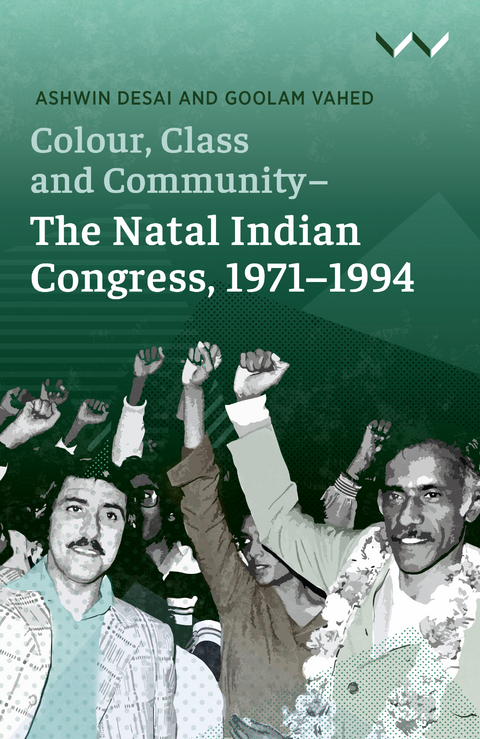
Colour, Class and Community - The Natal Indian Congress, 1971-1994 (eBook)
Wits University Press (Verlag)
978-1-77614-718-2 (ISBN)
Following a hiatus in the 1960s, the Natal Indian Congress (NIC) in South Africa was revived in 1971. In fascinating detail, Ashwin Desai and Goolam Vahed bring the inner workings of the NIC to life against the canvas of major political developments in South Africa during the 1970s and 1980s, and up to the first democratic elections in 1994. The NIC was relaunched during the rise of the Black Consciousness Movement, which attracted a following among Indian university students, and whose invocation of Indians as Black led to a major debate about ethnic organisations such as the NIC. This debate persisted in the 1980s with the rise of the United Democratic Front and its commitment to non-racialism. The NIC was central to other major debates of the period, most significantly the lines drawn between boycotting and participating in government-created structures such as the Tri-Cameral Parliament. Despite threats of banning and incarceration, the NIC kept attracting recruits who encouraged the development of community organisations, such as students radicalised by the 1980s education boycotts and civic protests. Colour, Class and Community, The Natal Indian Congress, 1971-1994 details how some members of the NIC played dual roles, as members of a legal organisation and as allies of the African National Congress' underground armed struggle. Drawing on varied sources, including oral interviews, newspaper reports, and minutes of organisational meetings, this in-depth study tells a largely untold history, challenging existing narratives around Indian 'cabalism', and bringing the African and Indian political story into present debates about race, class and nation.
List of Illustrations Acknowledgements Acronyms and Abbreviations Introduction Chapter 1 Repression, Revelation and Resurrection: The Revival of the NIC Chapter 2 Black Consciousness and the Challenge to the ‘I’ in the NIC Chapter 3 Between Principle and Pragmatism: Debates over the SAIC, 1971−1978 Chapter 4 Changing Geographies and New Terrains of Struggle Chapter 5 Class(rooms) of Dissent: Education Boycotts and Democratic Trade Unions, 1976−1985 Chapter 6 Lenin and the Duma Come to Durban: Reigniting the Participation Debate Chapter 7 The Anti-SAIC Campaign of 1981: Prefigurative Politics? Chapter 8 Botha’s 1984 and the Rise of the UDF Chapter 9 Letters from Near and Afar: The Consulate Six Chapter 10 Inanda, Inkatha and Insurrection: 1985 Chapter 11 Building Up Steam: Operation Vula and Local Networks 191 Chapter 12 Between Fact and Factions: The 1987 Conference 209 Chapter 13 ‘Caught With Our Pants Down’: The NIC and the Crumbling of Apartheid 1988−1990 Chapter 14 Snapping the Strings of the UDF Chapter 15 Digging Their Own Grave: Debating the Future of the NIC Chapter 16 The Ballot Box, 1994: A Punch in the Gut? Chapter 17 Between Rajbansi’s ‘Ethnic Guitar’ and the String of the ANC Party List Conclusion: A Spoke in the Wheel Notes Bibliography Index
| Erscheint lt. Verlag | 1.11.2021 |
|---|---|
| Verlagsort | Johannesburg |
| Sprache | englisch |
| Themenwelt | Geisteswissenschaften ► Geschichte ► Allgemeine Geschichte |
| Sozialwissenschaften ► Politik / Verwaltung | |
| ISBN-10 | 1-77614-718-9 / 1776147189 |
| ISBN-13 | 978-1-77614-718-2 / 9781776147182 |
| Informationen gemäß Produktsicherheitsverordnung (GPSR) | |
| Haben Sie eine Frage zum Produkt? |
 EPUB (Adobe DRM)
Kopierschutz: Adobe-DRM
Adobe-DRM ist ein Kopierschutz, der das eBook vor Mißbrauch schützen soll. Dabei wird das eBook bereits beim Download auf Ihre persönliche Adobe-ID autorisiert. Lesen können Sie das eBook dann nur auf den Geräten, welche ebenfalls auf Ihre Adobe-ID registriert sind.
Details zum Adobe-DRM
Dateiformat: EPUB (Electronic Publication)
EPUB ist ein offener Standard für eBooks und eignet sich besonders zur Darstellung von Belletristik und Sachbüchern. Der Fließtext wird dynamisch an die Display- und Schriftgröße angepasst. Auch für mobile Lesegeräte ist EPUB daher gut geeignet.
Systemvoraussetzungen:
PC/Mac: Mit einem PC oder Mac können Sie dieses eBook lesen. Sie benötigen eine
eReader: Dieses eBook kann mit (fast) allen eBook-Readern gelesen werden. Mit dem amazon-Kindle ist es aber nicht kompatibel.
Smartphone/Tablet: Egal ob Apple oder Android, dieses eBook können Sie lesen. Sie benötigen eine
Geräteliste und zusätzliche Hinweise
Buying eBooks from abroad
For tax law reasons we can sell eBooks just within Germany and Switzerland. Regrettably we cannot fulfill eBook-orders from other countries.
aus dem Bereich