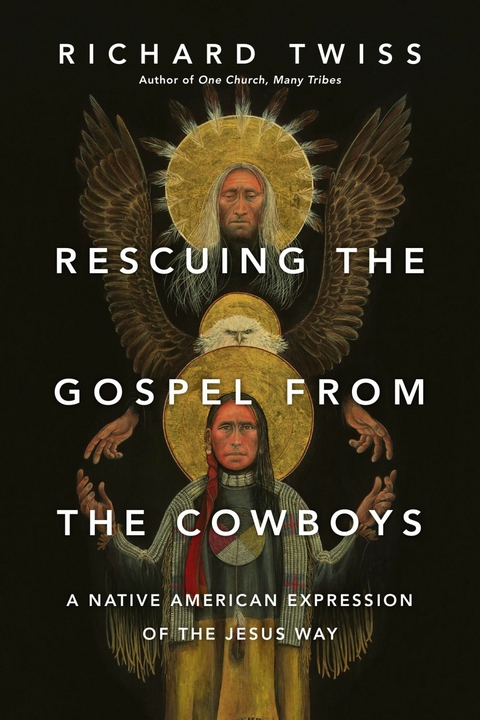
Rescuing the Gospel from the Cowboys (eBook)
InterVarsity Press (Verlag)
978-0-8308-9853-4 (ISBN)
Richard Twiss (Taoyate Ob Najin, 'He Stands with His People,' 1954-2013), was the founder of Wiconi International. A Sicangu Lakota, he was a cofounder of NAIITS (North American Institute for Indigenous Theological Studies) and a cofounder of Evangelicals for Justice. He earned a doctorate in missiology from Asbury Theological Seminary and was the author of One Church, Many Tribes. He is survived by his wife, Katherine, and his sons and grandsons.
Missio Alliance Essential Reading ListOne of Seedbed's 10 Notable BooksThe gospel of Jesus has not always been good news for Native Americans. The history of North America is marred by atrocities committed against Native peoples. Indigenous cultures were erased in the name of Christianity. As a result, to this day few Native Americans are followers of Jesus. However, despite the far-reaching effects of colonialism, some Natives have forged culturally authentic ways to follow the way of Jesus. In his final work, Richard Twiss provides a contextualized Indigenous expression of the Christian faith among the Native communities of North America. He surveys the painful, complicated history of Christian missions among Indigenous peoples and chronicles more hopeful visions of culturally contextual Native Christian faith. For Twiss, contextualization is not merely a formula or evangelistic strategy, but rather a relational process of theological and cultural reflection within a local community. Native leaders reframe the gospel narrative in light of post-colonization, reincorporating traditional practices and rituals while critiquing and correcting the assumptions of American Christian mythologies. Twiss gives voice to the stories of Native followers of Jesus, with perspectives on theology and spirituality plus concrete models for intercultural ministry. Future generations of Native followers of Jesus, and those working crossculturally with them, will be indebted to this work.
Richard Twiss (1954–2013) was the founder and president of Wiconi International, a nonprofit that works for the betterment of Native people and communities by advancing culture, education, spirituality and social justice in the spirit of Jesus. A member of the Sicangu Lakota Oyate from the Rosebud Sioux Reservation in South Dakota, his native name was Taoyate Ob Najin, or "He Stands with His People." He is the author of One Church, Many Tribes.A widely traveled speaker, activist, educator, author and networker within the Native North American community, Twiss led Native American performing arts teams and addressed issues of spirituality and justice in hundreds of venues worldwide. He served as a local pastor for thirteen years, worked as national director of Native ministries for the International Bible Society and was the U.S. representative for the World Christian Gathering of Indigenous People Movement. A board member of CCDA (Christian Community Development Association), he was a cofounder of NAIITS (North American Institute for Indigenous Theological Studies) and Evangelicals for Justice. Twiss was committed to serving the local Native community in Portland, Oregon, as a respected spiritual leader with his wife Katherine, who continues his vision today. He was a member of the Portland Indian Leadership Roundtable and was a board member of the city's Native American Youth and Family Center. He also taught at Portland State University, Warner Pacific College and Sioux Falls and George Fox Seminaries. As a writer, Twiss contributed to The Justice Project, Holy Bible: Mosaic, Jamestown Remembered, Coming Together in the 21st Century and Common Prayer by Shane Claiborne, Jonathan Wilson-Hartgrove and Enuma Okoro. He was a contributing editor for Cultural Encounters and wrote a bi-monthly column in Charisma Magazine called Smoke Signals. He earned a doctorate of missiology in inter-cultural studies from Asbury Theological Seminary.
1
THE CREATOR’S PRESENCE
AMONG NATIVE PEOPLE
There is only one Creator of heaven and earth. There are not “many” Creators. Just one! All of human and nonhuman creation comes out of this one Creator. There is not a Creator who created Africa and Africans, or Asia and Asians, or Europe and Europeans, and so forth. Who can create something from nothing or bring into existence something that was previously nonexistent? It is only this one Creator and there is none like him/her.1 That being said, this one Creator self-reveals in and through a myriad of cultural realities in human and nonhuman persons throughout Unci Maka, our “Mother Earth.”2
There are world religions that present names for this one Creator. These religions provide creation stories and explanations for heaven, earth and humans, and supply wisdom and doctrines to help humanity resolve its existential dilemma. There are world religions that have a sacred text to reference their beliefs, and there are thousands of “folk religions” with oral traditions that do the same through story, yet—there is still just one Creator.
For us First Nations people, following Creator-Jesus within our Indigenous cultural ways without submitting to the hegemonic cultural assumptions of today’s conservative evangelicals is tough. I am reminded weekly of these neocolonial and ignorant assumptions as they show up on the radar of my life. The following email conversation I had in 2012 typifies these “pings.”
A group of my First Nations friends and I were looking for a facility to host a weekend planning retreat. We looked at a few of them and decided on one I knew about from past experience. The negotiations to book the facility took an unexpected but not totally surprising turn as the registration person reacted to the “heathen Indians” once again:
Hello Mr. Twiss,
Whenever we have a new group register with our facility we take the time and effort to research their beliefs and methods, etc. I have been doing that with your group and we must CANCEL your retreat with us. In your effort to “restore culture” you are taking the indigenous people back into paganism, shamanism, false gods and the occult. You are leading them away from the Gospel message of the Bible. We pray you will rethink what you are doing to the very people you love so much. I will return your deposit.
Thank you. “Jane Doe.”
Greetings Jane Doe,
Thank you for your response. I have many years of involvement and friendship with people in your center. I look forward to continuing this conversation and still keeping our reservation to host our retreat there. While a few may have some narrow and misinformed ideas about our faith in Jesus and the scriptures, please be assured our group is as remarkable a group of Christ-followers as you will meet! Please feel free to give me a call on my cell phone today.
Thank you, Richard
Hello Richard,
Thank you so much for your email. I am aware of your history. We do not doubt your sincere heart and desires. But some of the teachings of your group and/or its speakers seem to be steering people away from the solid Gospel and taking people toward other gods. It may be subtle, and it may not be your intent, but if one person leaves our facility compromised in their Christian walk then we have failed in our mission. It is a hard thing we have to do but the Lord has asked us to take a very strong stand and we can do nothing less. I have returned the deposit and have still canceled the retreat. We pray the Lord will continue to guide you carefully in your efforts.
Jane Doe
Greetings Jane,
Thanks for your response, which honestly surprises me. It is certainly not the spirit that I have felt from the organization’s beginning as its founders poured their lives into creating a space for people to wrestle with the deep issues of life and spiritual growth. So many of us were in our early twenties when we first journeyed there, struggling to make sense of this new faith and life we found in Jesus.
The accusations you make against us—“biblical compromise [falsehood/heresy], steering people away from the Gospel into idolatry [rejecting Christ],” clothed in the notion of protecting the true Gospel from Native cultural ways of our Native Christian community—are plainly offensive, theologically arrogant and judgmental at best—perhaps culturally racist at worst. Your language of “the Lord has asked us to take a very strong stand” against people like us and the way we express our faith in Jesus, biblically, culturally and theologically, reveals the kind of cultural oppression our people face from an idealized and racialized view of scripture. If the goal is to turn your center into a bastion of biblical protectionism, theological control and cultural judgmentalism, your words well reflect that direction.
Peace and grace—Richard
Richard,
The answer is still “NO.” I hear what you are saying, but we still cannot support what your group and the Indigenous People Movement are teaching. No retreat at our facility.
Jane Doe
While this person may represent a more extreme point of view, it nonetheless is what the majority of Euro-American evangelicals believe about our Native cultural and ceremonial ways. Ignorance, suspicion and fear of Native ways run deep in the soul of the American church. I will show later how this has been (and remains) the American church’s attitude toward our Native ways for centuries now. The tragedy is that it is not just we who suffer. Because we suffer so deeply, the entire church and nation does too!
However, suspicion and fear run both ways. Indigenous people have a lot to fear about the “white man’s religion”! Conquest, racism, hatred, prejudice, exclusion, forced assimilation and ongoing institutional injustices are just a few of the fears that come to mind.
“Even When We Get it Right, We Get it Wrong”—Spokane Garry
When my wife and I lived on the Coeur d’Alene Reservation in Northern Idaho in 1996, I was introduced to a life-changing story about a remarkable Native leader named Chief Spokane Garry. He is one of my heroes of faith and culture. Creator used Chief Garry (1811–1892) as a “messenger” who had a profound spiritual impact by spreading the gospel (along with his friend and co-worker Kootenai Pelly) among his people and numerous other tribes in Washington, Idaho, Oregon and southward.3
I have been to the cemetery in Spokane, Washington where Chief Garry was buried. It was an honor and a privilege to be standing there and I was deeply touched. He was a tribal leader, husband, father and advocate for justice and Christian values. While his efforts appeared to have no lasting impact and did not bring the white settlers to an understanding of justice, nevertheless—throughout it all—he remained true to his faith in Jesus. He died rejected and impoverished.
While we were living on the “Rez” (reservation), we did not know of one Native man who regularly attended any of the six Protestant evangelical churches—despite Garry’s life work. Barely half a dozen women attended. This was true as well for the neighboring Nez Perce and Kalispel reservations. This fact stood in stark contrast to the amazing spiritual movement inspired by Chief Garry in this region that occurred prior to an established colonial presence.
There were other instances of divine intervention in “preparing the way of the Lord” (Isaiah 40:3) for mission work among the tribes of this area, including prophecies among the Middle Spokane and Kalispel tribes.
Yuree-rachen. Yuree-rachen, “Circling Raven,” was a shaman from the Middle Spokane tribe in the late 1700s. He had a personal crisis of faith in Creator after his son’s untimely death, so he went to Mt. Spokane for a time of fasting and prayer. During this worship time, he received a vision from Creator, whom they called Quilent-sat-men, “He-Made-Us.” In the vision, Yuree-rachen saw white men dressed strangely, carrying bundles of leaves fastened together. He was told that the people were to learn from the teachings inscribed on the leaves.4
Shining Shirt. A similar vision, in about the same time period, was given to “Shining Shirt,” said to be both a chief and a shaman of the Kalispel tribe. Ethnologist Harry Holbert Turney-High writes that Shining Shirt was granted a vision in which he was told that there is a Creator, and that fair-skinned men in black robes would come and teach them how to live in a new way, according to a moral law. During the vision Shining Shirt was given a metal object engraved with a cross. White men were unknown to these tribal people at that time.5
Creator had been at work preparing the Native people for the arrival of the gospel of Jesus. The Christian revival among those tribes evangelized by Spokane Garry and Kootenai Pelly was noted by white settlers and explorers. For example, Washington Irving, in “The Adventures of Captain Bonneville,” further documents the spread of Christianity throughout the tribes of that region. During the winter of 1832, Bonneville camped with the Nez Perce on the upper Salmon River in Oregon and observed:
Simply to call these people religious . . . would convey but a faint idea of the deep hue of piety and devotion which pervades their whole conduct. Their...
| Erscheint lt. Verlag | 9.6.2015 |
|---|---|
| Verlagsort | Lisle |
| Sprache | englisch |
| Themenwelt | Geschichte ► Teilgebiete der Geschichte ► Kulturgeschichte |
| Religion / Theologie ► Christentum ► Kirchengeschichte | |
| Sozialwissenschaften ► Ethnologie | |
| Sozialwissenschaften ► Soziologie | |
| Schlagworte | American Indian • assimilation • Christian • Christianity • Colonial • Colonialism • Colonization • contextual • contextualization • Contextualized • cross-cultural ministry • Cultural • Culture • First Nations • Gospel • Indigenous • intercultural ministry • Jesus • Jesus way • Lakota • Missiology • missions • Native • Native American • Neo-Colonialism • Postcolonial • Post-Colonialism • Sioux • Wiconi International |
| ISBN-10 | 0-8308-9853-0 / 0830898530 |
| ISBN-13 | 978-0-8308-9853-4 / 9780830898534 |
| Informationen gemäß Produktsicherheitsverordnung (GPSR) | |
| Haben Sie eine Frage zum Produkt? |
 EPUB (Adobe DRM)
Kopierschutz: Adobe-DRM
Adobe-DRM ist ein Kopierschutz, der das eBook vor Mißbrauch schützen soll. Dabei wird das eBook bereits beim Download auf Ihre persönliche Adobe-ID autorisiert. Lesen können Sie das eBook dann nur auf den Geräten, welche ebenfalls auf Ihre Adobe-ID registriert sind.
Details zum Adobe-DRM
Dateiformat: EPUB (Electronic Publication)
EPUB ist ein offener Standard für eBooks und eignet sich besonders zur Darstellung von Belletristik und Sachbüchern. Der Fließtext wird dynamisch an die Display- und Schriftgröße angepasst. Auch für mobile Lesegeräte ist EPUB daher gut geeignet.
Systemvoraussetzungen:
PC/Mac: Mit einem PC oder Mac können Sie dieses eBook lesen. Sie benötigen eine
eReader: Dieses eBook kann mit (fast) allen eBook-Readern gelesen werden. Mit dem amazon-Kindle ist es aber nicht kompatibel.
Smartphone/Tablet: Egal ob Apple oder Android, dieses eBook können Sie lesen. Sie benötigen eine
Geräteliste und zusätzliche Hinweise
Buying eBooks from abroad
For tax law reasons we can sell eBooks just within Germany and Switzerland. Regrettably we cannot fulfill eBook-orders from other countries.
aus dem Bereich