Zum Hauptinhalt springen
Nicht aus der Schweiz? Besuchen Sie lehmanns.de

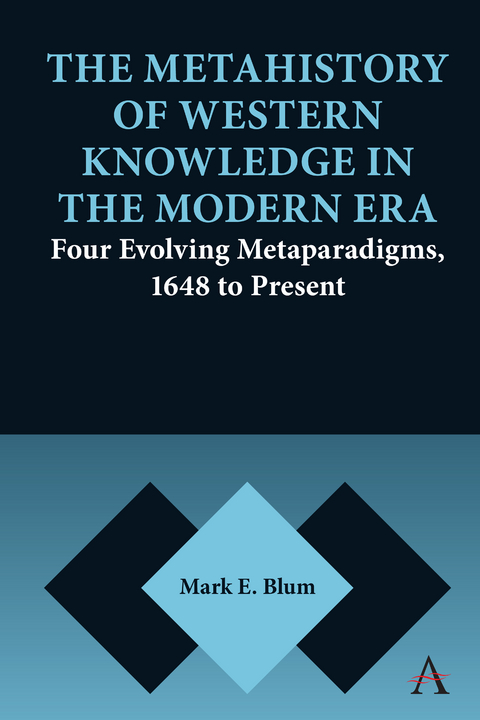
The Metahistory of Western Knowledge in the Modern Era (eBook)

Four Evolving Metaparadigms, 1648 to Present

(Autor)

eBook Download: PDF
2021
270 Seiten
Anthem Press (Verlag)
9781785276996 (ISBN)
Lese- und Medienproben

The Metahistory of Western Knowledge in the Modern Era - Mark E. Blum
Systemvoraussetzungen
36,99 inkl. MwSt
(CHF 36,10)
Der eBook-Verkauf erfolgt durch die Lehmanns Media GmbH (Berlin) zum Preis in Euro inkl. MwSt.
  • Download sofort lieferbar
  • Zahlungsarten anzeigen
When one organizes events over periods of years and gives them an appellation such as "e;Modernism,"e; the organization of facts is guided by concepts and values discerned throughout these periods, comparable facts sufficient to call it an "e;era,"e; or an "e;epoch,"e; or other terms that insist on the shared aspects of those years, regardless of differences seen as well over the span considered. One can call such an effort a "e;metahistory,"e; in that what is tracked is not merely human events that are political, economic, ideological, sociological, or other disciplinary descriptors, but an overview that critically links all the years under consideration. Even more, to have a "e;metahistory"e; is to discern how the people of eras, epochs, or the other organizational labels, thought. Human history is generated by choices, choices informed by intuitions and more intentional understandings. One of the aspects the book dwells upon in this "e;metahistory"e; of Modernism is the presence of "e;perspective,"e; how one sees in a time what is there to be addressed and dealt with. Perspectives can be poorly informed or in their very nature not adequate for a sufficient knowledge of what is addressed, even as one must as a human judge what faces one. To discern from evidence how one's perspective configures an event is the "e;meta"e; of "e;metahistory"e;. Modernism, the epoch from 1648 to the Present, can be described among its tenets as a period where the notion of "e;objectivity"e; has been developed. This has occurred in every field of the emergent arts and sciences in these years. Post-modernism, as will be addressed, is a more critical modernism that has brought to light the idea of multiple perspectives of objectivity as a univocal perspective of 'objectivity'. Other modernist ideas have expanded in all fields and the ideas of what is human consciousness, epistemologies of both a reflective and a pre-reflective consciousness (called by some the 'unconscious') have emerged in art, aesthetics, psychology, philosophy, the social sciences, as well as the neurosciences To have "e;meta"e; knowledge is this comprehension of the scope and benefits, yet limitations, of one's "e;perspective"e; and that of others of a time. Only a historian interested in such perspectives can be called a "e;metahistorian."e;The book uses the concept of the "e;metaparadigm,"e; taken from Thomas Kuhn, to track the evolution of how in a period of time the problems of the existing disciplines of knowledge are articulated, and how inquiry methods are used to flesh out a solvable problem and effectively resolve it. The book details four phases that constitute the period of time in which a metaparadigm develops. The first phase is a new set of concepts that challenge the existing approach to knowledge in each discipline. The second phase is a systematic theory that will guide inquiry. The third phase is the actual practice of the discipline in solving problems, a phase that can conflict with the older approach or be congruent with it. The fourth phase integrates the older approaches in the new one, and thus expands in an augmented manner the discipline.The four phases of each metaparadigm have certain durations. The initial three phases usually endure for about 30-40 years, and the fourth phase for over 50 years. These phases each recur in the next period of time; that is the next metaparadigmatic period. Four evolving metaparadigms are shown in Western thought in this book, tracking one or more disciplines in the social sciences, the humanities, and the natural sciences through each of the four phases of a metaparadigm, and the four metaparadigms that occur between 1648 and the present.
Erscheint lt. Verlag 4.2.2021
Reihe/Serie Anthem Series on Thresholds and Transformations
Anthem Series on Thresholds and Transformations
Sprache englisch
Maße 150 x 150 mm
Gewicht 454 g
Themenwelt Kunst / Musik / Theater Kunstgeschichte / Kunststile
Sozialwissenschaften Pädagogik
ISBN-13 9781785276996 / 9781785276996
Informationen gemäß Produktsicherheitsverordnung (GPSR)
Haben Sie eine Frage zum Produkt?
PDFPDF (Adobe DRM)

Kopierschutz: Adobe-DRM
Adobe-DRM ist ein Kopierschutz, der das eBook vor Mißbrauch schützen soll. Dabei wird das eBook bereits beim Download auf Ihre persönliche Adobe-ID autorisiert. Lesen können Sie das eBook dann nur auf den Geräten, welche ebenfalls auf Ihre Adobe-ID registriert sind.
Details zum Adobe-DRM

Dateiformat: PDF (Portable Document Format)
Mit einem festen Seiten­layout eignet sich die PDF besonders für Fach­bücher mit Spalten, Tabellen und Abbild­ungen. Eine PDF kann auf fast allen Geräten ange­zeigt werden, ist aber für kleine Displays (Smart­phone, eReader) nur einge­schränkt geeignet.

Systemvoraussetzungen:
PC/Mac: Mit einem PC oder Mac können Sie dieses eBook lesen. Sie benötigen eine Adobe-ID und die Software Adobe Digital Editions (kostenlos). Von der Benutzung der OverDrive Media Console raten wir Ihnen ab. Erfahrungsgemäß treten hier gehäuft Probleme mit dem Adobe DRM auf.
eReader: Dieses eBook kann mit (fast) allen eBook-Readern gelesen werden. Mit dem amazon-Kindle ist es aber nicht kompatibel.
Smartphone/Tablet: Egal ob Apple oder Android, dieses eBook können Sie lesen. Sie benötigen eine Adobe-ID sowie eine kostenlose App.
Geräteliste und zusätzliche Hinweise

Buying eBooks from abroad
For tax law reasons we can sell eBooks just within Germany and Switzerland. Regrettably we cannot fulfill eBook-orders from other countries.

Mehr entdecken
aus dem Bereich