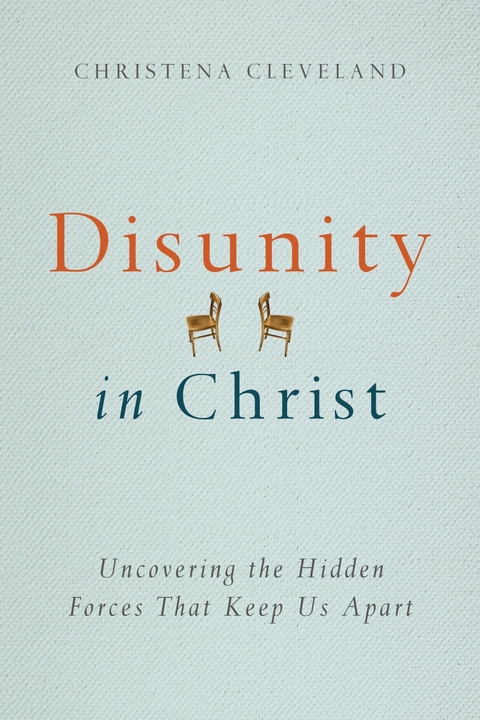
Disunity in Christ (eBook)
220 Seiten
IVP (Verlag)
978-0-8308-6495-9 (ISBN)
Christena Cleveland (Ph.D., University of California, Santa Barbara) is a social psychologist who teaches at St. Catherine University. She is an award-winning researcher and gifted teacher who brings organizational experience to her efforts to build unity. She consults with pastors and organizational leaders on multicultural issues and speaks regularly at organizations, churches, conferences, universities and schools.
Christena Cleveland (PhD, University of California, Santa Barbara) is associate professor of reconciliation studies at Bethel University in St. Paul, Minnesota. She is an award-winning researcher and gifted teacher who brings organizational experience to her efforts to build unity. She consults with pastors and organizational leaders on multicultural issues and speaks regularly at organizations, churches, conferences, universities and schools.
1
Right Christian, Wrong Christian
I was taking a bus ride through the snow-capped Rockies in Colorado, complaining to myself about this guy at my church who drove me crazy. Ben and I were pretty much the only unmarried adults in our small church community, so we were often paired together during social events. As if this weren’t annoying enough, Ben happened to be quite possibly the most offensive person I knew.
I wish I could say this wasn’t the case, but everything about Ben bugged me—from his inflexible and preachy conservatism to his career as an engineer who designs nuclear warheads (I mean, seriously?) to his dorky Hawaiian-print button-downs (alas, perhaps his greatest offense). Anyway, there I was riding through Colorado, lamenting the fact that Ben was a part of my life and plotting ways to avoid interacting with him ever again. And suddenly I was confronted with the idea that Ben was going to be in heaven.
With me.
For all eternity.
And I would never, ever be rid of him.
Suddenly the idea of frolicking on the streets of gold seemed less enticing. That’s okay, I quickly reassured myself. Heaven is going to be a big, big place.
Growing the Wrong Way
When I first began walking with Christ, I felt an immediate and authentic connection with any other Christian who crossed my path. Orthodox, Catholic, charismatic, Lutheran, evangelical, black, white, Asian, Ben—didn’t matter. We were family.
But as I walked with Jesus, somehow my “growth” had been coupled with increasingly stronger opinions about the “right” way to be a follower. I started keeping people I didn’t enjoy or agree with at arm’s length. I managed to avoid most of the Bens in my life by locating them, categorizing them and gracefully shunning them, all while appearing to be both spiritual and community-oriented. Further, I could do all of this without wasting any of my precious brainpower. I was quite good.
I chose to build community with people with whom I could pretty much agree on everything. I invested lots of time and energy in fostering relationships with people who had similar ethnic backgrounds, were about my age, possessed similar educational degrees, professed similar theology, worshiped like me, voted like me and were fluent in the language of my postmodern, intellectual, wanderlustful, “diverse” culture. I sincerely thought that I was doing a fabulous job because, hey, I was “living in community,” and isn’t that what good Christians are supposed to do?
Over time, when I met other Christians, I found myself asking them what church they attended. Some answers were more acceptable than others. The way I saw it, there were two types of Christians: the wrong kind of Christian and the right kind of Christian.
It was that simple.
Wrong Christian was not a thinker. He hadn’t read a book in the previous two years and had the limited vocabulary to prove it. (Although, come to think of it, he did read a book a few years back about a woman’s rightful place in the home.) He voted based on one or two issues: abortion and homosexuality (two issues that Jesus didn’t even mention once, mind you). Wrong Christian lacked crosscultural sensitivity and somehow managed to avoid spending quality time with anyone who did not share his race and culture.
Naturally, he only dated women within his race, although he occasionally crushed on more “exotic” types. When he was not rockin’ the suburbs in his gas-guzzling SUV, he surfed or played ultimate or some other inane “sport.” He proudly served in the United States military and inexplicably (to me) was more concerned with the preservation of the Second Amendment than the First. He was a card-carrying and proselytizing Calvinist. In fact, the last time I was over at his house, I noticed that the acronym TULIP was boldly painted above his door. He voted Republican! Republican! Republican!
And he was a he. Seriously, did you expect Wrong Christian to be a woman? Pshaw.
Curiously, Right Christian was a lot more like me. While driving her Prius en route to the farmer’s market, she self-righteously zipped past Wrong Christian’s lumbering SUV, blithely unaware of the fact that Prius owners (and farmer’s market shoppers, who are basically the same people) are consumers, just like everyone else.
She was a woman of the world; she was well traveled and able to thrive in any cultural setting (except for those conservative Christian ones in the flyover states, naturally). She boasted of the ethnic diversity of her friend group and joked that she and her friends looked like they had just walked off the pages of a United Colors of Benetton clothing ad. (Despite her high IQ—or perhaps due to it—she overlooked the fact that as well-educated, upwardly mobile, frequent Benetton shoppers, she and her friends were perhaps not as diverse as they thought.) She hopped onto the poverty, social justice and environmental bandwagons as well as any other bandwagons that were in vogue at the time.
She wasn’t bound by political party affiliation. Rather, she thought for herself and voted independently (in other words, she voted Democrat! Democrat! Democrat!). Right Christian was a reader and a writer. In fact, she’d written more books than Wrong Christian had read. She was an equal-opportunity dater. (Translation: she’d date anybody but Wrong Christian and his buddies.) She was strong. She knew that she was wonderful, charming and, quite frankly, a more valuable member of the body of Christ than Wrong Christian. All of these characteristics (and many, many more) made her Right Christian.
So it all began with two labels: Right Christian and Wrong Christian. The funny thing is, the more I talk with people about these labels, the more I realize that many of us carry our own descriptions of Right Christian and Wrong Christian. Perhaps in your opinion, my Right Christian is your Wrong Christian and my Wrong Christian is your Right Christian. Or maybe your Wrong Christian and Right Christian are totally different birds.
Recently, a friend told me that he’s not willing to attend a particular church in our town because the last time he visited this church, he noticed a young man wearing a baseball cap during the worship service. According to my friend, Wrong Christian is an irreverent little twerp who wears baseball caps during church. Maybe this isn’t your issue. I have another dear friend who is unable to talk about charismatic churches without a noticeable amount of disdain in his tone of voice. To him, Wrong Christian is a charismatic guy who speaks in tongues and worships weirdly.
Maybe to you, Wrong Christian attends a church that allows female leadership. Or maybe Wrong Christian attends a church that doesn’t allow female leadership. Maybe Wrong Christian went to a Christian college. Maybe Wrong Christian doesn’t speak English. Maybe Wrong Christian is in a college fraternity. Maybe Wrong Christian drives a Hummer. Maybe Wrong Christian promotes Reformed theology. Maybe Wrong Christian dresses like she’s in a music video. Maybe Wrong Christian is pro-choice. Maybe Wrong Christian takes the bus. Maybe Wrong Christian is just annoying. Maybe Wrong Christian is unequivocally pro-Israel. Maybe Wrong Christian is a Yankees fan.
You get the picture.
My opinion of Wrong Christian was so strong that I not only avoided him, but I also actively condemned him. Perhaps you’re not as opinionated as I am (although I’m sure many of you are). Maybe you have opinions but don’t voice them in a forceful and condescending way. Or maybe you don’t voice them at all—you’re not around Wrong Christian very much, so you’re not devoting a lot of time and energy to criticizing him. He’s so far outside your circle of (Right) Christians that he barely exists. The mere act of creating Right Christian and Wrong Christian labels makes Wrong Christians a target of your criticism or simply dead to you—or both.
For the most part, I was happy to keep Wrong Christian at bay. There was just one cosmic problem. As I got to know Jesus, I began to realize that this was not exactly what he had in mind when he invited us to participate in his kingdom on earth.
I discovered that Jesus apparently didn’t get the memo concerning the colossal importance of my distinction between Right Christian and Wrong Christian. In fact, he doesn’t seem to care much for this distinction at all. I think this is what God meant when he said, “So are my ways higher than your ways and my thoughts than your thoughts” in Isaiah 55:9.
There I was, convinced that I was defending Jesus by condemning Wrong Christian, when I saw that Jesus was beckoning both Right Christian and Wrong Christian and inviting all of us to know more of his heart. As I read through the Gospels, I noticed that he had a habit of connecting with everybody: conservative theologians, liberal theologians, prostitutes, divorcees, children, politicians, people who party hard, military servicemen, women, lepers, ethnic minorities, celebrities, you name it. He was pretty serious about connecting, in spite of natural and ideological differences. And it doesn’t end in the Gospels. He repeatedly disregards my Right Christian and Wrong Christian labels and continues to beckon me, even though I still tend to cling to such earthly distinctions. He’s relentless.
Rather than using his power to distance himself from us, Jesus uses it to approach us. He follows his own commandment to love your neighbor as yourself—often to his detriment, I might add—by pursuing us with great tenacity in spite of our...
| Erscheint lt. Verlag | 4.10.2013 |
|---|---|
| Verlagsort | Lisle |
| Sprache | englisch |
| Themenwelt | Geisteswissenschaften ► Psychologie ► Sozialpsychologie |
| Religion / Theologie ► Christentum ► Kirchengeschichte | |
| Sozialwissenschaften ► Soziologie ► Spezielle Soziologien | |
| Schlagworte | Age • Bias • body of Christ • Broken • categories • Christian • Church • Community • conflict • Conflict Resolution • Connection • ConText • Cultural • Culture • Denominations • Different • Diverse • Diversity • divide • Divided by Faith • Division • Dynamics • Ecclesiology • economic • Ethnic • Gender • Group • In-Group • Interactions • Leader • Men • out-group • Practical • Race • separate • Social Psychology • Socioeconomic Status • Sociology • Sterotypes • Theology • together • Understanding • United • UNITY • Women |
| ISBN-10 | 0-8308-6495-4 / 0830864954 |
| ISBN-13 | 978-0-8308-6495-9 / 9780830864959 |
| Informationen gemäß Produktsicherheitsverordnung (GPSR) | |
| Haben Sie eine Frage zum Produkt? |
 EPUB (Wasserzeichen)
DRM: Digitales Wasserzeichen
Dieses eBook enthält ein digitales Wasserzeichen und ist damit für Sie personalisiert. Bei einer missbräuchlichen Weitergabe des eBooks an Dritte ist eine Rückverfolgung an die Quelle möglich.
Dateiformat: EPUB (Electronic Publication)
EPUB ist ein offener Standard für eBooks und eignet sich besonders zur Darstellung von Belletristik und Sachbüchern. Der Fließtext wird dynamisch an die Display- und Schriftgröße angepasst. Auch für mobile Lesegeräte ist EPUB daher gut geeignet.
Systemvoraussetzungen:
PC/Mac: Mit einem PC oder Mac können Sie dieses eBook lesen. Sie benötigen dafür die kostenlose Software Adobe Digital Editions.
eReader: Dieses eBook kann mit (fast) allen eBook-Readern gelesen werden. Mit dem amazon-Kindle ist es aber nicht kompatibel.
Smartphone/Tablet: Egal ob Apple oder Android, dieses eBook können Sie lesen. Sie benötigen dafür eine kostenlose App.
Geräteliste und zusätzliche Hinweise
Buying eBooks from abroad
For tax law reasons we can sell eBooks just within Germany and Switzerland. Regrettably we cannot fulfill eBook-orders from other countries.
aus dem Bereich