


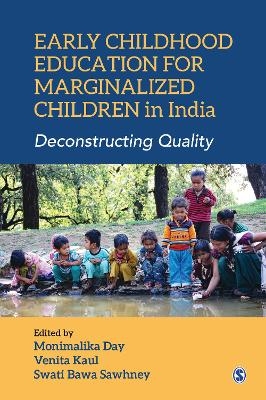
Early Childhood Education for Marginalized Children in India
Sage Publications India Pvt Ltd (Verlag)
9789354791468 (ISBN)
- Keine Verlagsinformationen verfügbar
- Artikel merken
Societal hierarchies in the form of caste, gender, religion and class continue to deprive a large percentage of young children in India of learning opportunities, leading to intergenerational poverty. Existing research indicates that this cycle can be broken by providing appropriate early childhood care and education. Early Childhood Education for Marginalized Children in India reviews India’s achievements and challenges, and identifies the complex issues related to providing early childhood education to children from marginalized communities.
The book presents evidence-based approaches to developing and scaling up good quality early childhood education programmes. It explores what ‘quality’ means in the Indian context and identifies core elements that must be integral to all initiatives that aim to promote holistic development, while addressing India’s significant scale and sociocultural diversity. The available literature has mostly discussed information from Western nations and the book attempts to address this gap.
Monimalika Day is an Associate Professor at the School of Education Studies in Ambedkar University, Delhi. She specializes in early childhood education (ECE) and has led several research projects at the Centre for Early Childhood Education and Development (CECED). Prior to this, she was an Assistant Professor at George Mason University in the College of Education and Human Development, USA. She has a doctoral degree in Special Education from the University of Maryland at College Park, USA. She has worked at ZERO TO THREE, a national non-profit organization for infants, toddlers and families in the USA. She was the Assistant Director for the Center for Program Excellence, where she provided training and technical assistance to early childhood programmes across the USA. She has a master’s degree in Child Development from Jadavpur University. She began her career in Kolkata, where she was the founder and administrator of a drop-in centre for 300 children who lived in the streets. She also taught young children with disabilities at Manovikas Kendra, Kolkata. Her research projects focus on early stimulation, quality of services for young children, inclusion of children with disabilities, teacher education, and collaboration between schools and families. She has authored two books, several chapters and has published in peer-reviewed journals. Venita Kaul is Professor Emerita, Ambedkar University Delhi. Prior to her retirement in 2016, she was the Founder Director of CECED and Dean of School of Education Studies. Before joining the university, she served as a senior education specialist at the World Bank for 10 years and was a professor and head of Department of Preschool and Elementary Education at National Council of Educational Research and Training (NCERT) in New Delhi. She has been a member of several advisory committees set up by the Government of India and international agencies, including the National Advisory Committee constituted by the Ministry of Human Resource Development (MHRD) for the implementation of Right to Education (2010), Working Group constituted by the Ministry of Women and Child Development (MWCD) to advise on the development of National Policy on Early Childhood Care and Education (ECCE) (2011–2012) and a member of the committee constituted by MHRD to oversee functioning of the National Council for Teacher Education (NCTE). She was also an expert member on the ICDS Advisory Council and a member of the NCTE Council. At the international level, she has been a member of the Steering Group of Asia Pacific Regional Network for ECD (ARNEC) and an invited member of the Forum for Investing in the Young Child, Washington, DC. She has also been on the boards of a number of well-known NGOs working in the area of education including Pratham, Mobile Crèches and Sesame Street (India). She has led several research projects on the quality of ECE and decentralized planning and convergence of sectoral services for children. She is the author of a seminal book on early childhood programmes which was published by NCERT in 2006 and has several international and national publications to her credit. Swati Bawa Sawhney is an Assistant Professor (Ad hoc) at Delhi University. Prior to this, she worked as an early childhood consultant at the MWCF under the Strategic Health and Nutrition Partnership programme by the Department for International Development (DFID) to provide support to MWCD, Government of India, through Deloitte-led Technical Support Agency. Prior to working with the MWCD, she was a senior consultant at PricewaterhouseCoopers (PwC) and worked on multiple projects with the Government of India and United Nations. She has also worked at CECED, Ambedkar University, as a research associate. Her major area of work has been monitoring the status and implementation of National ECCE Policy across states/UTs, guidelines for integrating children with special needs, services for caregivers with children in the age group of 0–3 years on early stimulation and tracking of developmental delay. She also contributed to policy briefs titled ‘Unpacking Care: Protecting Early Childhood’ and ‘Brain Development in Early Years’ and research projects ‘Preparing Teachers for Early Childhood Care and Education’, case study of Uttarakhand Seva Nidhi ‘The Balwadi Programme’ and ‘Link for learning: Action Research in Bihar’.
Foreword by T. S. Saraswathi
Preface
Acknowledgements
PART I: Early Childhood Education in India: Quest for Quality
Challenges and Possibilities in Early Childhood Education - Venita Kaul and Monimalika Day
Deconstructing Quality: Grounded Theory from Multiple Case Studies - Monimalika Day
Curriculum in Multi-age Classrooms: Responding to Developmental and Contextual Challenges - Monimalika Day
Early Childhood Education Teachers in India: Professionals or Volunteers? - Venita Kaul and Swati Sawhney
Scaling Up and Contextualizing Early Childhood Education Quality: Negotiating the Paradox - Venita Kaul and Monimalika Day
PART II: Quality Preschool Programmes for Children in the Margins
Place-based Education in Himalayan Villages - Monimalika Day and Swati Bawa Sawhney
Community-managed Balwadi-cum- Crèches in Tribal Communities - Usha Abrol and Ratnamala Vallury
Relationship-based Programme for Semi-urban Communities - Nandita Chaudhary and Shashi Shukla
Educating Children from Urban Dalit Communities - Suman Sachdeva and Ashutosh Mishra
Community-based Programme in Urban Slums - Usha Nayar and Reeta Sonawat
Cooperative Preschools in a Cosmopolitan City - Usha Abrol and Chitkalamba N.
Diffusion Model: Scaling Up Quality in Tribal Areas - Venita Kaul and Preeti Mahalwal
Public-Private Partnership for Government Preschools in Rural Areas - Harini Raval
Index
| Erscheinungsdatum | 29.11.2021 |
|---|---|
| Verlagsort | New Delhi |
| Sprache | englisch |
| Maße | 139 x 215 mm |
| Gewicht | 640 g |
| Themenwelt | Sozialwissenschaften ► Pädagogik ► Vorschulpädagogik |
| Sozialwissenschaften ► Soziologie ► Spezielle Soziologien | |
| ISBN-13 | 9789354791468 / 9789354791468 |
| Zustand | Neuware |
| Informationen gemäß Produktsicherheitsverordnung (GPSR) | |
| Haben Sie eine Frage zum Produkt? |
aus dem Bereich


