The Summer of Theory (eBook)
John Wiley & Sons (Verlag)
978-1-5095-3987-1 (ISBN)

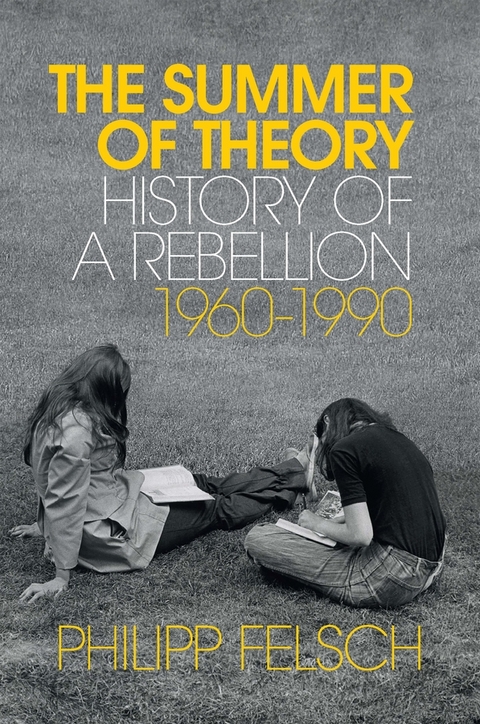
'Theory' - a magical glow has emanated from this word since the sixties. Theory was more than just a succession of ideas: it was an article of faith, a claim to truth, a lifestyle. It spread among its adherents in cheap paperbacks and triggered heated debates in seminar rooms and cafés. The Frankfurt School, Structuralism, Post-Structuralism, Adorno, Derrida, Foucault: these and others were the exotic schools and thinkers whose ideas were being devoured by young minds. But where did the fascination for dangerous thoughts come from?
In his magnificently written book, Philipp Felsch follows the hopes and dreams of a generation that entered the jungle of difficult texts. His setting is West Germany in the decades from the 1960s to the 1990s: in a world frozen in the Cold War, movement only came from big ideas. It was the time of apocalyptic master thinkers, upsetting reading experiences and glamorous incomprehensibility. As the German publisher Suhrkamp published Adorno's Minima Moralia and other High Theory works of the Frankfurt School, a small publisher in West Berlin, Merve Verlag, provided readers with a steady stream of the subversive new theory coming out of France.
By following the adventures of the publishers who provided the books and the reading communities that consumed and debated them, Philipp Felsch tells the remarkable story of an intellectual revolt when the German Left fell in love with Theory.
Philipp Felsch is Professor of Cultural History at Humboldt University, Berlin.
Theory a magical glow has emanated from this word since the sixties. Theory was more than just a succession of ideas: it was an article of faith, a claim to truth, a lifestyle. It spread among its adherents in cheap paperbacks and triggered heated debates in seminar rooms and caf s. The Frankfurt School, Structuralism, Post-Structuralism, Adorno, Derrida, Foucault: these and others were the exotic schools and thinkers whose ideas were being devoured by young minds. But where did the fascination for dangerous thoughts come from? In his magnificently written book, Philipp Felsch follows the hopes and dreams of a generation that entered the jungle of difficult texts. His setting is West Germany in the decades from the 1960s to the 1990s: in a world frozen in the Cold War, movement only came from big ideas. It was the time of apocalyptic master thinkers, upsetting reading experiences and glamorous incomprehensibility. As the German publisher Suhrkamp published Adorno s Minima Moralia and other High Theory works of the Frankfurt School, a small publisher in West Berlin, Merve Verlag, provided readers with a steady stream of the subversive new theory coming out of France. By following the adventures of the publishers who provided the books and the reading communities that consumed and debated them, Philipp Felsch tells the remarkable story of an intellectual revolt when the German Left fell in love with Theory.
Philipp Felsch is Professor of Cultural History at Humboldt University, Berlin.
Introduction: What Was Theory?
1965: The Hour of Theory
1. Federal Republic of Adorno
Reflections from Damaged Life
Culture After Working Hours
In the Literary Supermarket
Adorno Answers
Are Your Endeavours Aimed at Changing the World?
2. In the Suhrkamp Culture
New Leftists
He Didn't Write
School of Hard Books
Paperback Theory
Birth of a Genre
1970: Endless Discussions
3. Ill-made Books
Theoretical Practice
Smash Bourgeois Copyright!
Mondays, Fridays and Sundays
The Disorder of Discourse
4. Wolfsburg Empire
Proletarian Public Sphere
In the Land of Class Struggle
The Lightness of Being Communist
A Fateful Stroke of Luck
1977: Reading French in the German Autumn
5. (Possible) Reasons for the Happiness of Thought
All Kinds of Escapes
Intensity Is Not a Feeling
The Laugh of Merve
Vague Thinkers
6. The Reader as Partisan
The Death of the Author
The Pleasure of the Text
Children's Books
A Different Mode of Production
Lying on Water
7. Foucault and the Terrorists
A Schweppes in Paris
Political Tourists
Vermin
On Tunix Beach
1984: The End of History
8. Critique of Pure Text
The Master Thinkers
Adults Only
Sola Scriptura
Aesthetics of Counter-Enlightenment
A Little Materialism
9. Into the White Cube
The Mountain of Truth
Be Smart - Take Part
German Issues
The Island of Posthistoire
The Trouble with Duchamp
10. Prussianism and Spontaneism
War in the Time of Total Peace
Machiavelli in Westphalia
The Wild Academy
In Search of the Punctum
Jacob Taubes's Best Enemy
11. Disco Dispositive
Tyrannies of Intimacy
Pub Blather
The Art of Having a Beer
In the Jungle
Above the Clouds
Epilogue: After Theory?
Bibliography
Appendix: Translations of Illustrations
Notes
Index
"Impassioned and full of detail, this is a fascinating snapshot of the period."
--Publisher's Weekly
"Felsch's stance (well captured by his English translator, Tony Crawford) is that of a wry but sympathetic participant-observer. You end the book uncertain as to whether you should marvel at the grandiose pointlessness of it all, or celebrate a movement that put pure thought, accessed by careful reading and refined through intense discussions with comrades, at the very centre of life."
--Sheila Fitzpatrick, Australian Book Review
"...evocative and brilliant...."
--European Journal of Social Theory
"[A]n amazing book"
Thesis Eleven
Introduction: What Was Theory?
Sentenced to three years’ imprisonment for arson in 1968, Andreas Baader discovered letter-writing. He described the torment of solitude, ranted about the guards, and asked his friends to supply him with essentials. Besides cured meats and tobacco, that meant, most of all, books. He had people send him the student movement’s favourite authors, Marx, Marcuse and Wilhelm Reich, which he had only known from hearsay up to then. ‘Mountains of theory, the last thing I wanted’, he wrote to the mother of his daughter. ‘I work and I suffer, without complaining of course.’ Later, in the maximum-security prison at Stammheim, it was up to his lawyers to feed his hunger for reading material. At the time of his death, there were some 400 books in his cell: a respectable library for a terrorist who was notorious among his comrades for his recklessness. Without a doubt, Baader played the part of a jailhouse intellectual, just as he had previously played the revolutionary. Yet, at the same time, there was a great deal of seriousness in his studies. His letters indicate that he felt a need to catch up1 – after all, the struggle to which he had dedicated himself was founded on theoretical principles.2 In a different time, Baader would have taken up painting perhaps, or begun writing an autobiographical novel. Instead, he plunged – almost in spite of himself – into theory.
Now that the intellectual energies of ’68 have long since decayed to a feeble smouldering, it is hard to imagine the fascination of a genre that captivated generations of readers. Theory was more than just a succession of intellectual ideas: it was a claim of truth, an article of faith and a lifestyle accessory. It spread among its adherents in cheap paperbacks; it launched new language games in seminars and reading groups. The Frankfurt School, post-structuralism and systems theory were best-selling brands. West German students discovered in Adorno’s books the poetry of concepts. As the sixties dawned, the New Left rallied under the banner of its ‘theory work’ against the pragmatism of the Social Democrats: those who would change the world, they proclaimed, must start by thinking it through. But the thinking they had in mind had nothing to do with the philosophy of professors who stuck to interpreting the classic texts or the meaning of Being. It was concerned less with eternal truth and more with critiques of the dominant conditions, and under its scrutiny even the most mundane acts took on social relevance. Jacob Taubes, professor of the philosophy of religion in Berlin, saw his students reading the works of Herbert Marcuse with an intensity reminiscent of the zeal ‘with which young Talmud scholars once interpreted the text of the Torah’.3 On campus, theory conferred upon its readers not only academic capital, but also sex appeal. Marcuse led to Marx, and Marx to Hegel: those who wanted to have a say in the discussion got themselves the twenty-volume Suhrkamp edition of Hegel’s complete works.4 Only after the shock of the terrorists’ debacle in Stammheim and Mogadishu did any doubts about the canon of the ’68 generation mature into open resistance. New thinking came to Germany from Paris and did away with the tonality of dialectics. The books of Deleuze and Baudrillard called for a different kind of reading from those of Marx and Hegel. They seemed to have a more important purpose than the search for truth, and in the course of the 1980s theory metamorphosed into an aesthetic experience. And when ecology laid constraints of quantities and limits on the speculative imagination of the seventies, thorny philosophy set out to infiltrate the art world.
The first impetus to write this book dates from several years ago. In the spring of 2008, the editor of a journal of intellectual history called me to ask for an article on the German publishing house Merve. The editor was planning an issue about West Berlin, the walled-in city on the front lines of the Cold War, which Merve had supplied with theory for twenty long years. Peter Gente, the founder of Merve, had retired from publishing and sold his papers to an archive to finance his sunset years in Thailand, and so the time seemed ripe for historical retrospection.5 Although I wasn’t a Berliner, Merve was a byword to me too. There was no way I could refuse.
Merve has been called the ‘Reclam of postmodernism’ – Reclam, of course, are the publishers of the ‘Universal Library’, the yellow, pocket-sized standard texts that no German student can do without. Merve was the German home of postmodernism, and practically owned the copyright to the German word for ‘discourse’.6 Merve had made a name for itself in the 1980s, primarily with translations of the French post-structuralists. Its cheaply glued paperbacks were a guarantee of advanced ideas, and the pop-art look of their un-academic styling was ahead of its time. The coloured rhombus on the cover of the Internationaler Merve Diskurs series was a well-established logo whose renown rivalled that of the rainbow rows of Suhrkamp paperbacks.
I remember well the first Merve titles I read. It wasn’t easy, in Bologna in the mid-1990s, to get them by mail order. My intention had been to spend a semester there studying with Umberto Eco, but Eco’s lectures turned out to be a tourist attraction. Whatever the famous semiotician was saying into his microphone at the far end of the lecture hall was easier to assimilate by reading one of his introductory books. In retrospect, that was a stroke of luck, because it forced me to look for an alternative. And the search for a more intense educational experience led me – twelve years after his death – to Michel Foucault. My Foucault wasn’t bald and didn’t wear turtlenecks, and although he occasionally spoke French, his Italian accent was unmistakable. But his grand rhetorical flourishes and his tendency to overarticulate his words are engraved in my memory. In his best moments, he came very close to the original. Valerio Marchetti had heard the original Foucault at the Collège de France in the early 1980s, if I remember correctly, and absorbed – as I was later able to verify on YouTube – his way of talking as well as his way of thinking. He was a professor of early modern history at the University of Bologna. His lecture course, which was attended by very few students, was devoted to a topic only a Foucauldian could have come up with: ‘Hermaphroditism in France in the Baroque Period’. I was spellbound on learning of the seventeenth-century debates in which theologians and physicians had argued about the significance of anomalous sex characteristics.7 I had never heard of such a thing at my German university, where philosophy students read Plato and Kant. I hung on Marchetti’s every word, attending even the Yiddish course that he taught for some reason, and started reading the literature he cited: Michel Foucault, Paul Veyne, Claude Lévi-Strauss, Georges Devereux … I waited weeks for the German translations to arrive in the post. I read more than I have ever read since, and collected excerpts on coloured file cards. In the heat of the Italian summer, the ‘microphysics of power’ and the ‘iceberg of history’ stuck to my forearms.8
In 2008, I hadn’t touched these books in years. Their spines crumbled with a dry crackle when I opened them. Inside I discovered vigorous pencil marks, reminding me what a revelation theory had been to me in those days. But at a decade’s remove, that experience seemed strangely foreign: it seemed to belong to an intellectual era that was now irretrievably past. I went to Karlsruhe to have a look at the materials that Peter Gente had turned over to the Centre for Art and Media Technology. In the forty heavy boxes that had not yet been opened – much less catalogued – perhaps I would find a chapter of my own Bildungsroman. They contained the publisher’s correspondence with the famous – and the less famous – Merve authors, along with the paper detritus that lined the road to over 300 published titles: newspaper clippings, notes, budgets, dossiers … While Gente rested, I supposed, in the shade of coconut palms, I immersed myself in his papers. Only gradually did I realize that what I was looking at were not the typical assets of a liquidated business: it was the record of an epic adventure of reading.
The oldest documents dated back to the late 1950s, when Gente discovered the books of Adorno. That discovery changed everything. For five years, the young man ran around West Berlin with Minima Moralia in his hand, before he finally got in touch with the author. By then, Gente was in the middle of the New Left’s theoretical discussions, combing libraries and archives in search of the buried truth of the labour movement. He was everywhere, cheering Herbert Marcuse in the great hall of Freie Universität, demonstrating with Andreas Baader in Kurfürstendamm, running into Daniel Cohn-Bendit in Paris a few weeks before May of ’68. Later, he had discussions with Toni Negri, sat in jail with Foucault, put up Paul Virilio in his shared flat in Berlin. There was never any question that he belonged to the movement’s avant-garde – yet he kept himself in the background. It was a long time before he found his role; he didn’t care to play the part of an activist, nor that of an...
| Erscheint lt. Verlag | 16.9.2021 |
|---|---|
| Übersetzer | Tony Crawford |
| Sprache | englisch |
| Themenwelt | Sozialwissenschaften ► Soziologie ► Allgemeine Soziologie |
| Schlagworte | Adorno, Marcuse, Habermas, Frankfurt School, Marxism, Structuralism, Post-Structuralism, Merve, Suhrkamp, theory, reading, Berlin, Paris, Germany, France, post-war, 1968, Foucault, Deleuze, Derrida, Barthes, Althusser, Luhmann, philosophy, theory, critical theory, book, publishing, culture, Europe • Critical theory • Geschichte • Gesellschaftstheorie • History • Kritische Theorie • Philosophie • Philosophy • Social & Cultural History • Social Theory • Sociology • Sozial- u. Kulturgeschichte • Soziologie |
| ISBN-10 | 1-5095-3987-5 / 1509539875 |
| ISBN-13 | 978-1-5095-3987-1 / 9781509539871 |
| Informationen gemäß Produktsicherheitsverordnung (GPSR) | |
| Haben Sie eine Frage zum Produkt? |
 EPUB (Adobe DRM)
Kopierschutz: Adobe-DRM
Adobe-DRM ist ein Kopierschutz, der das eBook vor Mißbrauch schützen soll. Dabei wird das eBook bereits beim Download auf Ihre persönliche Adobe-ID autorisiert. Lesen können Sie das eBook dann nur auf den Geräten, welche ebenfalls auf Ihre Adobe-ID registriert sind.
Details zum Adobe-DRM
Dateiformat: EPUB (Electronic Publication)
EPUB ist ein offener Standard für eBooks und eignet sich besonders zur Darstellung von Belletristik und Sachbüchern. Der Fließtext wird dynamisch an die Display- und Schriftgröße angepasst. Auch für mobile Lesegeräte ist EPUB daher gut geeignet.
Systemvoraussetzungen:
PC/Mac: Mit einem PC oder Mac können Sie dieses eBook lesen. Sie benötigen eine
eReader: Dieses eBook kann mit (fast) allen eBook-Readern gelesen werden. Mit dem amazon-Kindle ist es aber nicht kompatibel.
Smartphone/Tablet: Egal ob Apple oder Android, dieses eBook können Sie lesen. Sie benötigen eine
Geräteliste und zusätzliche Hinweise
Buying eBooks from abroad
For tax law reasons we can sell eBooks just within Germany and Switzerland. Regrettably we cannot fulfill eBook-orders from other countries.
aus dem Bereich