


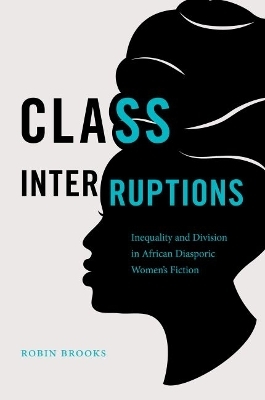
Class Interruptions
Inequality and Division in African Diasporic Women's Fiction
Seiten
2022
The University of North Carolina Press (Verlag)
978-1-4696-6647-1 (ISBN)
The University of North Carolina Press (Verlag)
978-1-4696-6647-1 (ISBN)
As downward mobility continues to be an international issue, Robin Brooks offers a timely intervention between the humanities and social sciences by examining how Black women’s cultural production engages debates about the growth in income and wealth gaps in global society during the late twentieth- and early twenty-first centuries.
As downward mobility continues to be an international issue, Robin Brooks offers a timely intervention between the humanities and social sciences by examining how Black women's cultural production engages debates about the growth in income and wealth gaps in global society during the late twentieth- and early twenty-first centuries. Using an interdisciplinary approach, this innovative book employs major contemporary texts by both African American and Caribbean writers—Toni Morrison, Gloria Naylor, Dawn Turner, Olive Senior, Oonya Kempadoo, Merle Hodge, and Diana McCaulay—to demonstrate how neoliberalism, within the broader framework of racial capitalism, reframes structural inequalities as personal failures, thus obscuring how to improve unjust conditions.
Through interviews with authors, textual analyses of the fiction, and a diagramming of cross-class relationships, Brooks offers compelling new insight on literary portrayals of class inequalities and division. She expands the scope of how the Black women's literary tradition, since the 1970s, has been conceptualized by repositioning the importance of class and explores why the imagination matters as we think about novel ways to address long-standing and simultaneously evolving issues.
As downward mobility continues to be an international issue, Robin Brooks offers a timely intervention between the humanities and social sciences by examining how Black women's cultural production engages debates about the growth in income and wealth gaps in global society during the late twentieth- and early twenty-first centuries. Using an interdisciplinary approach, this innovative book employs major contemporary texts by both African American and Caribbean writers—Toni Morrison, Gloria Naylor, Dawn Turner, Olive Senior, Oonya Kempadoo, Merle Hodge, and Diana McCaulay—to demonstrate how neoliberalism, within the broader framework of racial capitalism, reframes structural inequalities as personal failures, thus obscuring how to improve unjust conditions.
Through interviews with authors, textual analyses of the fiction, and a diagramming of cross-class relationships, Brooks offers compelling new insight on literary portrayals of class inequalities and division. She expands the scope of how the Black women's literary tradition, since the 1970s, has been conceptualized by repositioning the importance of class and explores why the imagination matters as we think about novel ways to address long-standing and simultaneously evolving issues.
Robin Brooks is assistant professor of Africana studies at the University of Pittsburgh.
| Erscheinungsdatum | 30.12.2021 |
|---|---|
| Zusatzinfo | 8 halftones |
| Verlagsort | Chapel Hill |
| Sprache | englisch |
| Maße | 155 x 233 mm |
| Gewicht | 333 g |
| Themenwelt | Geisteswissenschaften ► Sprach- / Literaturwissenschaft ► Anglistik / Amerikanistik |
| Geisteswissenschaften ► Sprach- / Literaturwissenschaft ► Literaturwissenschaft | |
| Sozialwissenschaften ► Soziologie ► Gender Studies | |
| ISBN-10 | 1-4696-6647-2 / 1469666472 |
| ISBN-13 | 978-1-4696-6647-1 / 9781469666471 |
| Zustand | Neuware |
| Informationen gemäß Produktsicherheitsverordnung (GPSR) | |
| Haben Sie eine Frage zum Produkt? |
Mehr entdecken
aus dem Bereich



aus dem Bereich
Paul Celans Poetik der Mehrsprachigkeit
Buch | Hardcover (2025)
De Gruyter (Verlag)
CHF 153,90


